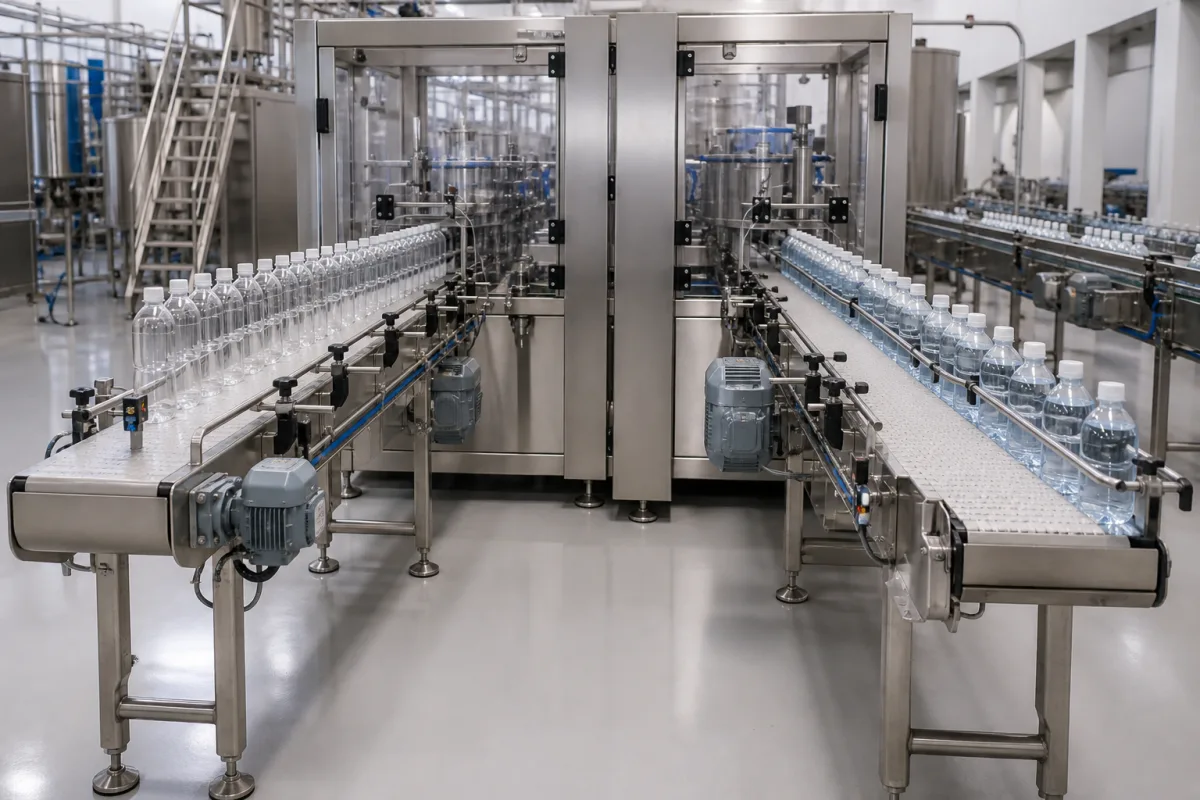
Infeed/outfeed conveyor section of an in-line container leak tester: spacing bottles into the test heads and rejecting leakers on the way out
Infeed and outfeed of in-line container leak testers · Feed screws and starwheels that space bottles into the test heads, gates, clutches and photo-eyes, outfeed starwheels and reject stations for leaking containers
This page covers the infeed and outfeed sections around an in-line container leak or integrity tester in a filling line: the infeed conveyor and gate, the feed (timing) screw that spaces bottles to the machine's pitch, the infeed starwheel that places each container under a test head, and the outfeed starwheel, conveyor and reject station that remove leaking containers. Ask three things first: the line rate against the tester's rate per test station, how containers are spaced and protected from jams at the infeed, and how and where leakers are rejected and counted.
Infeed and outfeed sections of in-line leak and integrity testers for bottles and containers, including infeed conveyors, gates, feed screws, infeed and outfeed starwheels, outfeed conveyors and reject stations. Single-file TableTop chain conveyors between machines are covered on the Conveyor module for beverage containers page, modular straight and curve sections on the Conveyor section page, and truck and container loading conveyors on their own page. Laboratory leak testers and the leak-test heads themselves are outside this page.
CNFX editorial research · Sources checked October 12, 2026 · 3 sources
Feed screw and infeed starwheel: putting each bottle in phase under a test head
Bonfiglioli Engineering describes its RLD rotary leak detector for plastic bottles: a feeding screw spaces the container flow and places the containers in phase into an entrance star, which positions each one under a sealing head; a cam then lifts the container against the sealing pad on its neck, and the container is pressurised and monitored for a leak. It gives outputs of 150 to 1,000 containers per minute depending on the customer's request, and up to 180 per minute for its linear HSL-200 with two to four test heads. [1]
US patent 5,571,949 describes the same sequence on a rotary vacuum tester: containers arrive on an infeed conveyor, an infeed screw spaces them for the infeed starwheel, which transfers them into equally spaced pockets on the test disc; an outfeed starwheel returns them to an outfeed conveyor. The patent places the tester ahead of filling and seaming stations so that defective containers do not reach a rotary retort. [3]
Give the supplier the containers (material, sizes, neck finish), the line rate, the leak test method and sensitivity, the infeed and outfeed conveyor heights and directions, accumulation space before and after, how rejects are to be collected and counted, and the format change time allowed.
02
Gate, clutches and photo-eyes at the infeed, and the rate each test station adds
US patent 6,473,169 for an integrated leak and vision inspection system feeds containers from the line conveyor through a gate mechanism that separates them by a short distance, then a timing screw and infeed starwheel onto a rotary turntable; the starwheels and timing screw have adjustable clutches that work with the PLC to control machine motion, and photo-eyes at the gate, the inspection stations and the reject station track each container. It states a rate of 10–30 bottles per minute per test station for 2-ounce to 2-gallon containers, depending on container size, required handling, configuration, conveyor speed and desired leak test sensitivity. [2]
Editorial calculation: at the patent's 10–30 bottles per minute per test station, a line running 600 containers per minute needs 20 to 60 test stations on the rotor; at 30 per station, 1,000 containers per minute needs about 34. [2][1]
03
Outfeed starwheel, reject station and the data kept on each leaker
In Bonfiglioli's tester a container found leaking is rejected automatically into a designated area at the tester's exit, and good containers leave through the conveyor; its PC-based HMI with SCADA stores production data per shift or batch for one year and keeps a database of test parameters for each container. [1] US patent 6,473,169 shifts each container from the exit starwheel onto the line conveyor and on to a reject station that removes containers below the set standards, while US patent 5,571,949 uses a sweep beside the disc to remove leaking containers. [2][3]
Editorial note: ask whether rejects are confirmed by a sensor after the reject device, whether a full reject bin stops the line, and how a container that jams in the screw or starwheel is handled, since the patents rely on clutches and photo-eyes for this.
04
Send the containers, line rate and reject handling together
Paste it into your enquiry below or into an email to a maker, then replace every bracket.
Containers: [material; sizes; neck finish]
Rate: [containers per minute; test stations]
Test: [pressure or vacuum; sensitivity]
Infeed: [conveyor height; gate; feed screw; starwheel]
Outfeed: [starwheel; reject device; reject confirmation]
Data: [counts per shift or batch; container recipes]
Explore company information and manufacturing capabilities, then discuss the scope of your project with a relevant supplier.
Share this page
Compiled and source-reviewed by the CNFX editorial team.
Each manufacturer above links to the page on that company's own website where the product is listed, with the date we checked it. How we source and review
· Page last updated 13 October 2026
Buyer questions
How are bottles fed into an in-line leak tester?
A feed (timing) screw spaces the bottles and puts them in phase into an infeed starwheel, which places each one under a test head, as Bonfiglioli and two US patents describe. [1][3]
How fast can an in-line leak tester run?
Bonfiglioli lists 150–1,000 containers per minute for rotary testers and up to 180 for a linear tester; one patent gives 10–30 bottles per minute per test station. [1][2]
Where are leaking containers rejected?
At the tester's exit: Bonfiglioli rejects them into a designated area, and US patent 6,473,169 moves them from the exit starwheel to a reject station on the line conveyor. [1][2]
Sources and what still needs a direct check
Sources checked 2026-10-12. Bonfiglioli Engineering describes its own leak testers; two US patents describe rotary leak testers and their infeed and outfeed.