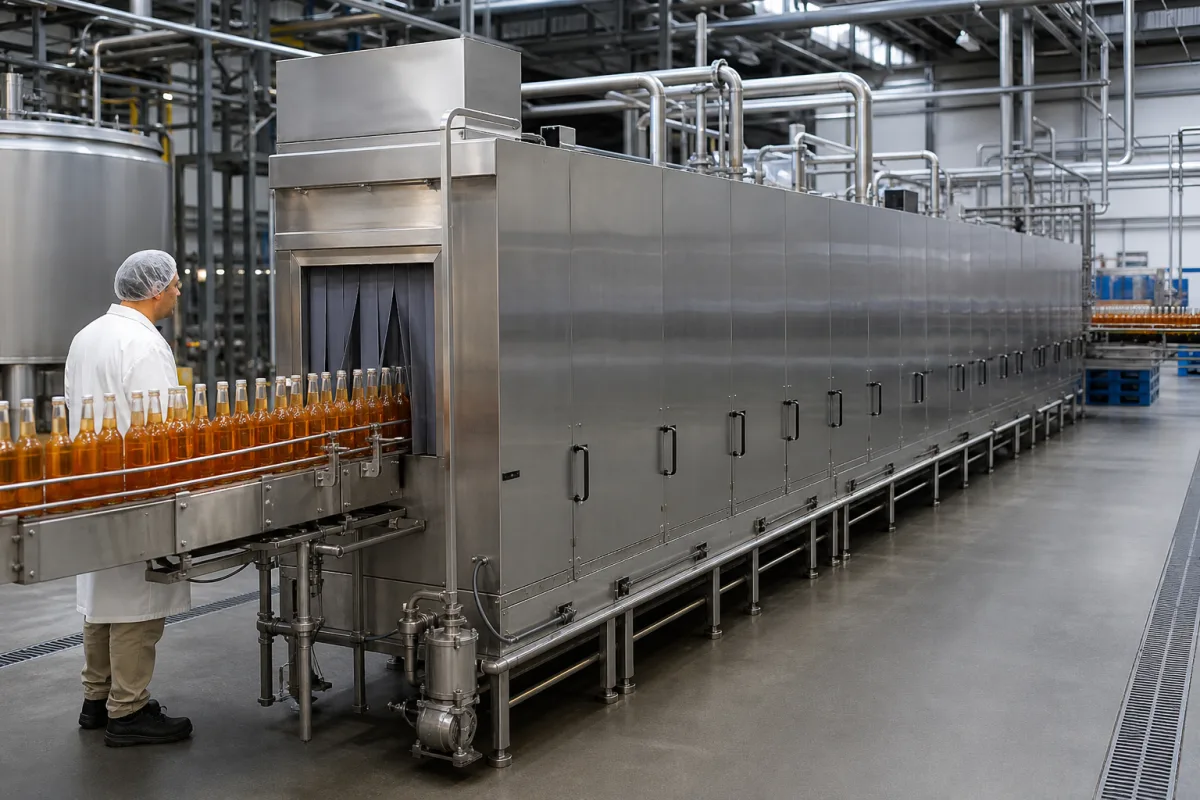
Tunnel sterilizer (tunnel pasteurizer) for filled bottles and cans
In-container heat treatment · Pasteurization units (PU), heating, holding and cooling zones, spray density and regeneration
A tunnel sterilizer, more precisely a tunnel pasteurizer, carries filled and closed bottles or cans on a conveyor through zones where water sprays heat them, hold them at pasteurizing temperature and cool them again before labelling. Ask three things first: what pasteurization dose in PU each container must receive, minimum and maximum, how the zones and sprays deliver that dose evenly across the belt, and what the control system does when the conveyor stops.
Hot-water spray tunnel pasteurizers and sterilizers for filled, sealed containers such as beer, juice and beverage bottles and cans. Depyrogenation tunnels for empty pharmaceutical vials, plate and tubular flow pasteurizers (in-line heat treatment before filling), retorts and cooling tunnels are outside this page.
CNFX editorial research · Sources checked October 12, 2026 · 4 sources
US patent 4,849,235 defines one pasteurization unit (UP or PU) as the effect of holding beer for one minute at 60 °C (140 °F), with PU = t × 10^((T − 60)/z), where t is the holding time, T the temperature in °C and z, a parameter of the organisms to be destroyed, equal to 7 for beer. It notes that over-pasteurization can denature the taste, cloud the liquid or cook it, so a run must reach a minimum PU without exceeding a maximum. [1]
Becker's US patent 4,490,401 describes brewers establishing “a minimum PU limit between 5-10 PU”. Anheuser-Busch's US patent 4,693,902 targets 5.6 to 20 PU per package, preferably more than 10, and a PU standard deviation across packages of no more than about 2, against 4–8 it found in existing pasteurizers. [3][2]
Anheuser-Busch tabulates lethality rising from 0.025 PU/min at 120 °F to 1.00 at 140 °F, 2.51 at 145 °F and 39.81 at 160 °F. It places the container's cold spot 1/4 in above the bottom at the centre and aims to hold it at 140–143 °F, preferably 141 °F. [2] Editorial calculation: with Braymand's formula, 62 °C gives 10^(2/7) ≈ 1.93 PU/min, so a 10 PU dose takes about 5.2 min at 62 °C against 10 min at 60 °C; at 142 °F (61.1 °C) the formula gives 1.44 PU/min, matching the 1.45 in Anheuser-Busch's table. [1][2]
Editorial note: PU constants differ by product; the 60 °C reference and z = 7 are the patents' beer values, so ask the supplier which reference temperature, z value and PU limits the control system uses for your drink.
Give the supplier the product and its PU minimum and maximum (or time-temperature target), container type, size and material, output per hour, conveyor width, inlet and required outlet temperature, utilities (steam, hot water, cooling water, power), water treatment, and the stoppage and PU monitoring functions required.
02
Lay out the zones, sprays and regeneration
Braymand describes a tunnel divided into a preheat zone without PU acquisition, a prepasteurization zone where PU acquisition begins (for example 0.1 PU/min from about 53 °C for beer), a pasteurization zone held at, for example, 60 °C, and a cooling zone where containers gain a few more PU before leaving. [1]
Anheuser-Busch's process uses spray densities above about 6 gal/min/ft² of tunnel area, preferably above 7 and up to about 9, through hollow-cone nozzles with a 3/8 in bore at about 5–6 psig on staggered centres 9–12 in apart, closer at the side walls. It notes earlier heads ran at 3–4 gal/min/ft², which left wide variations in PU input. [2] Editorial calculation: 6 gal/min/ft² is about 244 L/min per m² of tunnel area.
Becker explains regeneration: a cold zone and a hot zone are coupled in a closed loop, so spray water cooled by incoming product heats outgoing product and vice versa. Economic justification becomes difficult at five or more regenerative pairs. [3]
03
Control what happens when the conveyor stops
Becker writes that brewers “would rather err on the high side, and control equipment is designed to fail accordingly”; downstream delays force the pasteurizer to stop while hot product keeps pasteurizing until it cools to nominally 120 °F; a ten-minute delay at 145 °F adds over 25 PU. [3] Editorial calculation: Anheuser-Busch's 2.51 PU/min at 145 °F × 10 min ≈ 25 PU, consistent with that figure. [2]
Braymand's patent divides the prepasteurization and pasteurization zones into regulation sub-zones, calculates the PU acquired by reference containers in each, and switches a sub-zone to cooling when a reference container reaches the maximum PU while the others have reached the minimum, so that belt speed can follow production demand. [1]
Editorial note: ask how the offered machine calculates PU, where it measures temperature, and how it cools or holds zones during stoppages and gaps in container flow, and test it with a travelling PU recorder at acceptance.
04
Spray tunnels offered by juice and dairy line builders
The suppliers reviewed also build tanks, flow sterilizers and complete juice or dairy lines; ask each for the zone layout, PU control method and capacity for your container.
05
Ask for the cold-spot record and heat balance of the tunnel
A University of Perugia study in MDPI's Processes measured an industrial tunnel pasteurizer for a viscous bottled herbal liquid, not beer. It had five chambers: pre-heating at 54 °C, heating at 88 °C, holding at 88 °C, pre-cooling at 54 °C and cooling at 30 °C, with a 36 min residence time at a conveyor speed of 250 mm/min and a capacity of 150 bottles per minute; water from pre-cooling was recirculated to pre-heating. The target was at least 72 °C for 12 min at the coldest point. An instrumented bottle stayed above 72 °C for about 22 min near the wall and 17–18 min at the core, with wall-to-core differences exceeding 15 °C during heating. [4]
The authors' heat balance put heating-phase efficiency at 37.29%, cooling-phase efficiency at 47.54% and overall efficiency at 40.57%. They estimated, without testing it, that a 5 min holding stage would cut holding-stage heat from 97.15 MJ to 48.58 MJ, about 33.7% less process energy. [4] Editorial note: ask the supplier for a core-temperature record from an instrumented container of your own product and a zone-by-zone heat balance at your line speed.
06
Conveyor, zones, spray headers and regeneration loops
PU spread, spray pressure and utilities at your container rate
The patents supply the holding-temperature, PU-spread, spray-pressure and regeneration rows; capacity, utilities, dimensions, noise and enclosure need the supplier's figures for your containers.
Chenma lists a continuous conveyor tunnel that heats, sterilizes and cools bottles, cans, jars and cartons with hot-water sprays; Goldcheer lists a tunnel sterilizer with sterilization, pre-cooling and cooling zones among its juice and dairy line equipment.
Shandong Chenma Machinery
Manufacturing site to be confirmed for the order
Lists a continuous conveyor tunnel sterilizer that heats, sterilizes and cools bottles, cans, jars and cartons with hot-water sprays.
Explore company information and manufacturing capabilities, then discuss the scope of your project with a relevant supplier.
Share this page
Compiled and source-reviewed by the CNFX editorial team.
Each manufacturer above links to the page on that company's own website where the product is listed, with the date we checked it. How we source and review
· Page last updated 13 October 2026
Buyer questions
What is a pasteurization unit (PU)?
In the beer example of US patent 4,849,235, 1 PU is one minute at 60 °C, and PU = t × 10^((T − 60)/7). [1]
How many PU does beer need?
Becker's patent describes brewers establishing “a minimum PU limit between 5-10 PU”; Anheuser-Busch targeted 5.6–20 PU, preferably above 10. [3][2]
Why are conveyor stops a problem in a tunnel pasteurizer?
Hot containers keep gaining PU; Becker notes a ten-minute delay at 145 °F adds over 25 PU. [3]
How much of a tunnel pasteurizer's heat reaches the product?
In a University of Perugia study published by MDPI, an industrial tunnel pasteurizer for a bottled herbal liquid had an overall heat-transfer efficiency of 40.57%. [4]
Sources and what still needs a direct check
Sources checked 2026-10-12. All three sources are US patents: Braymand (assigned to Baele Gangloff), Becker and Anheuser-Busch describe their own methods and quote beer practice of their time; limits for your product must come from your own process authority.