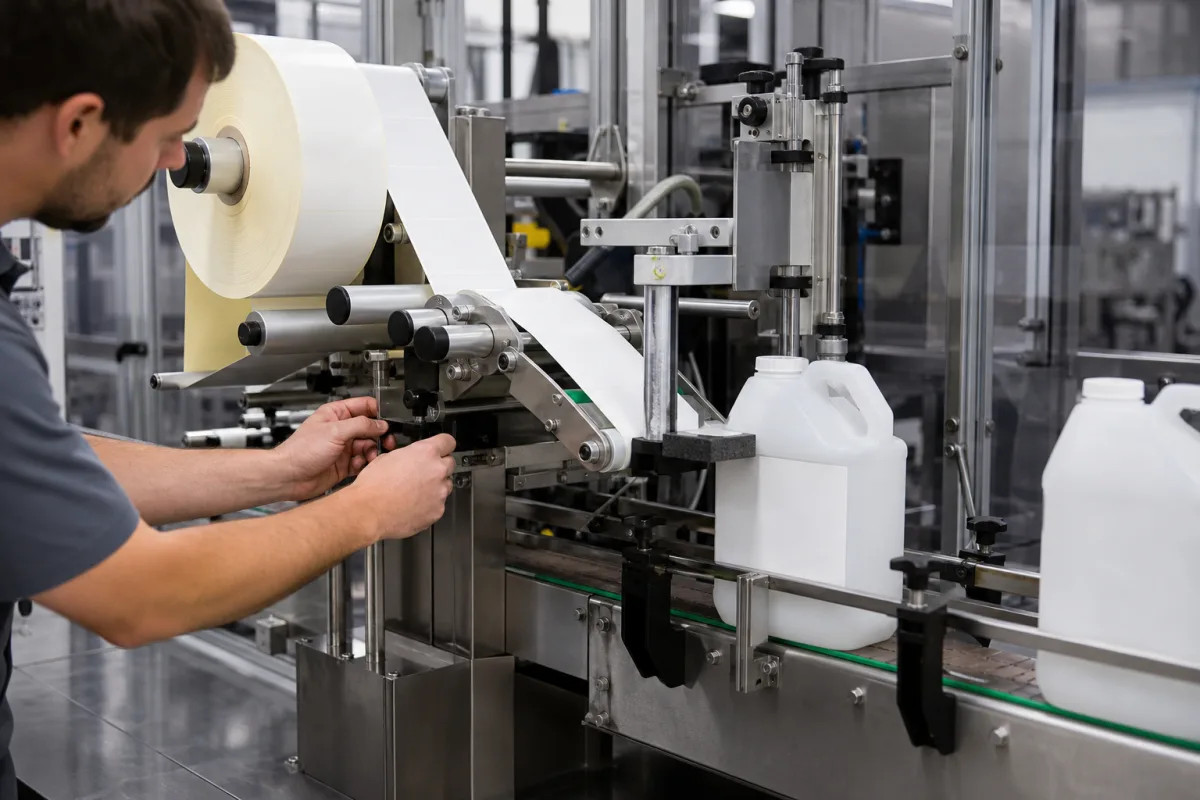
Label applicator module for handled jugs and jerrycans: wipe-on, tamp-blow and peel-plate transfer heads for self-adhesive panel labels
The applicator head on a chemical jug or jerrycan line · wipe-on, tamp-blow, air-blow and movable-peel-plate transfer, web width against the hazard-label size, and placement accuracy
A label applicator module is the head that does the labelling: it unwinds the label web, peels each label off its liner over a peel plate and puts it on the container, while the conveyor and the line control sit around it. On handled jugs and jerrycans for chemicals, the label goes on a side panel that may be flat, curved or set back between ribs, so the way the head transfers the label matters as much as its speed. The head also has to carry a label big enough for the hazard information the container needs.
Self-adhesive label applicator heads (modules) mounted beside a conveyor to label side panels of handled plastic jugs and jerrycans, with their wipe-on, tamp-blow, air-blow or movable-peel-plate transfer, web path and label sensing. Complete self-adhesive labelling systems for bottles, cans, cartons and packs are covered on the Labeling systems for packaging lines page; print-and-apply stations for 200-litre drums and IBCs on the Print-and-apply drum labelling station for filled chemical drums page; benchtop peel-and-present dispensers on the Automatic label dispenser page; and roll-fed hot-melt wrap-around labellers on the Labeling unit page. Label stock and printers on their own are outside this page.
CNFX editorial research · Sources checked October 13, 2026 · 3 sources
Wipe-on, tamp-blow, air-blow or a movable peel plate: how the label reaches the panel
Label-Aire sells three primary applicator heads on one platform, which makes the difference in transfer method easy to see: the 3115-TS is a wipe-on head, the 3114-TS tamps or blows it from a pad, and the 3111-TS blows it on with air. All three list web speeds up to 38.1 m/min (50.8 m/min with powered rewind), ±0.8 mm (±1/32 in) accuracy, velocity compensation and a stepper-motor drive, and can apply to top, side or bottom. [1]
HERMA describes the 500 MB sequence step by step: after the start signal the peel plate moves pneumatically under the tamp pad while the label is transported, vacuum holds the label on the pad, the linear transfer unit applies it to the product and returns, and the peel plate goes back to its home position. HERMA states that this gives results on flat surfaces and on surfaces with raised or recessed areas, at up to 70 products a minute and a labelling tolerance of up to 0.2 mm, with products fed separated and centred. Its list of labelled items includes plastic bottles, shaped bottles and paint buckets. [2]
Editorial note: a wipe-on head needs the container to pass at web speed against a brush or roller; a tamp or peel-plate transfer can reach a panel set back between handle and ribs, as in the image. Ask the supplier to run your actual container, empty and filled, before fixing the transfer method.
The image shows a self-adhesive applicator head with an unwind roll, guide rollers and a vertical stand beside a conveyor carrying white handled plastic jugs, with an operator threading the web. Ask whether the module matches its web speed to the container's speed; Label-Aire names velocity compensation on all three heads.
02
Fitting a 74 × 105 mm hazard label on the web and in the cycle
Under the GB CLP Regulation (retained Regulation (EC) No 1272/2008, Annex I, Table 1.3), the label for packages over 3 litres and up to 50 litres must be at least 74 × 105 mm with each pictogram at least 23 × 23 mm; up to 3 litres the label should be at least 52 × 74 mm where possible. Each pictogram must cover at least one fifteenth of the minimum label area and never less than 1 cm². [3]
Editorial calculation: 74 × 105 mm is 7,770 mm²; one fifteenth is 518 mm², a square of about 22.8 mm, which is why the table rounds the pictogram up to 23 × 23 mm. [3]
Editorial calculation on fit: on the HERMA 500 MB (labels 15–160 mm wide, 10–100 mm long) taking the published width as the dimension across the web, a 74 × 105 mm label only fits with the 105 mm side across, because 105 mm exceeds the 100 mm length limit. [2] On the Label-Aire 3111-TS the standard web is 16–105 mm wide, so the same label fits with its 74 mm side across; with the 105 mm side across, the web would be wider than 105 mm and needs the 181 mm option. The 3114-TS and 3115-TS take webs up to 181 mm. [1]
Editorial calculation on timing: 38.1 m/min is 635 mm/s, so dispensing a 105 mm label takes about 0.17 s, and about 0.12 s at 50.8 m/min; HERMA's 70 products a minute is one container every 0.86 s. [1][2] For a jerrycan carrying labels on two panels, count each label as a separate application when comparing these figures.
03
Container and label data for an applicator head
Paste it into your enquiry below or into an email to a maker, then replace every bracket.
Container: [jug or jerrycan; volume; panel flat, curved or recessed; handle position]
Label: [size; orientation on the web; liner; labels per container]
Line: [containers per minute; conveyor speed; spacing; encoder available]
Head: [wipe-on, tamp-blow, air-blow or peel-plate transfer; left or right hand]
Accuracy: [placement tolerance on the panel]
Utilities: [air pressure and flow; supply voltage]
Explore company information and manufacturing capabilities, then discuss the scope of your project with a relevant supplier.
Share this page
Compiled and source-reviewed by the CNFX editorial team.
Each manufacturer above links to the page on that company's own website where the product is listed, with the date we checked it. How we source and review
· Page last updated 13 October 2026
Buyer questions
What label size does a 5–25 litre chemical container need under GB CLP?
Packages over 3 and up to 50 litres need a label of at least 74 × 105 mm with pictograms of at least 23 × 23 mm. [3]
What is the difference between wipe-on and tamp-blow applicator heads?
On Label-Aire's heads, the 3115-TS is a wipe-on head that needs air only with an imprinter, while the 3114-TS applies from a tamp pad and needs 4 cfm at 90–110 psi. [1]
Can an applicator label a recessed panel?
HERMA states that its 500 MB, which moves the peel plate under a tamp pad, labels flat surfaces and surfaces with raised or recessed areas at up to 70 products a minute. [2]
How accurate are label applicator modules?
Label-Aire lists ±0.8 mm (±1/32 in) for its primary applicators; HERMA lists a labelling tolerance of up to 0.2 mm for the 500 MB. [1][2]
Sources and what still needs a direct check
Sources checked 2026-10-13. Product specifications for three Label-Aire primary applicators and HERMA's 500 MB movable-peel-plate applicator, and the label size table in Annex I of the GB CLP Regulation.