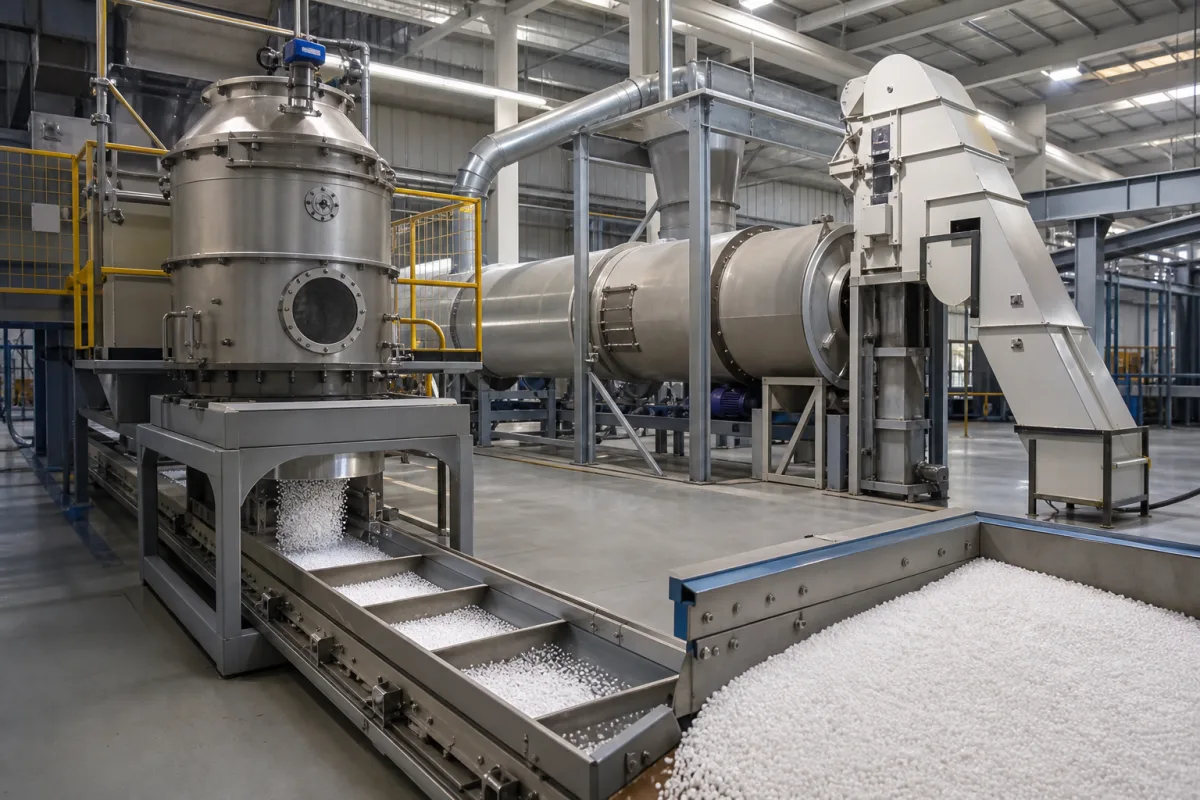
Urea finishing · melt from synthesis and concentration, prilling towers (fluidized and non-fluidized bed) versus drum and pan granulation, cooling, screening and recycle, anti-caking additives, and particulate and ammonia emissions with scrubbers
A urea granulation and prilling system turns concentrated urea melt into solid fertilizer or feed-grade particles: either by spraying melt down a prill tower against rising air, or by building up granules in layers in a rotating drum or pan, followed by cooling, screening, recycling of off-size material and, where used, coating or additives. Ask three things first: which product (prills or granules, agricultural or feed grade) and size the system must make, how heat and off-size material are handled, and how particulate and ammonia emissions will be controlled.
Urea solids-formation and finishing plant: prill towers, drum and pan granulators, rotary coolers, screens, recycle, coating or additive systems and their dust and ammonia scrubbers. Urea synthesis and concentration units, ammonia plants and fertilizer blending or bagging lines alone are outside this page except where compared.
CNFX editorial research · Sources checked October 12, 2026 · 4 sources
EPA's AP-42 Section 8.2 describes urea manufacture as up to seven operations: solution synthesis, solution concentration, solids formation, solids cooling, solids screening, solids coating, and bagging or bulk shipping. Ammonia and carbon dioxide react at 180–200 °C and 140–250 atm to form ammonium carbamate, which is dehydrated to a 70–77% urea solution; concentration by vacuum concentration, crystallization or atmospheric evaporation produces the melt, and the method depends on how much biuret impurity is allowed, since urea solution begins to decompose to biuret and ammonia at 60 °C. In prilling, molten urea is sprayed from the top of a prill tower and droplets solidify into nearly spherical particles as they fall through countercurrent air; towers are fluidized-bed or non-fluidized-bed, the latter possibly needing separate cooling for agricultural-grade prills. AP-42 states that “granulation is used more frequently than prilling in producing solid urea for fertilizer” and that granules are stronger, in crushing strength and abrasion resistance; drum granulators build layers on seed granules in a rotating drum about 4.3 m in diameter, and pan granulators also layer the product, but AP-42 notes they “are not commonly used in the U. S.”. Screening removes off-size product for return to the process, and AP-42 says the use of clay coating against caking and dust “has diminished considerably, being replaced by injection of formaldehyde additives” into the urea melt. [1]
The same section notes that drum granulators can produce very large particles and need less air than prill towers, but cannot economically produce small feed-grade granules; making smaller granules needs a higher seed recycle rate, which raises fines and emissions. [1]
Toyo Engineering's spout fluid bed granulation process shows how a granulation route is specified. Urea solution or melt is sprayed through multiple nozzles onto spouting recycle seeds; spouting air evaporates the water and internal fluidized beds cool the granules. A double-deck screen separates product, undersize goes back as seed, and oversize is crushed in a double-roller crusher and recycled. Toyo gives product quality of 46.3 wt% total nitrogen, 0.8 wt% biuret, 0.2 wt% moisture, 0.45 wt% formaldehyde, 95 wt% of granules at 2–4 mm and hardness 3.5 kg per 3 mm granule, with utilities of 0.01 t steam and 24 kWh power per tonne (19 kWh/t with a water-cooled bulk-flow cooler). Its data sheet labels them a “Typical standard figure depending on the design conditions of each plant”. [3]
Give the supplier the product (prills or granules), grade (agricultural or feed), target size distribution and crushing strength, capacity, melt concentration and temperature, additive or coating needs, cooling requirements and climate, screening and recycle arrangement, emission limits for particulate and ammonia, scrubber type and water balance, layout and utilities.
02
Control particulate and ammonia emissions
AP-42 gives uncontrolled particulate emission factors of 1.9 kg/Mg for non-fluidized-bed agricultural-grade prilling, 3.1 kg/Mg for fluidized-bed agricultural-grade prilling and 120 kg/Mg for drum granulation, with controlled factors of 0.032 (based on a wetted fibre filter scrubber at 98.3% efficiency, which AP-42 says “represents a higher degree of control than is typical in this industry”), 0.39 and 0.115 kg/Mg respectively; wet scrubbers are standard process equipment on drum granulators, whose cooling air entrains about 10–20% of the product. Prill tower emissions depend on product grade, air flow, bed type and ambient temperature and humidity: colder air forms smaller particles that are harder to remove, and AP-42 says air flow must rise with high humidity and “higher air flow rates usually cause higher emissions”. Ammonia is emitted during synthesis and solids production, and scrubbers installed for particulate showed no ammonia control. [1]
Editorial calculation: for drum granulation, 0.115 / 120 means the scrubber removes about 99.9% of particulate; for fluidized-bed agricultural prilling, 0.39 / 3.1 corresponds to about 87% control. At 1,000 Mg of granules a day, drum-granulation controlled emissions would be about 1,000 × 0.115 = 115 kg/day. The plant size is an assumed example; use permit limits and supplier guarantees for design. [1]
Toyo states that its low-pressure-drop scrubber, washing granulator air with circulating water, reduces urea dust to less than 30 mg/Nm³ of air, and that an acid scrubber using sulfuric or nitric acid can be added where ammonia must also be reduced. Ask each licensor for dust and ammonia guarantees in the same units, since AP-42 factors are per tonne of product and licensor figures are per cubic metre of air. [3][1]
03
Check melt-side materials when a conditioning agent is added
A 1991 study by the Tennessee Valley Authority's National Fertilizer and Environmental Research Center (Muscle Shoals) traced failures of heat exchanger tube bundles to molten urea containing lignosulfonate as a granulation conditioning-hardening agent (Urea LS), which was corrosive to Types 304 and 316 stainless steel. Field and laboratory immersion tests showed that corrosivity depended strongly on process temperature rather than on the conditioner composition. [4]
Editorial calculation: 100 mils per year is 2.54 mm per year, so a rate in the hundreds of mils per year would consume a tube wall of a few millimetres within about a year; the Celsius values in the table are conversions of TVA's Fahrenheit figures. [4]
Give the supplier the additive type and dose, the maximum melt temperature at the heat exchangers, pumps and spray heads, and ask for the wetted-part alloys and their corrosion data at that temperature with the additive present. [4]
Copper detrimental; TVA: “chromium is the most beneficial”; nickel minor effect [4]
Better-performing materials
Copper-free, chromium stainless steels, up to 345 °F (about 174 °C) [4]
04
Prill towers, drum and pan granulators, and spout fluid bed units
Configurations include non-fluidized-bed and fluidized-bed prill towers, drum granulators with rotary drum coolers, and pan granulators, each with screening, recycle and wet scrubbing. [1][2]
A licensed spout fluid bed granulator combines spouted and fluidized beds in one vessel, with a product cooler, screens, a roller crusher for oversize and a wet dust scrubber. [3]
05
Melt supply, prill tower or granulator, cooler, screens, crusher and scrubber
Screens and recycle sit in every route: AP-42 notes that making smaller drum granules needs a higher seed recycle rate, which raises fines and emissions. [1]
Explore company information and manufacturing capabilities, then discuss the scope of your project with a relevant supplier.
Share this page
Compiled and source-reviewed by the CNFX editorial team.
Each manufacturer above links to the page on that company's own website where the product is listed, with the date we checked it. How we source and review
· Page last updated 13 October 2026
Buyer questions
What is the difference between urea prilling and granulation?
AP-42 says prills form as melt droplets fall through countercurrent air in a tower, while granulation builds layers on seed granules in a drum or pan; granules are stronger. [1]
Why do drum granulators need scrubbers?
Cooling air entrains about 10–20% of the product; uncontrolled particulate is 120 kg/Mg against 0.115 kg/Mg with the standard wet scrubber. [1]
Does weather affect prill tower emissions?
Yes; colder air forms smaller, harder-to-remove particles, and AP-42 says air flow must rise with high humidity and “higher air flow rates usually cause higher emissions”. [1]
What granule size and hardness does a urea granulation plant give?
Toyo gives 95 wt% of granules at 2–4 mm and 3.5 kg hardness per 3 mm granule for its spout fluid bed process, labelled a “Typical standard figure depending on the design conditions of each plant”. [3]
Does a urea granulation additive affect equipment materials?
TVA found molten urea with a lignosulfonate conditioning agent harmless to 304 and 316 stainless below 295 °F but extremely corrosive above 300 °F, at up to hundreds of mils per year; copper-free chromium stainless steels did better up to 345 °F. [4]
Sources and what still needs a direct check
Sources checked 2026-10-12. Both sources are US Environmental Protection Agency AP-42 documents on urea manufacture (cited from Internet Archive copies of epa.gov files); their emission factors are dated averages, not guarantees. Toyo Engineering describes its own licensed process; the TVA report (1991) records corrosion tests on molten urea with a conditioning agent.