Editorial Technical Reference

Aluminum Cable Gland

This page explains how Aluminum Cable Gland is classified within Custom Aluminum Parts Manufacturing. Technical values and manufacturer relationships are research references; confirm the current specification and supplier evidence for each order.

Technical Definition & Core Assembly

An aluminum cable gland is a mechanical device used to attach and secure the end of an electrical cable to equipment, providing strain relief and environmental sealing.

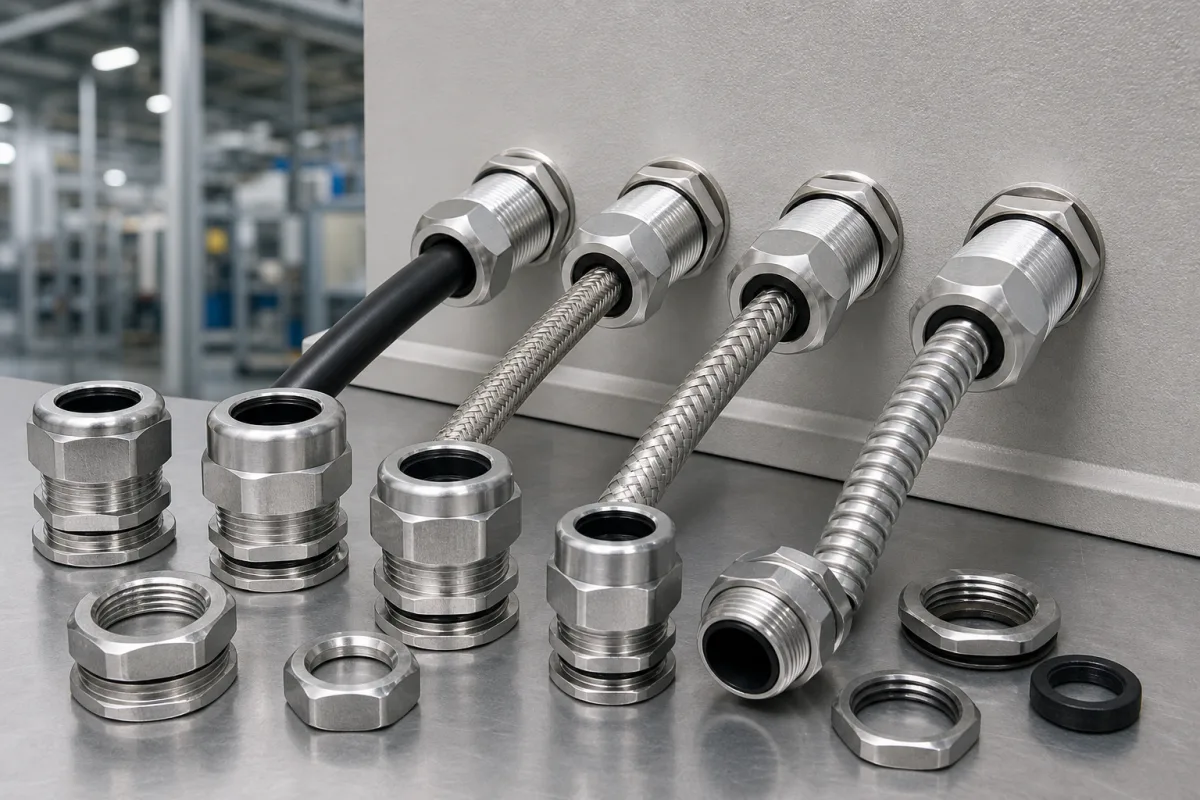
Representative product image. Confirm appearance and specifications with the manufacturer.

Product Specifications

Technical details and manufacturing context for Aluminum Cable Gland

Definition
An aluminum cable gland is a mechanical device used to attach and secure the end of an electrical cable to equipment, providing strain relief and environmental sealing. It prevents cable pull-out and protects against dust, moisture, and other contaminants in industrial environments. These components are essential for maintaining IP ratings in electrical enclosures and junction boxes across various industries including automation, machinery, and infrastructure. The gland typically consists of a threaded aluminum body, sealing elements, and a locknut. The body is made of aluminum alloy 6061-T6, which offers a tensile strength of at least 310 MPa per ASTM B221. The sealing elements are available in NBR or EPDM, with neoprene seals also used, and the locknut is nickel-plated brass. The gland accommodates cable diameters from 3 to 44 mm, with mounting thread sizes ranging from M12 to M63 per DIN EN 60423. It provides ingress protection from IP54 to IP68 per IEC 60529, depending on the sealing material and assembly. Operating temperature ranges from -40°C to 100°C, with silicone seals rated up to 180°C. Thread tolerance is 6g/6H per ISO 965. The surface finish is anodized Type II, 10–25 μm per MIL-A-8625. Weight varies from 20 to 500 g depending on size. Humidity range is 0–95% RH non-condensing. These values are reference ranges; verify model-specific specifications with the manufacturer. The gland is used in various industrial applications to maintain enclosure integrity and cable security.
Working Principle
The aluminum cable gland works by threading its body into an enclosure opening. The cable is inserted through the gland, and as the gland's nut is tightened, the internal sealing elements compress around the cable, creating a tight seal. This compression provides strain relief, preventing the cable from being pulled out, and seals against dust and moisture. The threaded body ensures a secure mechanical connection to the enclosure, while the sealing material (NBR, EPDM, or neoprene) conforms to the cable's outer surface. The locknut secures the gland in place. Proper installation requires matching the thread size and cable diameter to the gland specifications. The IP rating achieved depends on the sealing material and the torque applied during installation. Regular inspection is needed to ensure seals are not degraded and the gland remains tight.
Common Materials
aluminum alloy, neoprene seal, nickel-plated brass locknut
Technical Parameters
ParameterTypical rangeNotes & selection driver
Thread SizeRequiredM12–M63 mmMounting thread specificationDIN EN 60423
Cable Diameter RangeRequired3–44 mmMin-max compatible cable diameter
IP RatingRequiredIP54–IP68 IPXXIngress protection levelIEC 60529
Material Grade6061-T6 noneAluminum alloy specificationASTM B221
Operating Temperature-40–100 °CSilicone seal up to 180°C
Tensile Strength≥310 MPaFor 6061-T6ASTM B221
Sealing MaterialNBR/EPDMEPDM for high temp
Thread Tolerance6g/6HStandard fitISO 965
Surface FinishAnodizedType II, 10–25 μmMIL-A-8625
Weight20–500 gVaries with size
Humidity Range0–95 % RHNon-condensing

Ranges are indicative industry figures for RFQ preparation, not a supplier commitment. Confirm every value and standard with the legal manufacturer before ordering.

Components / BOM
  • Gland Body Part
    Main structural housing
    Material: Aluminum Alloy
  • Sealing Ring Part
    Environmental seal around cable
    Material: Neoprene
  • Locknut Part
    Secures gland to enclosure
    Material: Nickel-plated Brass
  • Compression Nut Part
    Compresses sealing elements
    Material: Aluminum Alloy

Industry Taxonomies & Aliases

Commonly used trade names and technical identifiers for Aluminum Cable Gland.

Industrial Ecosystem & Supply Chain Structure

Complementary Systems
Downstream Applications
Specialized Tooling

Application Fit & Sizing Matrix

Operational Limits
pressure: Up to 10 bar (IP68 rating)
other spec: Cable diameter range: 3mm to 75mm, IP68 ingress protection
temperature: -40°C to +120°C
Media Compatibility
✓ PVC insulated cables ✓ Rubber sheathed cables ✓ XLPE insulated cables
Unsuitable: Marine/saltwater environments (corrosion risk)
Sizing Data Required
  • Cable outer diameter (mm)
  • Enclosure entry thread size (e.g., M20, PG13.5)
  • IP protection rating required

Reliability & Engineering Risk Analysis

Failure Mode & Root Cause
Corrosion-induced degradation
Cause: Galvanic corrosion due to dissimilar metal contact between aluminum gland and copper cable or steel conduit in corrosive environments (e.g., marine, chemical plants), accelerated by moisture ingress and salt exposure.
Mechanical loosening and seal failure
Cause: Vibration-induced thread loosening from equipment operation, thermal cycling causing expansion/contraction, or improper installation torque leading to compromised IP rating and cable retention.
Maintenance Indicators
  • Visible white powdery oxidation (aluminum oxide) or pitting on gland surface indicating active corrosion
  • Audible cable movement or rattling within gland during equipment operation, suggesting loss of clamping force
Engineering Tips
  • Apply dielectric grease or corrosion-inhibiting compound at aluminum-copper/steel interfaces to prevent galvanic corrosion, and specify marine-grade aluminum alloys (e.g., 5052, 6061) for harsh environments
  • Use vibration-resistant locking nuts or thread-locking compounds on gland threads, and implement torque-controlled installation with periodic retorquing checks during preventive maintenance

Indicative industry ranges for design and RFQ preparation. Confirm the exact figures and applicable standard with the manufacturer before specifying.

Compliance & Manufacturing Standards

Applicable Standards
IEC 62444:2010 - Cable Glands for Electrical Installations ATEX Directive 2014/34/EU - Equipment for Explosive Atmospheres

Quoted from the published standard.

Manufacturing Precision
  • Thread Pitch: +/-0.05mm
  • Sealing Surface Flatness: 0.08mm
Quality Inspection
  • Pressure Test (IP68/IP69K)
  • Material Composition Verification (XRF Analysis)

Manufacturers of Aluminum Cable Gland

12 companies list this product among what they make. Company figures are quoted from each company's own website; every card states where the relationship came from.

Andeli Group Co., Ltd.
Shanghai, CN
Founded 19853000 + staff235,000 m²
Listed on the company's own website · profile compiled by CNFX from public sources
ZHEJIANG ETEK ELECTRICAL TECHNOLOGY CO.LTD.
Zhejiang, CN
CE VDE TUV CB
Listed on the company's own website · profile compiled by CNFX from public sources
Advanced Microwave Technologies Co., Ltd
Shaanxi, CN
Also makes: Waveguide Array, Active Device, Feed Network and 9 more
Listed on the company's own website · profile compiled by CNFX from public sources
ARTang Instrument Co., Ltd.
Zhejiang, CN
Listed on the company's own website · profile compiled by CNFX from public sources
DEGSON
Zhejiang, CN
Listed on the company's own website · profile compiled by CNFX from public sources
FZOLINK
Fujian, CN
Also makes: Wire Connectors, Terminal Block, Junction Box and 2 more
Listed on the company's own website · profile compiled by CNFX from public sources
GEYA Electric
Zhejiang, CN
Listed on the company's own website · profile compiled by CNFX from public sources
NBC
Guangdong, CN
Listed on the company's own website · profile compiled by CNFX from public sources
Ningbo Xiatao Plastic Industry Co.,Ltd
Zhejiang, CN
Listed on the company's own website · profile compiled by CNFX from public sources
PCM Cable
Dongguan, Guangdong, CN
Also makes: Industrial Camera, Feed Box, Control Cabinet and 6 more
Listed on the company's own website · profile compiled by CNFX from public sources
PowerTel Solutions Limited
Jiangsu, CN
Listed on the company's own website · profile compiled by CNFX from public sources
Qualwave Inc.
Chengdu, Sichuan, CN
Also makes: Calibration Kit, Rotary Joints, Power Divider and 4 more
Listed on the company's own website · profile compiled by CNFX from public sources
View All Factories

Manufacturer listings support early research and capability understanding. They are not certification, ranking, or transaction guarantees.

Technical documentation
Request current drawings, revision history, and a signed specification sheet.
Manufacturing capability
Verify equipment lists, process limits, capacity, and representative production evidence.
Inspection readiness
Confirm test methods, calibrated equipment, sampling plans, and traceable reports.
Supplier transparency
Check the legal entity, factory address, ownership, certifications, and direct contacts.

CNFX does not score or rank suppliers. Buyers must verify all claims and documents with the legal manufacturer before ordering.

Frequently Asked Questions

What is the typical thread size range for this aluminum cable gland?

The thread size ranges from M12 to M63 per DIN EN 60423. This is a reference range; the specific thread size must be selected based on the enclosure opening and cable diameter.

What IP ratings can be achieved with this gland?

The gland can provide ingress protection from IP54 to IP68 per IEC 60529, depending on the sealing material and proper installation. The actual rating depends on the specific model and assembly.

What materials are used in this cable gland?

The body is aluminum alloy 6061-T6, the sealing elements can be NBR, EPDM, or neoprene, and the locknut is nickel-plated brass. These materials are specified in the product data.

What is the operating temperature range?

The operating temperature range is -40°C to 100°C, with silicone seals rated up to 180°C. This is a reference range; verify the specific model's temperature rating with the manufacturer.

Data Basis

Editorial classification, named public sources where available, and source-reviewed manufacturer records.

Preliminary Technical Classification
This page supports structured research, RFQ preparation, and supplier evaluation. It does not replace buyer-led supplier qualification, standards review, or technical approval.
Buyer enquiry

Request manufacturing insight for Aluminum Cable Gland

Ask for use case, specification boundaries, supplier type, and RFQ preparation information for this product.

Where it goes
Straight to the CNFX editorial desk, and to the manufacturer if this product is linked to a claimed profile. Nothing is broadcast to a supplier list.
Your details stay here
We do not sell or rent enquiry data, and we do not add you to a mailing list. Used only to answer this request.
No commission, no middleman
CNFX is a directory. We take no cut of any order and never negotiate on a supplier's behalf.
What we don't claim
A listing is not an endorsement. Qualify every supplier and verify every figure yourself before ordering.

Your business information is used only to process this request.

Thank you! Your message has been sent. We'll respond within 1–3 business days.
Sorry, we couldn't send your message. Please try again, or email us at contact@cnfx.com.

Need to Manufacture Aluminum Cable Gland?

Compare manufacturer profiles with relevant product and process capability.

Previous Product
Aluminum Profile CNC Machining Center
Last Product
Get QuotesChat