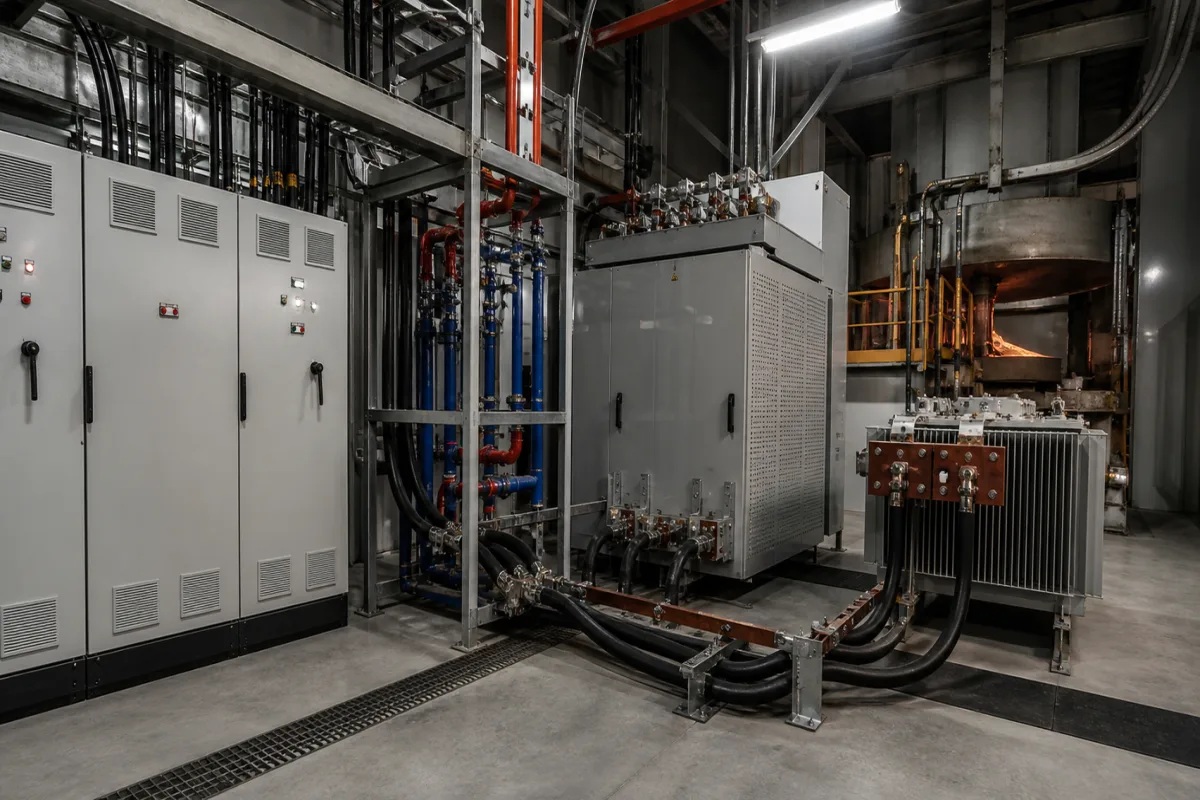
Power supply system (induction melting furnace power system: transformer, rectifier, inverter and tuning capacitors feeding the furnace coil)
Power supply systems for induction melting furnaces · supply transformer, 6- and 12-pulse rectifiers, DC reactors and filter capacitors, inverters, tuning capacitors, frequency choice and multi-furnace power sharing
A power supply system here is the chain that takes utility power at 50 or 60 Hz and delivers single-phase, variable-frequency current to the coil of an induction melting furnace: a supply transformer, a rectifier with DC reactor and filter capacitors, an inverter, and a tuning capacitor bank connected to the coil. Ask three things first: what power and frequency the furnace needs for its alloy and charge, how the rectifier meets your utility's harmonic limits, and whether one supply serves one furnace or shares power between two or more.
Power supply systems for induction melting and holding furnaces: transformers, thyristor or diode rectifiers, DC reactors and filter capacitors, SCR or IGBT inverters, tuning capacitor banks and connections to the coil, single or shared between furnaces. DIN-rail power supplies are covered on the Industrial DIN-Rail Power Supply Unit page; high-current DC rectifiers for electrolysis are on the Power supply unit page; furnaces, coils and cooling water systems are outside this page.
CNFX editorial research · Sources checked October 12, 2026 · 4 sources
Set the power and frequency for the alloy, charge and melt rate
Ajax Tocco explains that utilities supply 3-phase power at 50 or 60 Hz and induction power supplies convert it to the power and frequency the job needs; the frequency depends on the alloy and the size of the workpiece because it sets how deep the induced eddy currents penetrate, with lower frequencies for thicker sections and higher ones for smaller sections. It builds IGBT, SCR and MOSFET power supplies and offers "Powershare" options. [1]
An Inductotherm patent states that the solid state converter turns three-phase 50 or 60 Hz power into single-phase variable-frequency current for the coil, adjusting frequency "to match the inductive impedance of the coil with the capacitive impedance of the power supply". Its example melt shop produces 100 t of molten metal an hour on about 50 MW: a 50 MW transformer-rectifier feeds three 24 MW inverters, each on a 35 t furnace that needs 24 MW for 40 minutes to melt a charge and 2 MW to hold it, so two furnaces melt while the third holds. [3]
Editorial calculation from that example: 24 MW for 40 minutes is 24 × 40 ÷ 60 = 16 MWh per 35 t charge, about 457 kWh per tonne at the power supply. [3]
Give the supplier the furnace type and capacity, alloy, charge make-up, melt rate and tap temperature, required melting and holding power, frequency range, number of furnaces and how power is shared, utility voltage, fault level and harmonic limits, cooling water system, room layout and cable or busbar run to the furnace, and the control and metering needed.
02
Lay out the rectifier, DC link, inverter and tuning capacitors
An Inductotherm patent describes the power supply as an AC-to-DC rectifier and filter section, a DC-to-AC inverter and a tuning capacitor section: a three-phase diode bridge rectifies the line, a current-limiting reactor smooths the DC current and a capacitor filters the DC voltage, a full-bridge of solid state switches produces the AC output, and the load coil wound round the crucible is tuned by a capacitor bank because it has a very low power factor. It notes that "these tuning capacitors are a significant cost and volume component of the power supply". [2]
An ABB patent on induction furnace systems shows two six-pulse thyristor bridges forming a twelve-pulse rectifier, as "typically done for a high power inverter", with the supply voltages "phase shifted by thirty degrees by means of appropriately selected supply transformer phasing"; for lower power only one six-pulse bridge is used. Reactors after the rectifiers limit inrush current and supply voltage disturbance while the filter capacitor banks charge, and the thyristor phase angle is raised gradually during that first charge. [4]
The Inductotherm melt-shop patent warns that a single very large inverter failing can leave a furnace with tonnes of molten metal without heat and send a transient back into the supply, and proposes modular transformer-rectifier and inverter units made of self-contained modules. [3]
03
Supply transformer, rectifier, DC reactor, inverter and tuning capacitors
The tuning capacitor bank is a large part of the system because the furnace coil has a very low power factor; the DC reactor also limits inrush while the filter capacitors charge.
Explore company information and manufacturing capabilities, then discuss the scope of your project with a relevant supplier.
Share this page
Compiled and source-reviewed by the CNFX editorial team.
Each manufacturer above links to the page on that company's own website where the product is listed, with the date we checked it. How we source and review
· Page last updated 13 October 2026
Buyer questions
How is this different from a DIN-rail power supply or a plating rectifier?
This page covers the power chain of an induction melting furnace; DIN-rail supplies and high-current electrolysis rectifiers have their own pages. [2][1]
Why does the frequency matter?
Ajax Tocco explains that frequency sets the depth of the induced eddy currents, so thicker sections use lower frequencies. [1]
Why are tuning capacitors needed?
An Inductotherm patent says the load coil has a very low power factor, so a tuning capacitor bank is required, and it is a significant cost and volume item. [2]
What does twelve-pulse rectification involve?
An ABB patent shows two six-pulse thyristor bridges fed by supply voltages phase-shifted by 30° through transformer phasing. [4]
Sources and what still needs a direct check
Sources checked 2026-10-12. Ajax Tocco explains induction power supply frequency and types; two Inductotherm patents describe power supply sections and a multi-furnace melt shop; an ABB patent describes twelve-pulse rectification for induction furnaces.