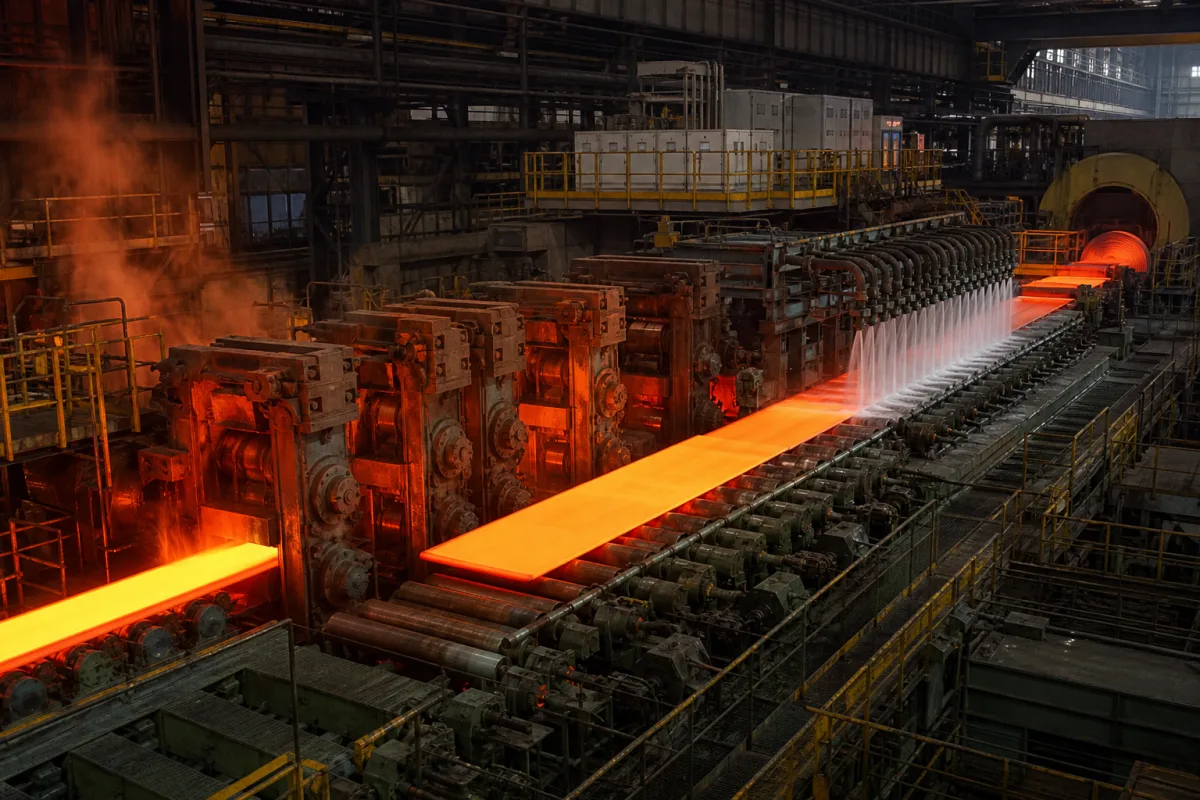
Hot strip mills from slab reheating to coiled strip · Reheating furnace, sizing press, roughing and finishing trains, coil box and transfer covers, cooling and coiling, and EU best-available-technique energy levels for reheating and rolling
An integrated hot strip rolling and finishing system — a hot strip mill — takes continuously cast slabs through a reheating furnace, descaling, a roughing mill (with a sizing press in some lines), a multi-stand finishing train, run-out table cooling and coilers to produce hot-rolled coils, with the automation that controls thickness, width, temperature and shape. Ask three things first: what slab sizes, steel grades and coil dimensions and how many tonnes per year the line must produce, how slabs reach the furnace and how heat is conserved between stages, and what energy, yield and emission performance the plant must meet.
Complete hot strip mills and major line packages for carbon and alloy steel: reheating furnaces, descalers, sizing presses, roughing and finishing mills, coil boxes, run-out cooling, coilers and line automation. Individual mill stands (see heavy-duty rolling mill stand), work rolls, hydraulic gap control, plate mills, bar and rod mills and cold rolling mills are outside this page except where compared.
CNFX editorial research · Sources checked October 12, 2026 · 4 sources
Commission Implementing Decision (EU) 2022/2110, the BAT conclusions for the ferrous metals processing industry, covers hot rolling mills with a capacity above 20 t of crude steel per hour and defines hot rolling as compressing heated steel between rolls at temperatures ranging from about 1,050 °C to 1,300 °C, including associated steps such as scarfing, finishing, pickling and oiling. Its BAT-associated environmental performance level for feedstock reheating of hot-rolled coils (strips) is 1,200–1,500 MJ/t as a yearly average, rising to up to 2,200 MJ/t for high-alloy steels such as austenitic stainless steel. [1]
To reach these levels it lists hot or direct charging of continuously cast slabs into the reheating furnace and near-net-shape thin-slab casting followed by rolling (both only for plants next to continuous casting), heat recovery from the cooling of furnace skids, and insulated covers between the caster and reheating furnace and between the roughing and finishing mills; general measures include burner and insulation design, segmented furnace doors, fewer supporting skids with insulation, combustion-air preheating with regenerative or recuperative burners balanced against NOx, and waste-heat boilers. [1]
Editorial calculation: a mill producing an assumed 3 Mt of hot-rolled coil per year at 1,200–1,500 MJ/t for reheating would use about 3.6–4.5 PJ a year in the furnaces, plus about 0.3–1.2 PJ for rolling at 100–400 MJ/t; ask bidders to state guaranteed specific energy for your product mix and charging temperature. [1]
US Department of Energy studies point the same way. DOE's 2004 Steel Industry Energy Bandwidth Study states that reheating is the major energy consumer in the rolling process, and that improving reheating efficiency through technology and sophisticated scheduling is key. [3] Its 2015 bandwidth study explains that slabs cooled to air temperature need longer reheating than slabs charged directly from continuous casting, which raises energy use. It also notes that heat treatments such as water quenching may be performed on a hot strip mill. [2]
The 2015 study estimates traditional hot rolling (hot strip, plate and section mills together) at an average of 3.00 GJ/t (2.58 MMBtu/ton), against a best value of 1.66 GJ/t (1.43 MMBtu/ton) for a traditional hot strip mill. It names recuperation and heat recovery, furnace controls, transfer bar edge heaters, energy-efficient burners and high-efficiency motors as the technologies behind the better values. Across the US iron and steel processes it studied, hot rolling had the largest current savings opportunity, 83 TBtu a year. [2]
Give the supplier the slab dimensions and weights, steel grades, hot or cold charging share and temperature, product range (strip thickness, width, coil weight), annual capacity and operating hours, existing caster layout, fuel and gas supply, energy and emission targets, automation level, building and crane constraints, and the scope split between equipment, civil works and erection.
02
Plan rolling, coiling and yield measures
The BAT conclusions set 100–400 MJ/t for rolling hot-rolled coils and heavy plates and list, for hot strip mills, a sizing press before the roughing mill that raises the hot-charging rate, gives more uniform width reduction and a near-rectangular slab needing fewer passes (for new plants and major upgrades); computer-aided rolling optimisation to minimise passes; reduced rolling friction; coil boxes, with coil recovery furnaces to restore rolling temperature after mill interruptions. [1]
For material efficiency it lists computer-aided slab quality control so only damaged areas are scarfed, slab slitting before rolling, edging or trimming of wedge-type slabs, crop optimisation after roughing using a shape measurement system such as a camera, and control of strip shape during rolling to minimise trimming. Dust, nickel and lead from descaling, roughing, rolling and finishing are to be collected and treated. [1]
DOE's 2015 study adds that electrical energy drives the mill motors and hydraulics, steam is used to remove scale, and combustion gases heat the reheat furnaces. It lists yield losses, and the energy lost with them, from oxidation of the steel, edge cracking during rolling and cropping of the ends during hot rolling. [2]
Editorial note: ask each bidder for guaranteed thickness, width, temperature and flatness tolerances, yield from slab to coil, roll changing times and the automation and measurement systems included.
03
Consider an integrated casting-and-rolling line as an alternative layout
Acciaieria Arvedi's Cremona works shows a different arrangement from a reheat-furnace hot strip mill. Since 2009 the site has run two complete flat-product lines, each with its own melting shop and an integrated casting and rolling line (ISP and ESP); production on the ESP (Endless Strip Production) line started in 2010. Arvedi lists a production capacity of about 4 million tonnes/year, with 2 EAFs (one with Consteel® technology), 4 ladle furnaces, 1 VOD furnace and 2 rolling mills based on Arvedi ISP/ESP® technology. [4]
The BAT conclusions on this page list hot or direct charging of slabs next to a caster among energy measures, and set reheating at 1,200–1,500 MJ/t for hot-rolled coil [1]. The same BAT list names near-net-shape thin-slab casting followed by rolling for plants next to continuous casting [1], which is the arrangement Arvedi describes, with each steel shop feeding its own casting and rolling line [4]. When comparing bids for a new plant, ask each supplier whether the layout is a conventional reheat-furnace mill or an integrated line, the thinnest gauge offered, and the guaranteed specific energy for reheating and rolling.
Arvedi states that its coils keep thickness tolerances in a close field with longitudinal profile variations of 0.4 mm, and publishes a tolerance table from 0,80 to 12,00 mm to UNI EN 10051 [4]. The DOE bandwidth studies cited here estimate the energy saving potential in hot rolling [2][3]; ask for the product mix and gauge distribution behind any energy or yield guarantee.
Editorial calculation: 4 million tonnes a year over two lines is about 2 Mt per line, or roughly 230 t per hour per line if each ran 8,760 hours a year; the 0,80–12,00 mm table spans a factor of 15 in thickness. [4]
Item
Arvedi Cremona (as published)
Lines
2 integrated casting and rolling lines (ISP and ESP), each with its own steel shop
Capacity
About 4 million tonnes/year
Melting and refining
2 EAFs (one Consteel®), 4 ladle furnaces, 1 VOD
ESP start
2010
Coil profile
Longitudinal profile with variations of 0.4 mm; practically flat cross-section
Thickness bands in tolerance table
0,80 to 12,00 mm (to UNI EN 10051)
Slitting
1.5 million tonnes/year of strip after three more slitting lines
Values are from Acciaieria Arvedi's company, Cremona site and hot-rolled dimensional tolerance pages.
04
Reference lines and energy guarantees to ask every mill bidder for
No hot strip mill supplier has been checked for this page yet. Ask each bidder for reference lines with a similar slab and product range, and for guaranteed reheating and rolling energy against the BAT levels of 1,200–1,500 and 100–400 MJ/t. [1]
Three of these sections double as energy measures in the BAT conclusions: hot charging into the furnace, a sizing press that raises the hot-charging rate, and transfer covers or a coil box that keep heat between roughing and finishing. [1]
Rolling temperature, reheating and rolling energy, charging, yield, capacity and thickness range for a mill enquiry
The two energy rows carry EU BAT-associated levels rather than equipment ratings, so ask bidders to guarantee specific energy against them on your own product mix. [1]
Explore company information and manufacturing capabilities, then discuss the scope of your project with a relevant supplier.
Share this page
Compiled and source-reviewed by the CNFX editorial team.
Each manufacturer above links to the page on that company's own website where the product is listed, with the date we checked it. How we source and review
· Page last updated 13 October 2026
Buyer questions
How much energy does slab reheating use in a hot strip mill?
The EU BAT-associated level for hot-rolled coil is 1,200–1,500 MJ/t as a yearly average, up to 2,200 MJ/t for high-alloy steels. [1]
What is a coil box used for?
It is listed among techniques to conserve heat and energy between roughing and finishing; coil recovery furnaces restore temperature after interruptions. [1]
At what temperature is steel hot rolled?
The EU BAT conclusions define hot rolling at temperatures ranging from about 1,050 °C to 1,300 °C. [1]
How much energy does hot rolling use?
DOE's 2015 bandwidth study estimates an average of 3.00 GJ/t for traditional hot rolling and a best value of 1.66 GJ/t for a traditional hot strip mill. [2]
What is an integrated casting and rolling (endless strip) line?
Acciaieria Arvedi's Cremona works runs two lines, each with its own melting shop feeding an integrated casting and rolling line (ISP and ESP); ESP production started in 2010 and the site lists about 4 million tonnes a year of capacity. [4]
Sources and what still needs a direct check
Sources checked 2026-10-12. The BAT conclusions set EU environmental performance expectations for permitted installations; they do not design a mill. Line design and guarantees must come from the bidders and your product plan. Two US DOE energy bandwidth studies (2004, 2015) add reheating and hot rolling energy data for US mills, and Acciaieria Arvedi's own pages describe its Cremona casting-and-rolling lines.