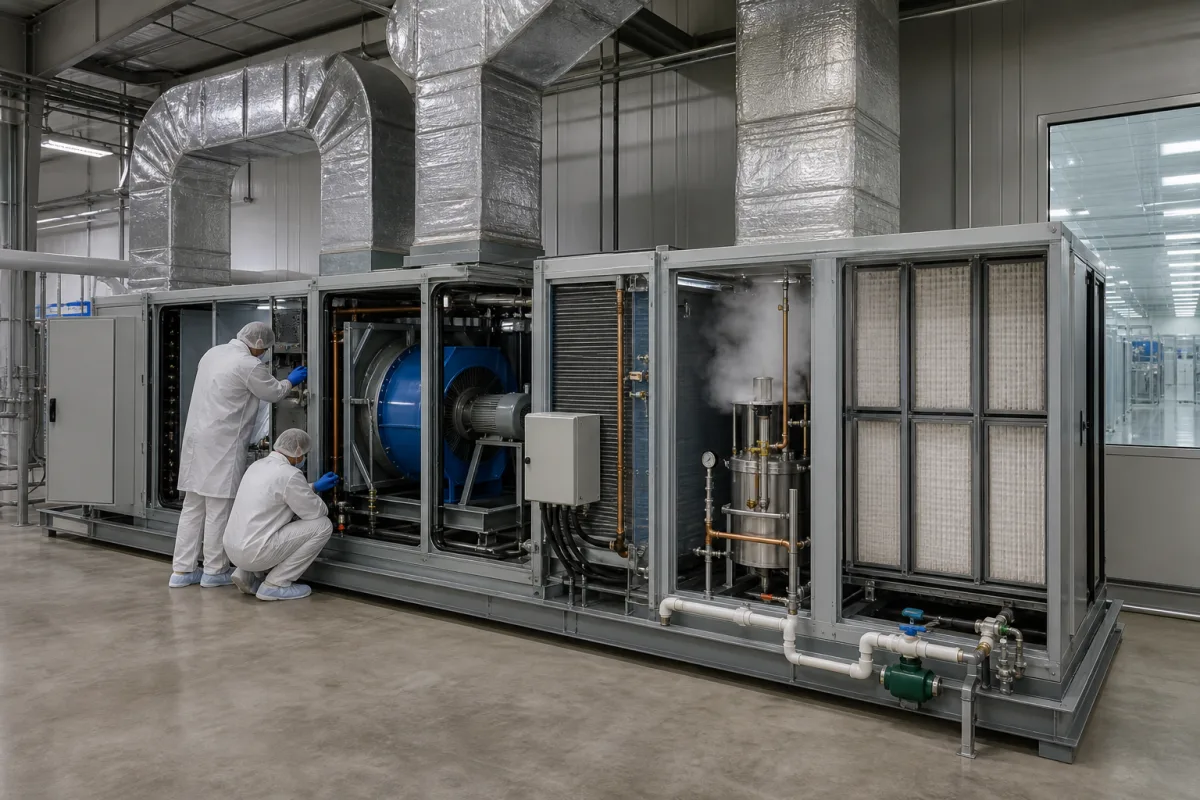
Cleanroom conditioning system (pharmaceutical HVAC air-handling unit)
Air conditioning for pharmaceutical cleanrooms · room pressure cascade of 10–15 Pa, air change rate, 0.36–0.54 m/s unidirectional airflow, HEPA classes, recirculation and humidity control
A cleanroom conditioning system is the heating, ventilation and air-conditioning plant, built around one or more air-handling units, that supplies filtered, temperature- and humidity-controlled air to pharmaceutical cleanrooms and keeps air flowing from cleaner to less clean rooms. Unlike the conditioning circuit inside a test chamber, it serves whole rooms with people and equipment in them, and regulators set the targets it is qualified against. Fix three things in the order: the pressure differences and alarm limits between rooms, the air volumes and velocities for each grade, and the filter classes, fresh-air share and humidity control.
HVAC systems and air-handling units that condition pharmaceutical and similar GMP cleanrooms: supply, return and exhaust air, filtration, room pressure cascades, air change rates, temperature and humidity control, and their qualification. Climatic test chambers, whose built-in conditioning systems control temperature and humidity inside a closed test space, are covered on the Test chamber page; low-pressure altitude chambers are covered on the Altitude test chamber page. Comfort air conditioning, vehicle and rail-car air conditioners and stand-alone filters are outside this page. Particle counters, viable air samplers and the alarm software that watch the rooms this air-handling plant serves are on the Cleanroom environmental monitoring system page.
CNFX editorial research · Sources checked October 12, 2026 · 3 sources
Room pressure cascade: 10–15 Pa between grades and alarms the AHU controls must raise
FDA's guidance on sterile drugs produced by aseptic processing recommends a positive pressure differential of at least 10–15 Pa (0.04–0.06 inches of water gauge) between adjacent rooms of different classification with doors closed, and a substantial overpressure, for example at least 12.5 Pa, from the aseptic processing room to any adjacent unclassified room at all times. It recommends monitoring pressure differentials continuously throughout each shift. [1]
EU GMP Annex 1 (2022) sets a minimum of 10 Pa as a guidance value between adjacent rooms of different grades and allows positively or negatively pressurised airlocks where pathogenic, highly toxic or radioactive materials must be contained. [2]
WHO's HVAC guideline for non-sterile products (TRS 1010, Annex 8) adds the control-side requirements: alert and action limits displayed at the gauge or in the building or environmental monitoring system, pressure control devices linked to alarms with justified dead times, tamper-proof zero setting of gauges, and pressure limits between adjacent areas chosen so that their dynamic operating ranges do not overlap. For rooms where dust is liberated, it describes the corridor held at a higher pressure than the rooms and the rooms above atmospheric pressure, and refers negative-pressure facilities to separate WHO guidance for hazardous products. [3]
Give the supplier a room list with grade or ISO class, room volumes, the pressure set point and tolerance for each room, door and airlock arrangement, extract equipment that can upset pressures, and the alarm and monitoring interface (EMS or BMS).
02
Air changes for support rooms, unidirectional air speed and clean-up time
FDA's non-binding guidance says airflow sufficient to achieve at least 20 air changes per hour can be acceptable for ISO 8 (Class 100,000) supporting rooms, and indicates significantly higher rates for ISO 7 and ISO 5 areas. [1]
For unidirectional airflow over critical zones, FDA's footnote gives 0.45 m/s (90 feet per minute) with a range of ±20% around the set point; Annex 1 gives a homogeneous air speed of 0.36–0.54 m/s at the working position as a guidance value unless otherwise scientifically justified. [1][2] Editorial calculation: 0.45 m/s × 0.8 = 0.36 m/s and 0.45 m/s × 1.2 = 0.54 m/s, so the two documents describe the same band. [1][2]
Annex 1 also expects the at-rest particle limits to be regained after a clean-up period, with a guidance value of less than 20 minutes, determined during qualification. [2] Editorial calculation: at 20 air changes per hour, a 150 m³ ISO 8 room needs at least 150 × 20 = 3,000 m³/h of supply air; the air-handling unit is sized on the sum of such room flows plus leakage and exhaust make-up. [1]
03
Inside the air-handling unit: HEPA class, fresh air versus recirculation, humidity and condensate
WHO accepts full fresh-air or recirculation systems. Where HEPA filters in the supply or return air protect against cross-contamination in a recirculating system, it asks for an EN 1822 class of at least H13 or equivalent, and it advises against recirculating air that might carry organic solvents or highly hazardous materials. [3]
WHO lists what sets the fresh-air quantity: enough to make up leakage and exhaust losses, operator occupancy and national legislation. It asks for controls on energy-recovery wheels in multiproduct plants so they do not carry contamination, and for humidification or dehumidification by means that do not become a contamination source, with cooling and dehumidification sections well drained so condensate does not accumulate. [3]
For terminal filters FDA states that an intact HEPA filter should retain at least 99.97% of particles larger than 0.3 µm, and recommends leak testing installed filters and monitoring the uniformity of air velocity across them. [1]
04
Tests the cleanroom HVAC is qualified against under Annex 1
Annex 1 lists the qualification tests for cleanrooms and clean air equipment, where relevant to the installation, and refers to the ISO 14644 series for methods. [2] Each test checks a different part of the conditioning system.
Coil, heater, humidifier and control performance. [2]
Recovery
Return to at-rest limits within the clean-up period. [2]
Microbial contamination; containment leak
Room and equipment cleanliness and containment. [2]
05
Send the room schedule, grades and plant limits
Paste it into your enquiry below or into an email to a maker, then replace every bracket.
Rooms: [name; volume; grade or ISO class; at rest and in operation]
Pressures: [set point per room; tolerance; airlocks; containment rooms]
Air: [air changes or supply volume; unidirectional zones and air speed]
Conditions: [temperature and RH limits per room]
Filtration: [prefilter and final filter classes; HEPA location]
Air scheme: [full fresh air or recirculation; energy recovery]
Utilities: [chilled and hot water or DX; clean steam]
Controls: [EMS/BMS; alarms; qualification documents]
1 company lists this product among what they make. Company figures are quoted from each
company's own website; every card states where the relationship came from.
Lists HVAC engineering in its cleanroom solution: air duct systems, cold and hot water units or air-cooled systems, and combined clean air-conditioning boxes with mixing, prefilter, heating/cooling, dehumidification, pressurisation, medium-efficiency and static-pressure sections.
Explore company information and manufacturing capabilities, then discuss the scope of your project with a relevant supplier.
Share this page
Compiled and source-reviewed by the CNFX editorial team.
Each manufacturer above links to the page on that company's own website where the product is listed, with the date we checked it. How we source and review
· Page last updated 13 October 2026
Buyer questions
What pressure difference should a cleanroom HVAC hold between rooms?
FDA recommends at least 10–15 Pa between adjacent rooms of different classification, and at least 12.5 Pa to unclassified rooms; EU GMP Annex 1 gives a 10 Pa minimum as a guidance value. [1][2]
How many air changes per hour does an ISO 8 cleanroom need?
FDA's guidance says at least 20 air changes per hour can be acceptable for ISO 8 supporting rooms and indicates significantly higher rates for ISO 7 and ISO 5. [1]
Which HEPA class should a recirculating pharmaceutical HVAC use?
WHO asks for at least EN 1822 H13 or equivalent where HEPA filters protect recirculated air against cross-contamination. [3]
Sources and what still needs a direct check
Sources checked 2026-10-12. FDA, the European Commission (EU GMP Annex 1) and WHO are regulators and a standard-setting body; their documents set guidance values that cleanroom HVAC systems are designed and qualified against. Values marked as guidance can be justified differently in a plant's own contamination control strategy.