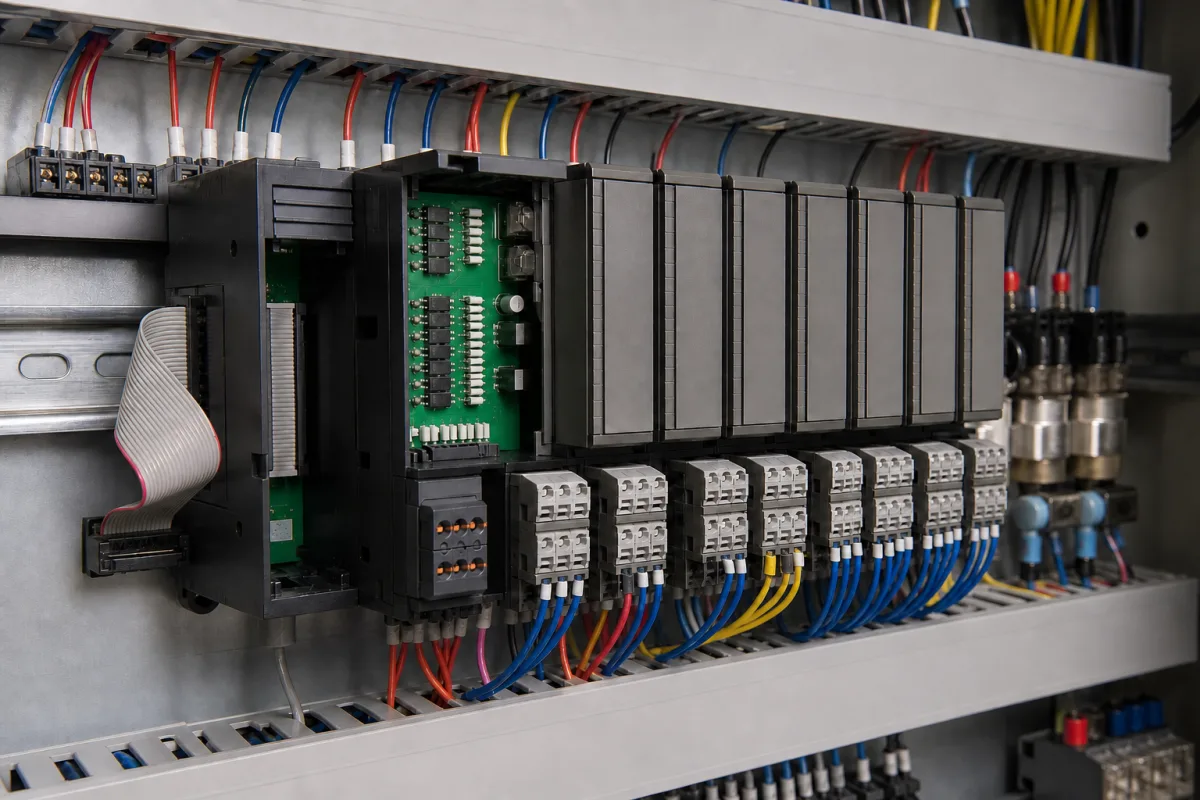
CNC input/output module (machine-side PLC I/O of a machine-tool control)
Machine-side PLC I/O of a CNC control · point counts per board or slice, output current per point and per module, fast probe inputs, operator-panel matrix keys and handwheels
A CNC input/output module is the board or slice-type unit that connects the PLC built into a machine-tool control to the machine itself: door and limit switches, pressure and level switches, clamp and coolant valves, lubrication pumps, lamps, and the keys, switches and handwheels of the machine operating panel. It sits on the control's own I/O bus rather than on a general plant network, and its point count, output current and input speed are set by the control maker's I/O system. Check three things first: how many inputs and outputs one module gives and how many modules the control accepts, how much current each output can drive when all of them are on, and whether the panel keys, handwheels and touch probes need dedicated inputs.
Digital and mixed I/O boards, base modules and slices that connect a CNC's integrated PLC to machine-tool switches, valves, lamps and operator-panel keys over the control maker's I/O link (for example SINUMERIK PP 72/48 boards on PROFINET, HEIDENHAIN PL 6000 on HSCI, FANUC connection units on I/O Link). General network remote I/O stations for plant PLCs are covered on the Remote I/O module page; 24 V DC discrete input cards on the Digital input module page; 6 mm coupling relays between controller outputs and field loads on the I/O interface module page; fieldbus and serial communication modules on the Communication module for wired industrial networks page. Servo drives, encoder interfaces and the CNC main computer are outside this page.
CNFX editorial research · Sources checked October 12, 2026 · 3 sources
72 inputs and 48 outputs on one board, or 16/8 slices up to 1,000 points
The two control makers reviewed here package machine I/O differently. Siemens' PP 72/48D 2/2A PN for SINUMERIK 828D is a single board without its own enclosure carrying 72 digital inputs, 48 digital outputs, 2 analog inputs and 2 analog outputs, connected to the control over PROFINET IO at up to 100 MBaud. [1] HEIDENHAIN's PL 6000 for the TNC 640 is a basic module on a 35 mm rail with 4, 6, 8 or 10 slots, filled with I/O modules such as the PLD-H 16-08-00 (16 digital inputs, 8 digital outputs) or PLD-H 08-16-00 (8 inputs, 16 outputs); the system supports a total of 1,000 inputs/outputs and up to seven PLB 6xxx base units. [2]
Editorial calculation: a PLB 6210 base filled with ten PLD-H 16-08-00 modules gives 10 × 16 = 160 inputs and 10 × 8 = 80 outputs, before the free points of the base module itself (12 inputs and 7 outputs without functional safety, per HEIDENHAIN). [2] On the Siemens board the I/O is fixed: the DIP switch table in the manual assigns device names for a 1st to 5th PP module on the same PROFINET line. [1]
HEIDENHAIN states that its MC main computer has no PLC inputs or outputs, so one PL 6000, UEC or UMC is necessary for each control. [2] Editorial note: the control model therefore decides which I/O module family can be used; a general-purpose remote I/O station on the same network is a different purchase from the control maker's own I/O.
State the control (maker, model, software version), the I/O bus it uses, the number of inputs and outputs needed now and as reserve, whether functional-safety I/O is required, and whether the module mounts on a rail, a mounting plate or behind the operator panel.
02
Output current per point when every output is on: 0.25 A against 2 A with an 8 A module limit
Siemens rates each digital output of the PP 72/48D 2/2A PN at 250 mA where the demand factor is 100% (all outputs active), with an internal resistance of at most 0.4 Ω, a maximum short-circuit current of 4 A for up to 100 µs at 24 V, and leakage of 50 µA typical and 400 µA maximum in the off state. Outputs are not galvanically isolated and are protected against short circuit, overtemperature and loss of ground, with automatic disconnection on undervoltage. [1]
Switching rate depends on the load: Siemens gives a maximum switching frequency of 100 Hz for a resistive load, 11 Hz for a lamp and 2 Hz for an inductive load, and a signal delay of 0.5 ms. [1] Editorial calculation: 48 outputs × 0.25 A = 12 A if every output carries its rated current, which the external 24 V DC supply feeding the outputs must provide; the voltage drop inside one output at 0.25 A is at most 0.25 × 0.4 = 0.1 V. [1]
HEIDENHAIN's digital I/O modules allow ≤ 2 A per output on outputs 0 to 7 but ≤ 8 A simultaneously, with a power output of at most 200 W. [2] Editorial calculation: 8 A ÷ 2 A = 4, so only four of the eight outputs on a PLD-H 16-08-00 can carry the full 2 A at the same time; 8 A × 24 V = 192 W, inside the 200 W limit. Editorial note: a solenoid valve coil or contactor coil above 0.25 A would need an interposing relay on the Siemens board, but can be driven directly from the HEIDENHAIN module within those limits.
List every load the outputs drive (valve coils, contactors, lamps, relays) with its current and type, and how many can be on at once, so the supplier can check per-point, per-group and per-module limits.
03
Input thresholds, 600 µs fast inputs and touch-probe connections
Siemens specifies the PP board's digital inputs at 15 to 30 V for a high level (24 V nominal), −30 to +5 V for a low level, 2 to 15 mA input current and 0.5 to 3 ms signal delay; eight inputs (X222, inputs 3.0 to 3.7) are fast inputs with a 600 µs delay. The inputs are not isolated, have no status LEDs and cannot take 2-wire BERO proximity switches. [1]
HEIDENHAIN's PLB 62xx system base module carries the connections for TS workpiece and TT tool touch probes, including probes with EnDat interface, rather than taking them through ordinary PLC input points. [2] Editorial note: list which signals are time-critical (probe trigger, reference cams, spindle orientation, fast stops) and ask on which inputs the control maker allows them; on the Siemens board only eight inputs are specified at 600 µs.
04
Operator-panel I/O: matrixed keys, rotary switches and handwheels
GE Fanuc's 72/56 connection unit (A20B-2002-0470) for FANUC i Series controls matrixes 56 of its 72 inputs and has sourced, electronically fused outputs; it connects to the CNC over I/O Link and takes up to three manual pulse generators (MPGs). On the North American operator panel, the pushbuttons use 44 of the 56 matrix inputs and the rotary switches 12 of the 16 discrete 24 V inputs, leaving 12 outputs, 12 matrix inputs and 4 discrete inputs for customer use. [3]
The same manual lists 48/32 units whose inputs are all non-matrixed, one with an MPG interface (A20B-2002-0520) and one without (A20B-2002-0521), and notes that only the I/O Link unit closest to the CNC should carry the MPGs, since that is the only active MPG circuit. [3] HEIDENHAIN's PLB 6001 adapter for an OEM operating panel has terminals for 72 PLC inputs and 40 PLC outputs plus the HR handwheel connection. [2]
Editorial note: a matrixed input is scanned as rows and columns, which saves wiring for keypads but suits only switches the control scans this way; limit switches and safety-related signals belong on discrete inputs.
05
Supply, power loss, enclosure and cabling of the Siemens and HEIDENHAIN units
Editorial note: IP00 means the Siemens board relies entirely on the control cabinet for protection, and the ribbon-cable connectors need terminal converters or distribution boards between the board and the field wiring. [1]
Send the control model, point list and output loads
Paste it into your enquiry below or into an email to a maker, then replace every bracket.
Control: [maker; model; software version; I/O bus]
Points: [digital inputs; digital outputs; analog in/out; reserve]
Outputs: [load type and current per point; how many on at once]
Fast inputs: [probe; reference cams; other time-critical signals]
Operator panel: [keys; rotary switches; handwheels (MPG/HR)]
Safety: [functional-safety I/O required or not]
Mounting: [rail, plate or panel; cabinet temperature]
Wiring: [ribbon cable and terminal converters, or terminals]
Explore company information and manufacturing capabilities, then discuss the scope of your project with a relevant supplier.
Share this page
Compiled and source-reviewed by the CNFX editorial team.
Each manufacturer above links to the page on that company's own website where the product is listed, with the date we checked it. How we source and review
· Page last updated 13 October 2026
Buyer questions
How much current can a CNC I/O output drive?
It depends on the module: Siemens rates the PP 72/48D 2/2A PN at 0.25 A per output with all outputs active, while HEIDENHAIN allows up to 2 A per output on its digital I/O modules but no more than 8 A at once. [1][2]
Are CNC I/O inputs fast enough for a touch probe?
Not all of them: the Siemens board specifies 0.5–3 ms delay on ordinary inputs and 600 µs on eight fast inputs, and HEIDENHAIN connects TS and TT probes to dedicated connections on the PLB 62xx base module. [1][2]
What is a matrixed input on a CNC panel I/O unit?
An input scanned as part of a row-and-column key matrix; GE Fanuc's 72/56 unit matrixes 56 of its 72 inputs, of which its operator panel pushbuttons use 44. [3]
Sources and what still needs a direct check
Sources checked 2026-10-12. Siemens and HEIDENHAIN publish data for their own CNC I/O systems; the GE Fanuc manual covers operator panels and connection units for FANUC i Series controls. Ratings apply to the stated module, demand factor and supply voltage.