Editorial Technical Reference

Linear guide / Rails

This page explains how Linear guide / Rails is classified within Machinery and Equipment Manufacturing. Technical values and manufacturer relationships are research references; confirm the current specification and supplier evidence for each order.

Technical Definition & Core Assembly

Precision mechanical component that provides smooth, low-friction linear motion along a fixed path.
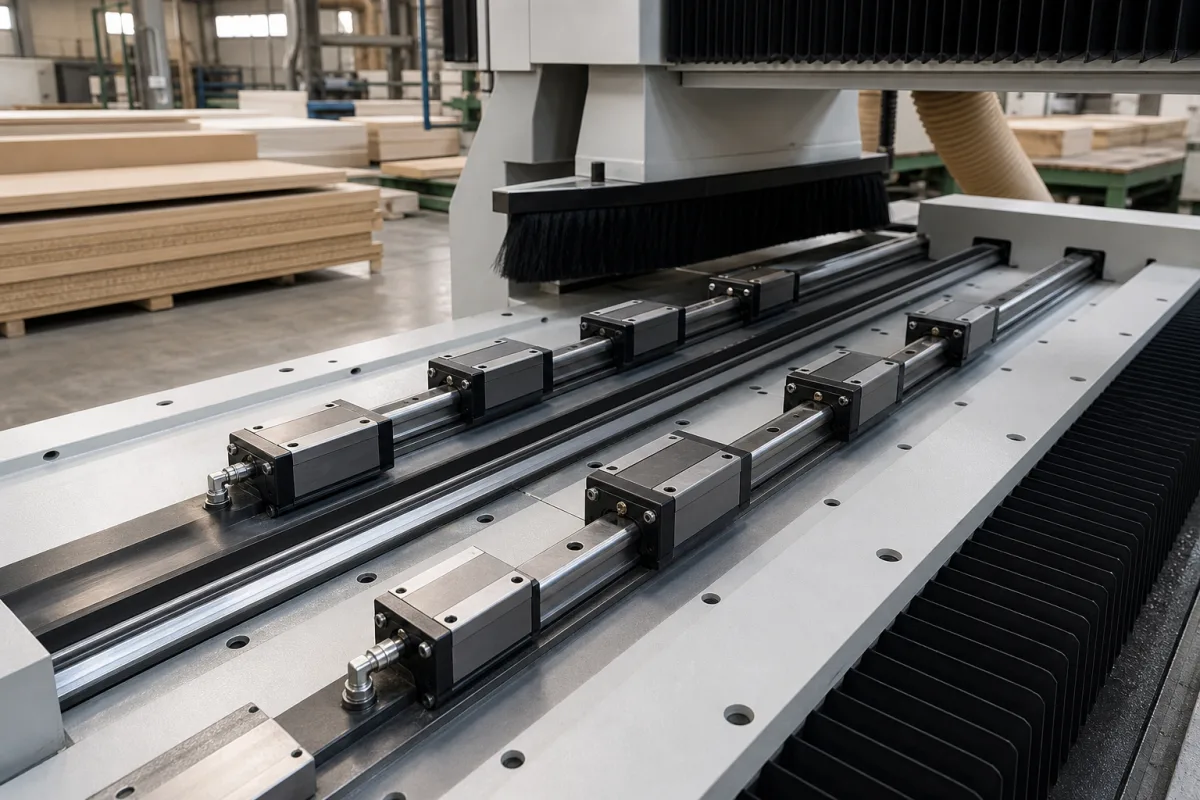
AI-assisted product visualization. Verify appearance with the manufacturer.

Product Specifications

Technical details and manufacturing context for Linear guide / Rails

Definition
A critical component within vertical actuators that guides and supports the moving platform or carriage along a precise vertical axis, ensuring accurate positioning, minimal deflection, and high load capacity during linear motion.
Working Principle
Utilizes rolling elements (balls or rollers) that circulate between the rail and the sliding block (carriage) to convert sliding friction into rolling friction, enabling smooth, precise, and low-resistance linear movement along the rail's hardened raceway.
Common Materials
Carbon chromium bearing steel (e.g., SUJ2), Stainless steel (e.g., SUS440C), Aluminum alloy
Technical Parameters
ParameterNotes & selection driver
Spec(mm) Rail width/height dimensions that define the guide size and load capacity (e.g., 15mm, 20mm, 25mm, 30mm, 35mm, 45mm).
Components / BOM
  • Rail Part
    Fixed track with precision-ground raceways that guide the rolling elements
    Material: Hardened steel
  • Carriage (Slider Block)
    Moving component that houses the rolling elements and attaches to the load
    Material: Hardened steel with seals
  • Rolling Elements Part
    Balls or rollers that circulate to enable smooth linear motion
    Material: Chrome steel or ceramic
  • End Seals Part
    Protect the internal raceways from contamination and retain lubrication
    Material: Synthetic rubber or polyurethane
  • Lubrication Port Part
    Fitting for applying grease or oil to the rolling elements
    Material: Brass or steel

Industry Taxonomies & Aliases

Commonly used trade names and technical identifiers for Linear guide / Rails.

Applied To / Applications

This component is essential for the following industrial systems and equipment:

Industrial Ecosystem & Supply Chain Structure

Complementary Systems
Downstream Applications
Specialized Tooling

Application Fit & Sizing Matrix

Operational Limits
speed: Up to 5 m/s with proper lubrication, 2 m/s typical continuous operation
accuracy: ±0.01 mm/m to ±0.001 mm/m depending on precision grade
pressure: Not applicable (mechanical component, not fluid handling)
temperature: -20°C to 80°C (standard), up to 150°C with special seals/lubricants
load capacity: Dynamic load rating: 5-50 kN depending on size, Static load rating: 10-100 kN
Media Compatibility
✓ Clean industrial environments ✓ Machine tool applications ✓ Automated assembly systems
Unsuitable: High particulate contamination environments without protective covers
Sizing Data Required
  • Maximum load (static and dynamic)
  • Required travel length and accuracy
  • Mounting configuration and space constraints

Reliability & Engineering Risk Analysis

Failure Mode & Root Cause
Wear and scoring
Cause: Contamination ingress (dust, chips, debris) leading to abrasive wear, inadequate lubrication, or misalignment causing uneven load distribution and metal-to-metal contact.
Corrosion and pitting
Cause: Exposure to corrosive environments (moisture, chemicals), use of incompatible lubricants, or lack of protective coatings leading to surface degradation and loss of precision.
Maintenance Indicators
  • Audible grinding, scraping, or squeaking noises during movement indicating contamination or lubrication failure.
  • Visible scoring marks, rust spots, or uneven wear patterns on the rail surfaces or guide blocks.
Engineering Tips
  • Implement regular cleaning and lubrication schedules using manufacturer-recommended greases or oils, and install protective covers or seals to prevent contamination ingress.
  • Ensure precise alignment during installation using laser alignment tools, and periodically check preload and mounting bolt torque to maintain even load distribution and prevent edge loading.

Compliance & Manufacturing Standards

Reference Standards
ISO 10285-1:2011 (Linear motion rolling bearings) ANSI B5.48-1977 (Linear Motion Rolling Bearings) DIN 645-1:2009 (Linear ball bearings and shaft assemblies)
Manufacturing Precision
  • Flatness: 0.01mm per 100mm
  • Parallelism: 0.02mm per 100mm
Quality Inspection
  • Dimensional Accuracy Verification (CMM)
  • Hardness Testing (Rockwell C Scale)

Published Manufacturer Relationships

Source-reviewed profile relationships currently associated with Linear guide / Rails

No source-reviewed manufacturer relationship is currently published for this product.

Manufacturer listings support early research and capability understanding. They are not certification, ranking, or transaction guarantees.

Technical documentation
Request current drawings, revision history, and a signed specification sheet.
Manufacturing capability
Verify equipment lists, process limits, capacity, and representative production evidence.
Inspection readiness
Confirm test methods, calibrated equipment, sampling plans, and traceable reports.
Supplier transparency
Check the legal entity, factory address, ownership, certifications, and direct contacts.

CNFX does not score or rank suppliers. Buyers must verify all claims and documents with the legal manufacturer before ordering.

Supply Chain Compatible Machinery & Devices

Hydraulic Press

Industrial machine using hydraulic pressure to compress, form, or assemble materials

Explore Specs →
Automated Powder Coating System

Integrated industrial system for applying dry powder coatings to metal substrates.

Explore Specs →
High-Precision CNC Laser Cutting Machine

Computer-controlled industrial machine using focused laser beams to cut sheet metal with micron-level accuracy.

Explore Specs →
Infeed Conveyor

A conveyor system component designed to receive and transport raw materials or workpieces into an industrial processing system.

Explore Specs →

Frequently Asked Questions

What are the main differences between carbon steel and stainless steel linear guides?

Carbon chromium bearing steel (SUJ2) offers superior hardness and load capacity for general industrial applications, while stainless steel (SUS440C) provides excellent corrosion resistance for harsh environments like food processing or marine applications.

How often should linear guides be lubricated for optimal performance?

Lubrication frequency depends on operating conditions, but typically linear guides require lubrication every 3-6 months under normal conditions. Heavy use or harsh environments may require monthly lubrication through the built-in lubrication ports.

What factors determine the appropriate linear guide size for my machinery?

Key factors include load capacity requirements (static and dynamic), required precision level, operating speed, environmental conditions, and available installation space. Consult manufacturer specifications for rail dimensions and carriage block compatibility.

Data Basis

Editorial classification, named public sources where available, and source-reviewed manufacturer records.

Preliminary Technical Classification
This page supports structured research, RFQ preparation, and supplier evaluation. It does not replace buyer-led supplier qualification, standards review, or technical approval.

Request Manufacturing Insight for Linear guide / Rails

Ask for use case, specification boundaries, supplier type, and RFQ preparation information for Linear guide / Rails.

Your business information is used only to process this request.

Thank you! Your message has been sent. We'll respond within 1–3 business days.
Sorry, we couldn't send your message. Please try again, or email us at contact@cnfx.com.

Need to Manufacture Linear guide / Rails?

Compare manufacturer profiles with relevant product and process capability.

Create Manufacturer Profile Contact Us
Previous Product
Workpiece Fixture
Last Product