Industry-Verified Manufacturing Data (2026)

Safety Interlock

Based on aggregated insights from multiple verified factory profiles within the CNFX directory, the standard Safety Interlock used in the Machinery and Equipment Manufacturing sector typically supports operational capacities ranging from standard industrial configurations to heavy-duty production requirements.

Technical Definition & Core Assembly

A canonical Safety Interlock is characterized by the integration of Actuator and Position Sensor. In industrial production environments, manufacturers listed on CNFX commonly emphasize Stainless Steel construction to support stable, high-cycle operation across diverse manufacturing scenarios.

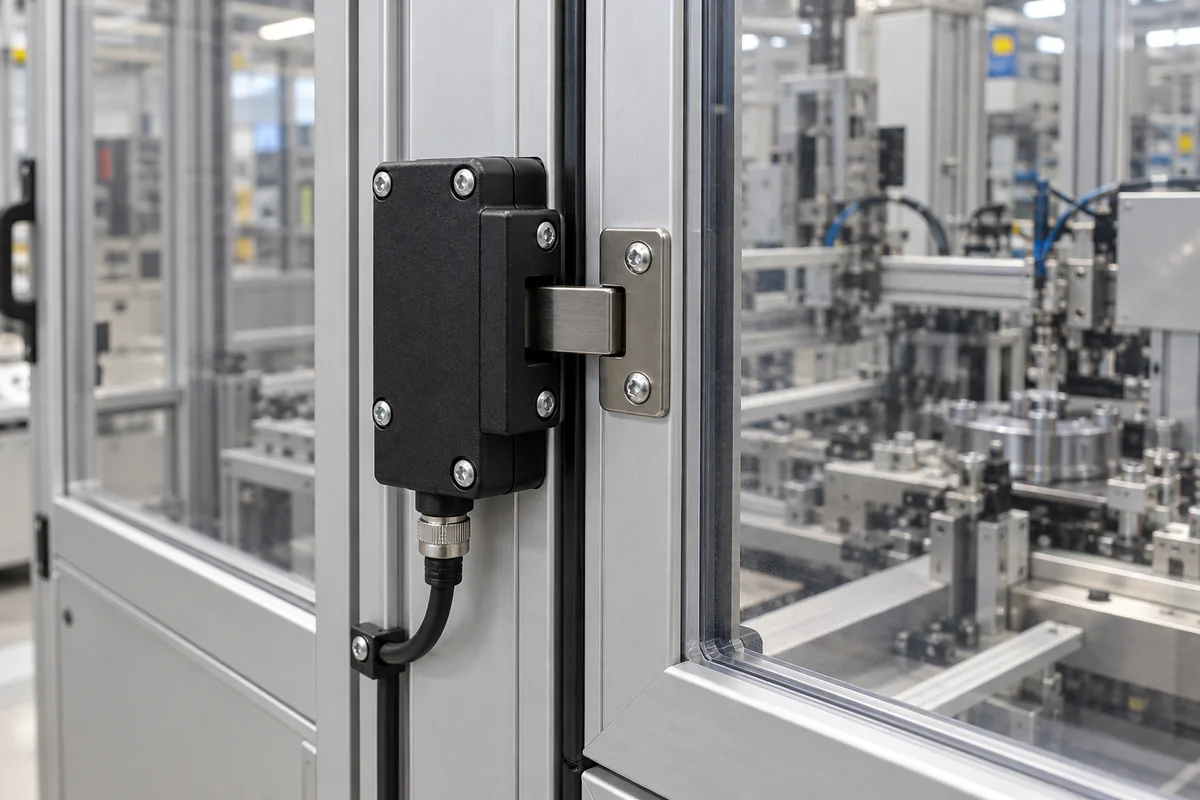
A safety mechanism that prevents access to hazardous areas of observation windows until machinery is in a safe state.
Product Specifications

Technical details and manufacturing context for Safety Interlock

Definition
A safety interlock is a critical component integrated into observation windows that ensures operator safety by mechanically or electronically preventing the opening of access panels or doors while machinery is operational or in a hazardous state. It is designed to comply with industrial safety standards (e.g., ISO 14119, ANSI B11.19) and is essential for preventing accidental exposure to moving parts, high temperatures, or chemical processes visible through the window.
Working Principle
The interlock typically uses a sensor or switch that detects the position or status of machinery (e.g., power-off, motion stopped). When unsafe conditions are detected, it engages a locking mechanism (mechanical bolt, electromagnetic lock) on the observation window's access point, preventing opening. Only when safe conditions are verified does the interlock disengage, allowing access.
Common Materials
Stainless Steel, Engineering Plastic (e.g., Polycarbonate)
Technical Parameters
  • Locking bolt diameter and throw length (mm) Customizable
Components / BOM
  • Actuator
    Mechanically engages/disengages the lock based on control signals
    Material: Stainless Steel
  • Position Sensor
    Detects whether the observation window access point is open or closed
    Material: Engineering Plastic with Metal Contacts
  • Control Circuit
    Processes safety signals from machinery and commands the actuator
    Material: PCB with Electronic Components
Engineering Reasoning
0.5-2.0 N·m torque at actuator shaft, 24 VDC ±10% supply voltage, -20°C to +85°C ambient temperature
Actuator torque <0.4 N·m prevents mechanical engagement, supply voltage <21.6 VDC causes relay dropout, ambient temperature >90°C triggers thermal shutdown
Design Rationale: Electromagnetic relay contact welding due to inrush currents exceeding 10A during inductive load switching, causing permanent circuit closure and safety bypass
Risk Mitigation (FMEA)
Trigger Corrosive atmosphere exposure (H2S concentration >50 ppm)
Mode: Electrical contact oxidation increasing resistance from <0.1Ω to >5Ω
Strategy: Hermetically sealed relay enclosure with nitrogen purging at 1.2 bar positive pressure
Trigger Mechanical vibration at 120 Hz resonance frequency exceeding 5 g RMS
Mode: Microswitch actuator arm fatigue fracture at stress concentration point
Strategy: Vibration isolation mounting with silicone dampeners having 40 durometer hardness and 70% compression deflection

Industry Taxonomies & Aliases

Commonly used trade names and technical identifiers for Safety Interlock.

Applied To / Applications

This component is essential for the following industrial systems and equipment:

Industrial Ecosystem & Supply Chain DNA

Complementary Systems
Downstream Applications
Specialized Tooling

Application Fit & Sizing Matrix

Operational Limits
pressure: 0 to 1 bar (atmospheric)
other spec: No direct flow or slurry contact; mechanical actuation only
temperature: -20°C to +80°C
Media Compatibility
✓ Clean industrial air environments ✓ Dry powder handling areas ✓ General manufacturing atmospheres
Unsuitable: High-pressure washdown or corrosive chemical exposure
Sizing Data Required
  • Window/door opening dimensions
  • Required safety integrity level (SIL/PL)
  • Machine safe-state signal type (e.g., relay, PLC, safety controller)

Reliability & Engineering Risk Analysis

Failure Mode & Root Cause
Contact failure
Cause: Oxidation, contamination, or mechanical wear of electrical contacts due to environmental exposure, arcing, or improper alignment
Mechanical binding/sticking
Cause: Corrosion, debris accumulation, or misalignment in the actuation mechanism preventing proper engagement/disengagement
Maintenance Indicators
  • Intermittent or inconsistent system response when interlock should engage/disengage
  • Visible corrosion, physical damage, or unusual wear on interlock components during inspection
Engineering Tips
  • Implement regular functional testing under controlled conditions to verify proper operation before failure occurs
  • Establish protective measures against environmental contaminants (seals, enclosures, positive pressure) and ensure proper alignment during installation

Compliance & Manufacturing Standards

Reference Standards
ISO 13849-1: Safety of machinery - Safety-related parts of control systems ANSI/ASSE Z244.1: Control of Hazardous Energy - Lockout/Tagout and Alternative Methods DIN EN 1088: Safety of machinery - Interlocking devices associated with guards - Principles for design and selection
Manufacturing Precision
  • Actuator Position Repeatability: +/-0.5 mm
  • Switch Contact Gap: +/-0.1 mm
Quality Inspection
  • Functional Safety Test (Performance Level verification per ISO 13849)
  • Mechanical Endurance Test (minimum 1 million cycles at rated load)

Factories Producing Safety Interlock

Verified manufacturers with capability to produce this product in China

✓ 98% Supplier Capability Match Found

S Sourcing Manager from Singapore Jan 12, 2026
★★★★★
"The Safety Interlock we sourced perfectly fits our Machinery and Equipment Manufacturing production line requirements."
Technical Specifications Verified
P Procurement Specialist from Germany Jan 09, 2026
★★★★☆
"Found 18+ suppliers for Safety Interlock on CNFX, but this spec remains the most cost-effective. (Delivery took slightly longer than expected, but technical support was excellent.)"
Technical Specifications Verified
T Technical Director from Brazil Jan 06, 2026
★★★★★
"The technical documentation for this Safety Interlock is very thorough, especially regarding technical reliability."
Technical Specifications Verified
Verification Protocol

“Feedback is collected from verified sourcing managers during RFQ (Request for Quote) and factory evaluation processes on CNFX. These reports represent historical performance data and technical audit summaries from our B2B manufacturing network.”

11 sourcing managers are analyzing this specification now. Last inquiry for Safety Interlock from Mexico (27m ago).

Supply Chain Compatible Machinery & Devices

Hydraulic Press

Industrial machine using hydraulic pressure to compress, form, or assemble materials

Explore Specs →
Heavy-Duty CNC Plasma Cutting Machine

Industrial machine for precision metal cutting using plasma arc technology

Explore Specs →
Automated Assembly Line System

Integrated production system for sequential component assembly operations

Explore Specs →
Automated Powder Coating System

Integrated industrial system for applying dry powder coatings to metal substrates.

Explore Specs →

Frequently Asked Questions

How does a safety interlock prevent access to hazardous areas?

The safety interlock uses an actuator and position sensor connected to a control circuit that monitors machinery status. It physically blocks access to observation windows until the equipment reaches a verified safe state, preventing operator exposure to moving parts or other hazards.

What are the benefits of using stainless steel and engineering plastic materials?

Stainless steel provides corrosion resistance and structural durability in industrial environments, while engineering plastics like polycarbonate offer impact resistance, electrical insulation, and chemical resistance. This material combination ensures long-term reliability and safety compliance.

Can this safety interlock be integrated with existing machinery control systems?

Yes, the control circuit is designed for integration with standard industrial control systems. It can interface with PLCs, safety relays, and machine monitoring systems to provide seamless safety functionality while maintaining operational efficiency.

Can I contact factories directly on CNFX?

CNFX is an open directory, not a transaction platform. Each factory profile provides direct contact information and production details to help you initiate direct inquiries with Chinese suppliers.

Get Quote for Safety Interlock

Request technical pricing, lead times, or customized specifications for Safety Interlock directly from verified manufacturing units.

Your business information is encrypted and only shared with verified Safety Interlock suppliers.

Thank you! Your message has been sent. We'll respond within 1–3 business days.

Need to Manufacture Safety Interlock?

Connect with verified factories specializing in this product category

Add Your Factory Contact Us
Previous Product
Safety Hook
Next Product
Safety Interlock & Control Panel