Editorial Technical Reference

Trailer Frame Welding Robot

This page explains how Trailer Frame Welding Robot is classified within Manufacture of Trailers and Semitrailers. Technical values and manufacturer relationships are research references; confirm the current specification and supplier evidence for each order.

Technical Definition & Core Assembly

Industrial robotic system for automated welding of trailer and semitrailer structural frames
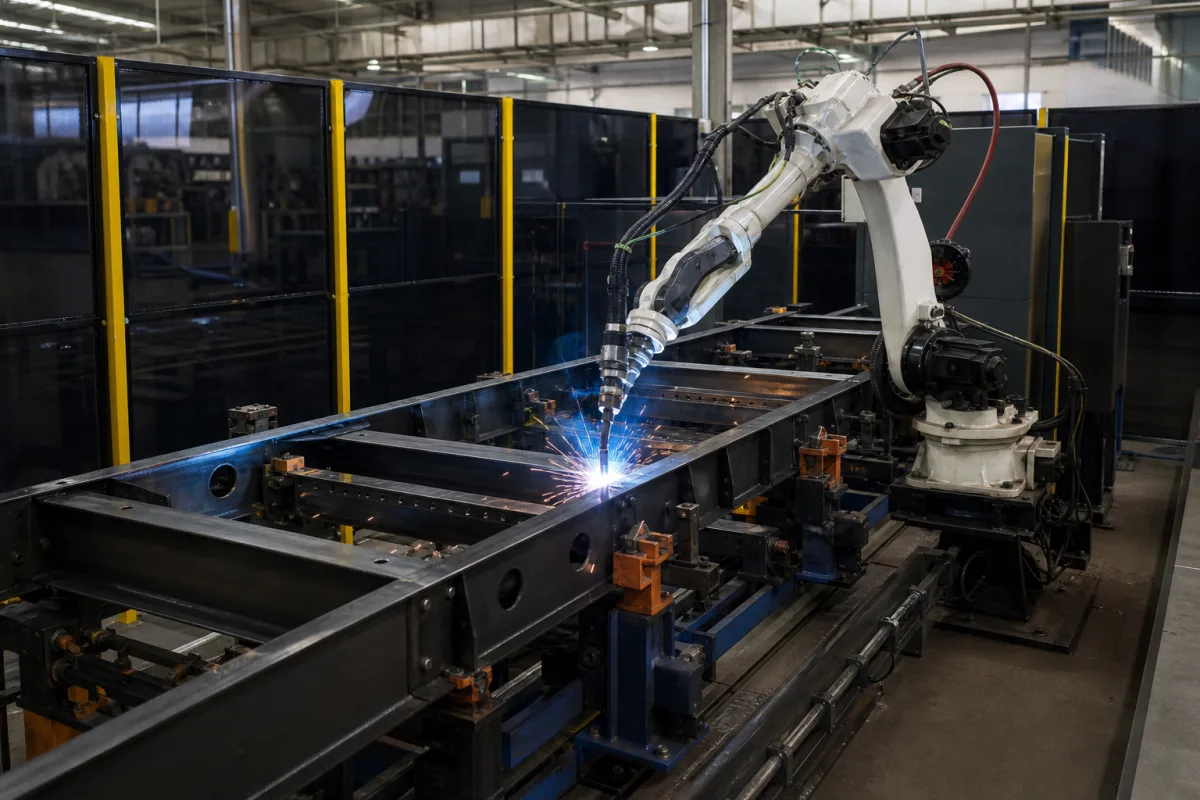
Trailer Frame Welding Robot in a manufacturing environment
Representative product image. Confirm appearance and specifications with the manufacturer.

Product Specifications

Technical details and manufacturing context for Trailer Frame Welding Robot

Definition
This industrial robotic system is designed for automated welding of structural frames used in trailers and semitrailers. It automates the welding of longitudinal beams, cross members, and reinforcement plates, producing precise and consistent frame assemblies. The system reduces manual labor while improving weld quality and repeatability in trailer manufacturing. It is engineered to handle large dimensions and heavy components typical in trailer frame construction. The system uses a multi-axis robotic arm with a welding torch that follows programmed paths to deposit weld material along joints. Components are precisely positioned on a heavy-duty fixture table. Arc welding processes with automated wire feed and shielding gas delivery are employed. The system supports high-strength steel and aluminum alloy materials. Key parameters include a welding speed of 0.5–2.0 mm/min, positioning accuracy of ±0.05 mm (ISO 9283), maximum frame length of 12000 mm, welding current range of 50–350 A, power requirement of 380–480 kVA (IEC 60038), 6-axis articulated robot, maximum payload of 10–20 kg (ISO 9283), repeatability of ±0.02 mm (ISO 9283), operating temperature range of -10 to 45 °C, protection class IP54 (IEC 60529), machine weight of 1500–2500 kg, and footprint of 5000×4000 mm. These values are reference ranges and must be verified for the specific model and application. The system is intended for use in trailer manufacturing facilities. It is not a consumer product; it is an industrial device. Buyers should confirm all specifications with the legal manufacturer or supplier before purchase.
Working Principle
A multi-axis robotic arm with a welding torch follows programmed paths to deposit weld material along joints between frame components, which are precisely positioned on a heavy-duty fixture table. The system uses arc welding processes with automated wire feed and shielding gas delivery. The robot's six axes allow complex weld paths. The fixture table holds components in place, ensuring accurate joint alignment. The welding parameters, such as current and speed, are controlled to suit material thickness and type. The system operates within a defined temperature range and is protected against dust and water splashes. The control cabinet houses the programming and control systems. The robot's payload capacity accommodates the welding torch and ancillary equipment. The system is designed for repetitive, high-volume production, providing consistent weld quality. It requires a specified power supply and floor space. The system's repeatability ensures uniform results across multiple cycles. The working principle is based on automated arc welding, which is a common industrial process.
Common Materials
High-strength steel, Aluminum alloy
Technical Parameters
ParameterTypical rangeNotes & selection driver
Welding SpeedRequired0.5–2.0 mm/minMaximum travel speed during welding operation
Positioning AccuracyRequired±0.05 mmRepeatability of weld path positioningISO 9283
Maximum Frame LengthRequired12000 metersLongest trailer frame that can be accommodated
Welding Current RangeRequired50–350 AAvailable welding current for different material thicknesses
Power Requirement380–480 kVAElectrical power consumption during operationIEC 60038
Number of Axes66-axis articulated robot for complex weld paths
Maximum Payload10–20 kgCapacity for welding torch and ancillary equipmentISO 9283
Repeatability±0.02 mmEnsures consistent weld quality across multiple cyclesISO 9283
Operating Temperature Range-10–45 °CSuitable for typical factory environments
Protection ClassIP54Protected against dust and water splashesIEC 60529
Machine Weight1500–2500 kgIncludes robot arm, base, and control cabinet
Footprint5000×4000 mmApproximate area required for installation

Ranges are indicative industry figures for RFQ preparation, not a supplier commitment. Confirm every value and standard with the legal manufacturer before ordering.

Components / BOM
  • Robotic Arm
    Multi-axis manipulator that positions welding torch
    Material: Cast aluminum and steel
  • Welding Power Source
    Provides controlled electrical current for arc welding
    Material: Steel enclosure with copper windings
  • Positioning Fixture
    Holds trailer frame components in precise alignment during welding
    Material: Heavy-duty steel
  • Wire Feed System
    Automatically supplies welding wire to the torch
    Material: Aluminum housing with steel drive rollers
  • Control Cabinet
    Houses PLC and electronics for system operation
    Material: Powder-coated steel

Industry Taxonomies & Aliases

Commonly used trade names and technical identifiers for Trailer Frame Welding Robot.

Industrial Ecosystem & Supply Chain Structure

Complementary Systems
Downstream Applications
Specialized Tooling

Application Fit & Sizing Matrix

Operational Limits
pressure: N/A (welding process, not fluid handling)
other spec: Max workpiece dimensions: 15m length × 3m width × 2m height, Welding speed: 0.3-1.5 m/min, Power supply: 380-480V AC, 3-phase, 50/60Hz
temperature: 5°C to 40°C (operating environment)
Media Compatibility
✓ Carbon steel frames ✓ High-strength low-alloy (HSLA) steel ✓ Aluminum alloy structures
Unsuitable: Explosive or highly flammable atmospheres (requires ATEX-rated equipment)
Sizing Data Required
  • Maximum frame dimensions (L×W×H)
  • Annual production volume (units/year)
  • Required welding processes (MIG, TIG, laser, etc.)

Reliability & Engineering Risk Analysis

Failure Mode & Root Cause
Weld Porosity
Cause: Contaminated welding wire or base metal, improper shielding gas flow, or moisture ingress leading to gas entrapment and weak welds.
Robot Arm Misalignment
Cause: Wear in harmonic drives or gearboxes, thermal expansion of components, or calibration drift from vibration over time.
Maintenance Indicators
  • Audible grinding or clicking noises from robot joints during movement
  • Visible weld spatter accumulation on torch nozzle or inconsistent bead appearance
Engineering Tips
  • Implement regular laser tracking calibration to compensate for positional drift and maintain weld path accuracy
  • Establish preventive replacement schedules for consumables (contact tips, nozzles, liners) based on arc hours rather than visual inspection alone

Indicative industry ranges for design and RFQ preparation. Confirm the exact figures and applicable standard with the manufacturer before specifying.

Compliance & Manufacturing Standards

Applicable Standards
ISO 3834-2: Quality requirements for fusion welding of metallic materials ANSI/AWS D1.1/D1.1M: Structural Welding Code - Steel EN 15085-2: Railway applications - Welding of railway vehicles and components

Quoted from the published standard.

Manufacturing Precision
  • Weld seam alignment: +/- 1.5mm
  • Frame squareness: 2mm per meter diagonal measurement
Quality Inspection
  • Ultrasonic Testing (UT) for weld integrity
  • Visual Inspection per AWS D1.1 acceptance criteria

Manufacturers of Trailer Frame Welding Robot

Manufacturer profiles associated with Trailer Frame Welding Robot.

Sourcing Trailer Frame Welding Robot from China?
Tell us your specification and target quantity — we will match it against manufacturer records and come back with the factories that fit.
Request manufacturers We manufacture this

Manufacturer listings support early research and capability understanding. They are not certification, ranking, or transaction guarantees.

Share this page
Technical documentation
Request current drawings, revision history, and a signed specification sheet.
Manufacturing capability
Verify equipment lists, process limits, capacity, and representative production evidence.
Inspection readiness
Confirm test methods, calibrated equipment, sampling plans, and traceable reports.
Supplier transparency
Check the legal entity, factory address, ownership, certifications, and direct contacts.

CNFX does not score or rank suppliers. Buyers must verify all claims and documents with the legal manufacturer before ordering.

Frequently Asked Questions

What materials can this welding robot handle?

According to the product data, the system is designed for high-strength steel and aluminum alloy. However, the actual weldability depends on the specific material grades and thicknesses, which should be confirmed with the manufacturer.

What is the maximum frame length it can accommodate?

The listed maximum frame length is 12000 mm (12 meters). This is a reference value and may vary depending on the specific configuration and fixture design. Verify with the supplier for your application.

What standards are referenced for the specifications?

The product data references ISO 9283 for positioning accuracy, repeatability, and payload; IEC 60038 for power requirement; and IEC 60529 for protection class. These standards are for verification purposes and do not imply certification.

What is the operating temperature range?

The operating temperature range is -10 to 45 °C. This indicates the ambient conditions in which the system is designed to operate. Ensure your facility meets these conditions.

Data Basis

Editorial classification, named public sources where available, and source-reviewed manufacturer records.

Preliminary Technical Classification
This page supports structured research, RFQ preparation, and supplier evaluation. It does not replace buyer-led supplier qualification, standards review, or technical approval.
Buyer enquiry

Request manufacturing insight for Trailer Frame Welding Robot

Ask for use case, specification boundaries, supplier type, and RFQ preparation information for this product.

Where it goes
Straight to the CNFX editorial desk, and to the manufacturer if this product is linked to a claimed profile. Nothing is broadcast to a supplier list.
Your details stay here
We do not sell or rent enquiry data, and we do not add you to a mailing list. Used only to answer this request.
No commission, no middleman
CNFX is a directory. We take no cut of any order and never negotiate on a supplier's behalf.
What we don't claim
A listing is not an endorsement. Qualify every supplier and verify every figure yourself before ordering.

Your business information is used only to process this request.

Thank you! Your message has been sent. We'll respond within 1–3 business days.
Sorry, we couldn't send your message. Please try again, or email us at [email protected].

Need to Manufacture Trailer Frame Welding Robot?

Compare manufacturer profiles with relevant product and process capability.

Get QuotesChat