Editorial Technical Reference

Cooling Spray System

This page explains how Cooling Spray System is classified within Basic Metal Manufacturing. Technical values and manufacturer relationships are research references; confirm the current specification and supplier evidence for each order.

Technical Definition & Core Assembly

A spray-based cooling subsystem integrated into run-out tables for controlled temperature reduction of hot metal products.
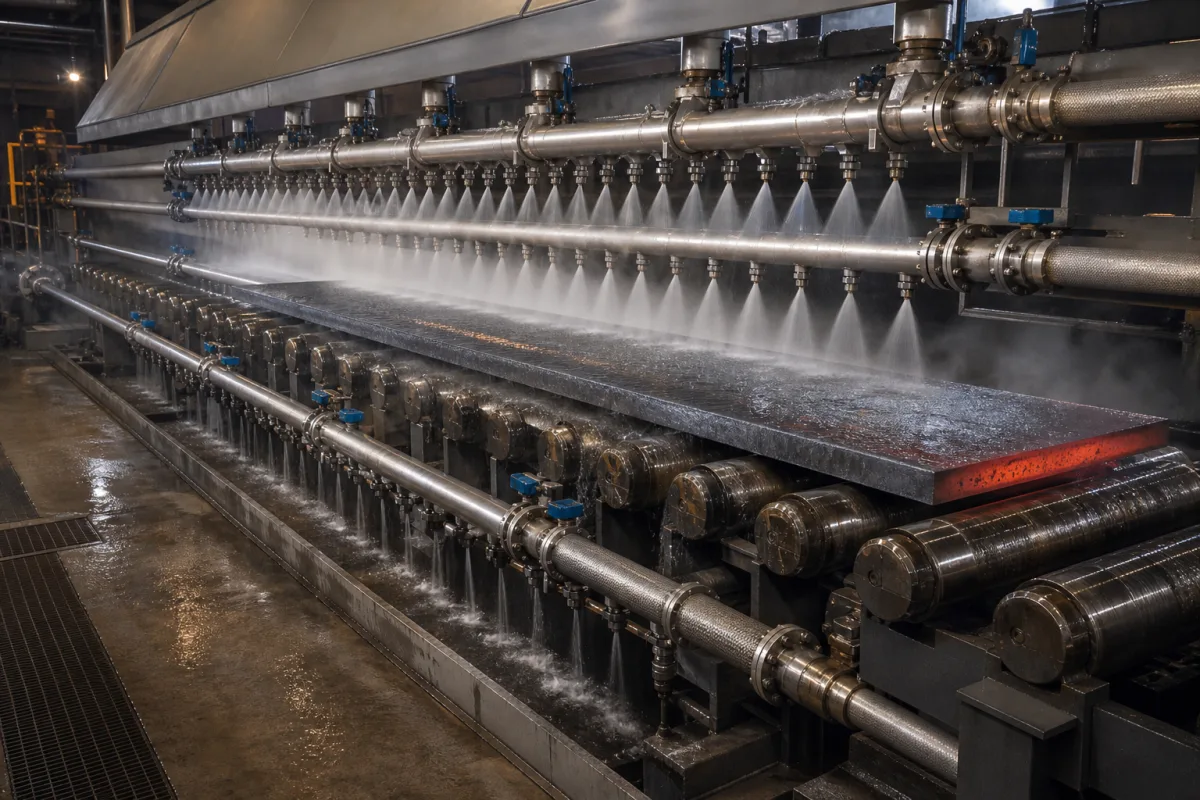
Representative product image. Confirm appearance and specifications with the manufacturer.

Product Specifications

Technical details and manufacturing context for Cooling Spray System

Definition
The Cooling Spray System is a critical component of run-out tables in metal processing lines, designed to apply controlled water or coolant sprays onto hot metal products (such as slabs, billets, or plates) to achieve precise temperature reduction, improve metallurgical properties, and prepare the material for subsequent handling or processing stages. The system operates by pumping coolant (typically water) through a network of pipes to strategically positioned spray nozzles or headers. These nozzles create uniform spray patterns that impinge on the hot metal surface, where heat transfer occurs through convection and evaporation, rapidly reducing the product's temperature according to preset cooling curves. This subsystem is typically used in basic metal manufacturing environments, where it must withstand high temperatures, thermal shock, and corrosive conditions. The materials on file include stainless steel, carbon steel, and copper alloys, which are selected for their durability and thermal conductivity. Key parameters that must be verified for a specific application include flow rate per spray header (50–200 L/min), operating pressure (1.0–1.6 MPa), spray angle (60–120°), nozzle count per header (20–80), cooling rate (10–50 °C/s), temperature range of cooling water (20–100 °C), water filtration level (50–200 μm), material grade (SS304 per ASTM A240), power consumption (5–15 kW), control voltage (24 V DC ±10% per IEC 61131-2), IP rating (IP54–IP65 per IEC 60529), and weight per header assembly (500–2000 kg). These values are directory reference ranges and must be confirmed with the legal manufacturer or supplier for the actual model and application. The system's performance is influenced by the specific metal product, line speed, and desired cooling curve. Proper integration requires consideration of the run-out table layout, coolant supply, and control system interfaces. Maintenance signals include reduced cooling uniformity, nozzle clogging, or pressure drops. Failure boundaries include operation outside the specified pressure range, which can lead to leakage, or operation with inadequate filtration, which can cause nozzle blockage. Always verify model-specific values and standards with the legal manufacturer or supplier.
Working Principle
The system operates by pumping coolant (typically water) through a network of pipes to strategically positioned spray nozzles or headers. These nozzles create uniform spray patterns that impinge on the hot metal surface, where heat transfer occurs through convection and evaporation, rapidly reducing the product's temperature according to preset cooling curves. The flow rate, pressure, and spray angle are controlled to achieve the desired cooling rate and uniformity. The system is designed to handle high-temperature environments and uses materials such as stainless steel, carbon steel, and copper alloys for durability. Proper filtration and pressure regulation are essential to prevent nozzle clogging and ensure consistent performance.
Common Materials
Stainless Steel, Carbon Steel, Copper Alloys
Technical Parameters
ParameterTypical rangeNotes & selection driver
Flow Rate50–200 L/minPer spray header; adjust for cooling rate
Spray Angle60–120 °Affects coverage and cooling uniformity
Nozzle Count20–80 pcsPer header; depends on strip width
Cooling Rate10–50 °C/sCritical for metallurgical properties
Temperature Range20–100 °CCooling water inlet temperature
Water Filtration50–200 μmPrevents nozzle clogging
MaterialSS304Corrosion resistant for water coolingASTM A240
Power Consumption5–15 kWFor pumps and control system
Control Voltage24 ±10% V DCFor solenoid valves and sensorsIEC 61131-2
IP RatingIP54–IP65Protection against water and dustIEC 60529
Weight500–2000 kgPer header assembly

Ranges are indicative industry figures for RFQ preparation, not a supplier commitment. Confirm every value and standard with the legal manufacturer before ordering.

Components / BOM
  • Spray Headers
    Distribute coolant to multiple spray nozzles in a linear arrangement
    Material: Stainless Steel
  • Spray Nozzles
    Create controlled spray patterns for uniform cooling coverage
    Material: Stainless Steel or Brass
  • Control Valves
    Regulate coolant flow to individual spray zones
    Material: Stainless Steel
  • Piping Network
    Transport coolant from supply to spray headers
    Material: Carbon Steel or Stainless Steel
  • Coolant Pump
    Pressurizes the coolant and pushes it to the spray headers.
  • Filtration Unit
    Keeps particulates out of the spray nozzles.

Applied To / Applications

This component is essential for the following industrial systems and equipment:

Industrial Ecosystem & Supply Chain Structure

Complementary Systems
Downstream Applications
Specialized Tooling

Application Fit & Sizing Matrix

Operational Limits
pressure: Up to 10 bar (system operating pressure)
flow rate: 5-500 L/min per nozzle (adjustable)
temperature: Ambient to 1200°C (hot metal surface temperature)
slurry concentration: Up to 15% solids by weight (for slurry cooling applications)
Media Compatibility
✓ Water-based cooling fluids ✓ Water-glycol mixtures ✓ Specialized metalworking emulsions
Unsuitable: Highly corrosive acidic environments (pH < 4)
Sizing Data Required
  • Required cooling capacity (kW)
  • Metal product dimensions and speed (mm/min)
  • Target temperature reduction (ΔT in °C)

Reliability & Engineering Risk Analysis

Failure Mode & Root Cause
Nozzle clogging
Cause: Accumulation of mineral deposits, debris, or biological growth in the spray nozzle orifice due to poor water quality, inadequate filtration, or infrequent cleaning.
Corrosion and pitting
Cause: Chemical attack from aggressive water chemistry (e.g., high chloride content, low pH), galvanic corrosion from dissimilar metals in the system, or exposure to corrosive process fluids or atmospheric conditions.
Maintenance Indicators
  • Irregular or uneven spray pattern (e.g., streaks, gaps, or misdirected spray) indicating partial clogging or nozzle wear.
  • Unusual hissing, whistling, or gurgling sounds from the spray head or supply lines, suggesting air entrainment, cavitation, or internal leakage.
Engineering Tips
  • Implement a regular preventive maintenance schedule for nozzle inspection, cleaning, and replacement, using filtered or treated water to minimize deposits and wear.
  • Select corrosion-resistant materials (e.g., stainless steel, plastics) for wetted parts, and apply protective coatings or cathodic protection where applicable, based on water chemistry analysis.

Indicative industry ranges for design and RFQ preparation. Confirm the exact figures and applicable standard with the manufacturer before specifying.

Compliance & Manufacturing Standards

Applicable Standards
ISO 1219-1:2012 (Fluid power systems and components) ANSI/ASME B31.3:2022 (Process piping) DIN EN 13480-3:2017 (Metallic industrial piping)

Quoted from the published standard.

Manufacturing Precision
  • Nozzle orifice diameter: +/-0.05mm
  • Spray pattern alignment: +/-2° angular deviation
Quality Inspection
  • Hydrostatic pressure test (1.5x max operating pressure)
  • Flow rate and distribution uniformity test

Manufacturers of Cooling Spray System

Manufacturer profiles associated with Cooling Spray System.

Sourcing Cooling Spray System from China?
Tell us your specification and target quantity — we will match it against manufacturer records and come back with the factories that fit.
Request manufacturers We manufacture this

Manufacturer listings support early research and capability understanding. They are not certification, ranking, or transaction guarantees.

Technical documentation
Request current drawings, revision history, and a signed specification sheet.
Manufacturing capability
Verify equipment lists, process limits, capacity, and representative production evidence.
Inspection readiness
Confirm test methods, calibrated equipment, sampling plans, and traceable reports.
Supplier transparency
Check the legal entity, factory address, ownership, certifications, and direct contacts.

CNFX does not score or rank suppliers. Buyers must verify all claims and documents with the legal manufacturer before ordering.

Supply Chain Compatible Machinery & Devices

Electroslag Remelting Furnace

An industrial furnace used in basic metal manufacturing for secondary refining of alloys through the electroslag remelting (ESR) process.

Explore Specs →
Molten Metal Temperature Measurement System

Automated system for continuous temperature monitoring of molten metals during processing.

Explore Specs →
Molten Metal Degassing System

The Molten Metal Degassing System is an industrial system used in basic metal manufacturing to remove dissolved hydrogen, oxygen, and nitrogen from molten aluminum, steel, and other non-ferrous metals.

Explore Specs →
Molten Metal Level Control System

Automated system for precise molten metal level monitoring and control in furnaces and vessels.

Explore Specs →

Frequently Asked Questions

What is the typical operating pressure range for the Cooling Spray System?

The operating pressure range is 1.0–1.6 MPa, as per the directory reference. Always verify the exact pressure requirements for your specific model and application with the manufacturer.

What materials are used in the construction of the Cooling Spray System?

The materials on file include stainless steel, carbon steel, and copper alloys. The material grade for water cooling is specified as SS304 per ASTM A240. Confirm the actual materials used for your specific system with the supplier.

How does the system achieve uniform cooling?

Uniform cooling is achieved through strategically positioned spray nozzles that create consistent spray patterns. The spray angle (60–120°) and nozzle count (20–80 per header) are selected to ensure coverage. The cooling rate (10–50 °C/s) is controlled via flow rate and pressure adjustments.

What maintenance signals indicate potential issues?

Signs of reduced cooling uniformity, nozzle clogging, or pressure drops indicate maintenance needs. Water filtration (50–200 μm) is critical to prevent clogging. If the system operates outside the specified pressure range, it may cause leakage. Regular inspection and verification with the manufacturer are recommended.

Data Basis

Editorial classification, named public sources where available, and source-reviewed manufacturer records.

Preliminary Technical Classification
This page supports structured research, RFQ preparation, and supplier evaluation. It does not replace buyer-led supplier qualification, standards review, or technical approval.
Buyer enquiry

Request manufacturing insight for Cooling Spray System

Ask for use case, specification boundaries, supplier type, and RFQ preparation information for this product.

Where it goes
Straight to the CNFX editorial desk, and to the manufacturer if this product is linked to a claimed profile. Nothing is broadcast to a supplier list.
Your details stay here
We do not sell or rent enquiry data, and we do not add you to a mailing list. Used only to answer this request.
No commission, no middleman
CNFX is a directory. We take no cut of any order and never negotiate on a supplier's behalf.
What we don't claim
A listing is not an endorsement. Qualify every supplier and verify every figure yourself before ordering.

Your business information is used only to process this request.

Thank you! Your message has been sent. We'll respond within 1–3 business days.
Sorry, we couldn't send your message. Please try again, or email us at contact@cnfx.com.

Need to Manufacture Cooling Spray System?

Compare manufacturer profiles with relevant product and process capability.

Previous Product
Work Rolls
Last Product
Get QuotesChat