Editorial Technical Reference

Slag Crushing System

This page explains how Slag Crushing System is classified within Basic Metal Manufacturing. Technical values and manufacturer relationships are research references; confirm the current specification and supplier evidence for each order.

Technical Definition & Core Assembly

A mechanical system designed to crush and reduce the size of slag produced during hot metal desulfurization for subsequent processing or disposal.
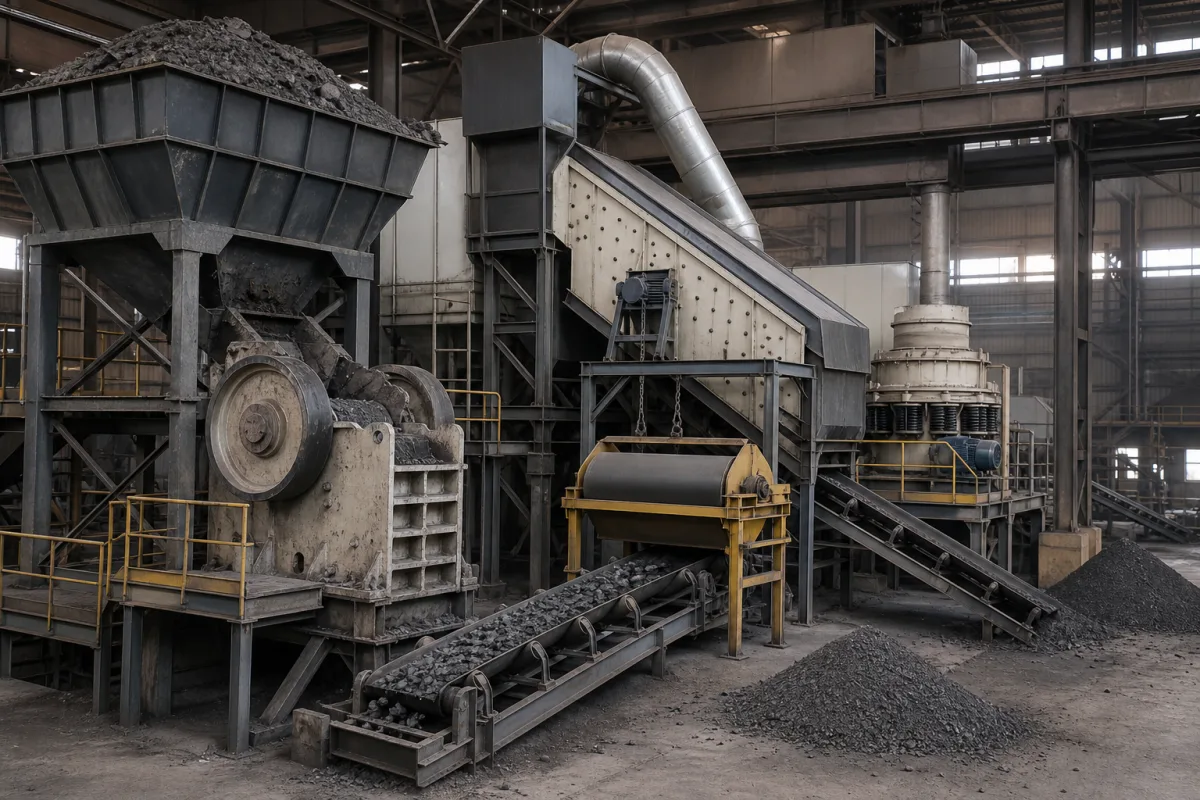
Slag Crushing System in a manufacturing environment
Representative product image. Confirm appearance and specifications with the manufacturer.

Product Specifications

Technical details and manufacturing context for Slag Crushing System

Definition
The Slag Crushing System is a component within an integrated hot metal desulfurization and slag treatment system. Its primary function is to receive solidified or semi-solidified slag from the desulfurization process and mechanically break it down into smaller, uniform particles. This size reduction facilitates efficient cooling, handling, transportation, and potential material recovery, such as metal reclamation or use as aggregate, thereby completing the slag treatment cycle and minimizing waste volume. The system typically employs crushers such as jaw crushers, impact crushers, or roll crushers to apply compressive or impact forces onto the incoming slag. Large chunks are fed into the crusher's chamber, where moving mechanical parts fracture the material against fixed surfaces or other moving parts. The crushed slag is discharged at a predetermined size, often controlled by adjustable gaps or grates. Key parameters include a crushing capacity of 5–20 t/h, feed size up to 300 mm, discharge size up to 25 mm, crushing ratio of 6–12, motor power of 15–45 kW, operating voltage of 380–690 V (IEC 60038), operating temperature of -20 to 50 °C, ingress protection of IP54–IP65 (IEC 60529), noise level up to 85 dB(A) at 1 m (ISO 3744), weight of 2–8 t, and dimensions varying by model. Materials used include high-chromium cast iron and manganese steel. These values are reference ranges and must be verified for the specific model and application. The system is designed for basic metal manufacturing environments. For procurement, confirm model-specific specifications and applicable standards with the legal manufacturer or supplier.
Working Principle
The system uses mechanical crushers, such as jaw, impact, or roll crushers, to apply compressive or impact forces to slag. Large slag chunks are fed into the crushing chamber, where moving parts fracture the material against fixed surfaces or other moving parts. The crushed slag exits at a controlled size, typically set by adjustable gaps or grates. The process reduces slag volume and prepares it for further treatment or disposal.
Common Materials
High-Chromium Cast Iron, Manganese Steel
Technical Parameters
ParameterTypical rangeNotes & selection driver
Crushing Capacity5–20 t/hDepends on slag hardness and feed size
Feed Size≤300 mmMaximum lump size for efficient crushing
Discharge Size≤25 mmAdjustable via crusher settings
Crushing Ratio6–12Ratio of feed to discharge size
Motor Power15–45 kWDepends on capacity and hardness
Operating Voltage380–690 VThree-phase AC, 50/60 HzIEC 60038
Operating Temperature-20–50 °CFor ambient conditions
Ingress ProtectionIP54–IP65For motor and electrical enclosuresIEC 60529
Noise Level≤85 dB(A)At 1 m distance, under loadISO 3744
Weight2–8 tDepends on configuration
Dimensions (L×W×H)2000–4000×1500–2500×1500–3000 mmVaries with model

Ranges are indicative industry figures for RFQ preparation, not a supplier commitment. Confirm every value and standard with the legal manufacturer before ordering.

Components / BOM
  • Feed Hopper
    Receives and channels incoming slag into the crusher uniformly.
    Material: Abrasion-Resistant Steel Plate
  • Primary Crusher
    Applies initial mechanical force to break large slag chunks into smaller pieces.
    Material: High-Chromium Cast Iron / Manganese Steel Castings
  • Discharge Conveyor
    Transports the crushed slag away from the crusher for further handling.
    Material: Steel (Frame), Rubber (Belt)
  • Drive System
    Provides mechanical power (via motor, gearbox, etc.) to operate the crusher.
    Material: Steel, Cast Iron, Copper (Windings)
  • Adjustable Grate
    Sets the discharge opening, which is what decides the crushed slag size.

Application & selection

Application Fit & Sizing Matrix

Operational Limits
pressure: Atmospheric to 1 bar gauge (non-pressurized system)
flow rate: 5-100 tons/hour (slag throughput)
temperature: Ambient to 150°C (post-cooling typical)
slurry concentration: Up to 70% solids by weight (water-cooled slag slurry)
Media Compatibility
✓ Hot metal desulfurization slag (CaO-based) ✓ Granulated blast furnace slag ✓ Steelmaking slag (basic oxygen furnace)
Unsuitable: Highly abrasive materials without pre-screening (e.g., tramp metal, refractory debris)
Sizing Data Required
  • Slag production rate (tons/hour)
  • Required output particle size (mm)
  • Slag initial temperature and cooling method

Risk, maintenance & compliance

Reliability & Engineering Risk Analysis

Failure Mode & Root Cause
Abrasive wear on crushing surfaces
Cause: Continuous impact and grinding of hard slag particles causes progressive material loss on hammers, liners, and anvils, leading to reduced crushing efficiency and eventual failure.
Bearing fatigue and overheating
Cause: High cyclic loading from uneven slag feed and vibration, combined with inadequate lubrication or contamination from slag dust, leads to premature bearing failure and potential seizure.
Maintenance Indicators
  • Unusual metallic grinding or knocking sounds during operation indicating worn components or loose parts
  • Visible excessive vibration or irregular motion of the crusher housing suggesting imbalance or mechanical wear
Engineering Tips
  • Implement regular hardness testing and rotational replacement of wear parts (hammers/liners) to distribute wear evenly and maintain crushing efficiency
  • Establish a strict lubrication schedule with high-temperature, contamination-resistant grease, and install bearing temperature sensors for early failure detection

Indicative industry ranges for design and RFQ preparation. Confirm the exact figures and applicable standard with the manufacturer before specifying.

Compliance & Manufacturing Standards

Applicable Standards
ISO 21873-1:2015 (Building construction machinery and equipment - Mobile crushers) DIN 22101:2011 (Continuous conveyors - Belt conveyors for loose bulk materials)

Quoted from the published standard.

Manufacturing Precision
  • Shaft alignment: +/-0.05mm
  • Crusher jaw plate flatness: 0.2mm
Quality Inspection
  • Ultrasonic thickness testing for wear plates
  • Hardness testing (Rockwell C) for crusher components
Technical documentation
Request current drawings, revision history, and a signed specification sheet.
Manufacturing capability
Verify equipment lists, process limits, capacity, and representative production evidence.
Inspection readiness
Confirm test methods, calibrated equipment, sampling plans, and traceable reports.
Supplier transparency
Check the legal entity, factory address, ownership, certifications, and direct contacts.

Compare the published product scope and source details, then include your specifications and quantity in an enquiry.

Manufacturers of Slag Crushing System

Manufacturer profiles associated with Slag Crushing System.

Sourcing Slag Crushing System from China?
Tell us your specification and target quantity — we will match it against manufacturer records and come back with the factories that fit.
Request manufacturers We manufacture this

Explore company information and manufacturing capabilities, then discuss the scope of your project with a relevant supplier.

Buyer enquiry

Request manufacturing insight for Slag Crushing System

Ask for use case, specification boundaries, supplier type, and RFQ preparation information for this product.

Where it goes
Straight to the CNFX editorial desk, and to the manufacturer if this product is linked to a claimed profile. Nothing is broadcast to a supplier list.
Your details stay here
We do not sell or rent enquiry data, and we do not add you to a mailing list. Used only to answer this request.
No commission, no middleman
CNFX is a directory. We take no cut of any order and never negotiate on a supplier's behalf.
What to include
Share your product specifications, quantity, destination and target delivery date.

Your business information is used only to process this request.

Thank you! Your message has been sent. We'll respond within 1–3 business days.
Sorry, we couldn't send your message. Please try again, or email us at [email protected].

Frequently Asked Questions

What is the typical crushing capacity of this system?

The reference range is 5–20 t/h, depending on slag hardness and feed size. Confirm the exact capacity for your specific model and application with the manufacturer.

What materials are used in the crusher components?

High-chromium cast iron and manganese steel are listed as materials on file. These are common wear-resistant materials, but verify the actual materials for your unit.

What standards apply to the electrical and noise specifications?

Operating voltage references IEC 60038, ingress protection references IEC 60529, and noise level references ISO 3744. These are reference standards; confirm compliance for your specific model.

How is the discharge size controlled?

Discharge size is adjustable via crusher settings, such as gaps or grates, and is typically up to 25 mm. The exact adjustment mechanism depends on the crusher type.

Related equipment

Industrial Ecosystem & Supply Chain Structure

Data Basis

Editorial classification, named public sources where available, and source-reviewed manufacturer records.

Preliminary Technical Classification
This page supports structured research, RFQ preparation, and supplier evaluation. It does not replace buyer-led supplier qualification, standards review, or technical approval.

Need to Manufacture Slag Crushing System?

Compare manufacturer profiles with relevant product and process capability.

Previous Product
Work Rolls
Last Product
Get QuotesChat