Position transducer for rolling mill hydraulic cylinders: mounting it inside or outside the cylinder, and what resolution and linearity really give the gap control
Position transducers on rolling mill hydraulic cylinders · Inside the cylinder for a direct reading and shelter from hot scale, or outside it on brackets; magnetostrictive rods through the piston rod, SSI at 25 bits, 0.5 µm resolution and 500 µs sampling against 0.01% FS linearity
This page covers linear position transducers on the hydraulic cylinders that set and hold the roll gap in hot and cold rolling stands: magnetostrictive rods inside the cylinder bore, and rod-type transducers mounted outside it on brackets. Ask three things first: whether the transducer will sit inside the cylinder or outside it, and how it is protected from heat, scale and strip breaks; what resolution, update time and interface the gap control needs; and how linearity and temperature limit the absolute accuracy.
Linear position transducers on rolling mill screwdown, gap control and bending cylinders, their mounting, protection and signal. Complete hydraulic gap control systems, with their control loops and redundant inside-and-outside transducer arrangement, are covered on the Heavy-duty rolling mill hydraulic gap control system page, and the replaceable head electronics of magnetostrictive sensors on the Sensor head electronics module page. Roll gap gauges on the strip, thickness gauges and rotary encoders on screwdown motors are outside this page.
CNFX editorial research · Sources checked October 12, 2026 · 3 sources
Inside the cylinder for a direct reading and shelter; outside it, exposed to the stand
Gefran describes a hot rolling stand in which billets heated to 1,150–1,220 °C pass through rolls held by four hydraulic cylinders, at least one of each pair under precise position control with the fastest possible update; its WRA-S magnetostrictive transducers are installed inside the hydraulic cylinders both for a direct reading with no intermediate mechanical gap and to protect them better from incandescent burrs. [1] An SMS Demag patent explains that measuring the gap with tongs next to the roll barrels left the device open to damage from strip wander or strip breaks and needed much maintenance, and instead places a magnetostrictive transducer in the work roll bending cylinder: the sensor rod penetrates the cylinder liner and runs through a bore in the piston rod, with the magnet in a central cavity of the piston, giving an indirect reference measurement of the roll gap. [3]
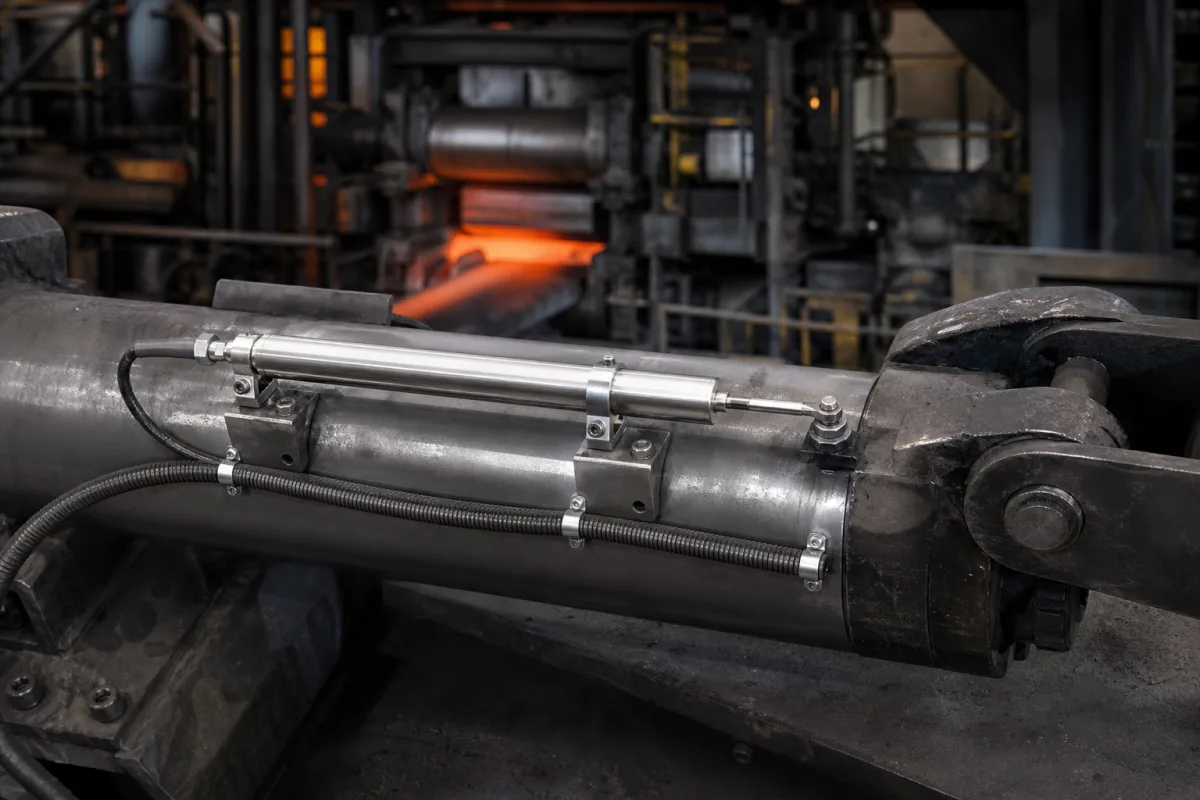
Temposonics' R-Series, as listed in the PROFIBUS product guide, offers both routes: the RH high-pressure rod model for installation in hydraulic cylinders, the RP profile model for external mounting, and the RF with a flexible measuring pipe for ranges up to 20 m. [2] Editorial note: a rod-type transducer clamped outside the cylinder, as in the illustration, is easier to fit and change but carries its rod, joint and cable in the stand environment; ask the supplier for its heat shielding, cable protection and the rod joint's play, since any play adds directly to the position error.
Give the supplier the cylinder type (screwdown, gap control, bending), stroke and bore, rod and piston drawings, internal or external mounting, the temperature at the cylinder surface, scale and water exposure, the interface to the gap controller, and the required update rate.
02
Resolution and update time against linearity: what the gap control actually receives
Gefran gives the WRA-S a working temperature up to 90 °C, resolution up to 0.5 µm, sampling time of 500 µs and linearity error of 0.01% FS, with SSI output in 25-bit Gray code wired directly to the PLC without a fieldbus; the installation it describes used a 550 mm stroke. Its overview states a resolution of 0.05 µm for that installation, while its product data and solution text give 0.5 µm. [1]
Editorial calculation: 0.01% of a 550 mm stroke is 55 µm of linearity error, a hundred times the 0.5 µm resolution, while 25 bits over 550 mm would step about 0.016 µm per count. For gap control, resolution and repeatability matter for holding and correcting the gap; absolute gap accuracy still depends on calibrating the zero against the rolls. [1] Temposonics' R-Series with PROFIBUS DP output is listed with a minimum resolution of 1 µm and linearity better than 0.01% of full stroke, and can read up to 30 magnets on one sensor. [2]
The SMS Demag patent adds that the reference values from the bending cylinder transducers can be used both to position the bending cylinders and as input to the hydraulic roll adjustment system, with one transducer per bending cylinder to raise the accuracy of the gap control. [3]
Item
Gefran WRA-S (hot rolling mill)
Resolution
Up to 0.5 µm in data; 0.05 µm in the case summary. [1]
Compare rolling mill position transducer suppliers
1 company lists this product among what they make. Company figures are quoted from each
company's own website; every card states where the relationship came from.
Shanghai Ziasiot Technology
Manufacturing site to be confirmed for the order
Lists linear position sensors alongside its pressure, level and temperature transmitters.
Explore company information and manufacturing capabilities, then discuss the scope of your project with a relevant supplier.
Share this page
Compiled and source-reviewed by the CNFX editorial team.
Each manufacturer above links to the page on that company's own website where the product is listed, with the date we checked it. How we source and review
· Page last updated 13 October 2026
Buyer questions
Why fit the position transducer inside a rolling mill cylinder?
Gefran installs its transducers in the cylinders for a direct reading with no intermediate mechanical gap and to protect them from incandescent burrs. [1]
What resolution do rolling mill cylinder transducers reach?
Gefran lists its WRA-S at up to 0.5 µm with 500 µs sampling and 25-bit SSI; its case summary also states 0.05 µm. [1]
How can a magnetostrictive sensor be built into a bending cylinder?
An SMS Demag patent runs the sensor rod through a bore in the piston rod, with the magnet in a central cavity of the piston. [3]
Sources and what still needs a direct check
Sources checked 2026-10-12. Gefran describes its own hot-mill installation; the PROFIBUS product guide lists Temposonics' R-Series; an SMS Demag patent describes transducers in bending cylinders; Ziasiot lists its sensors.