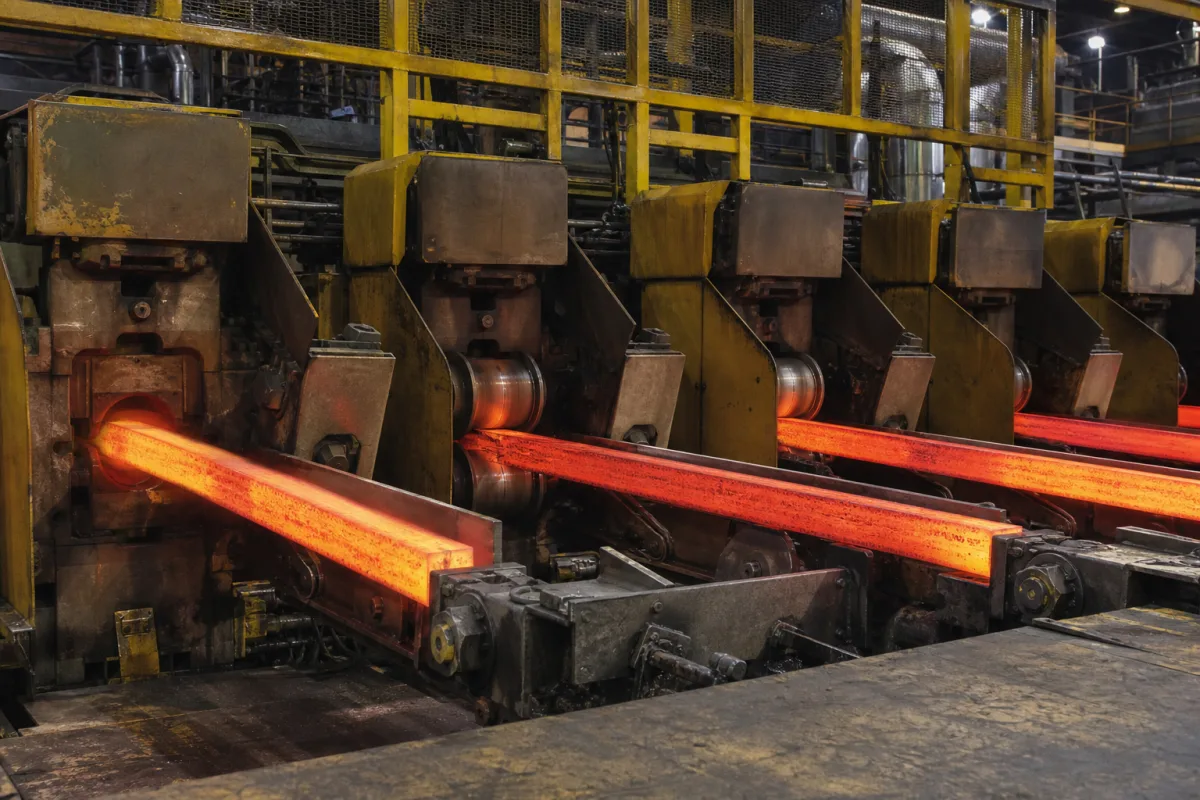
Withdrawal unit as a soft-reduction stand: using billet and bloom withdrawal rolls to squeeze the strand near final solidification against centre segregation
Billet and bloom casters · withdrawal pinch-roll stands used to squeeze the strand near the end of solidification: solid fraction at the rolls, reduction rate in mm/m, roll diameter and stand force
The withdrawal unit of a billet or bloom caster is the row of driven pinch-roll stands that pulls the strand out of the machine. Because these stands already have heavy rolls and hydraulic cylinders bearing on the strand, they can also be set to squeeze it by a few millimetres at the point where its centre is finishing solidification. That squeeze, called mechanical soft reduction, compensates for solidification shrinkage and stops enriched liquid being drawn to the centreline, where it would freeze as centre segregation. Whether it works depends on where the stands sit relative to the end of the liquid core, how fast they reduce and how large their rolls are.
Withdrawal (pinch-roll) stands and withdrawal-straightening units of billet and bloom casters used for mechanical soft or hard reduction: their position against the solidification end, reduction amount and rate, roll diameter, stand force and control, compared with dedicated reduction segments. Withdrawal force, dummy-bar handling and straightening strain on curved casters are covered on the Withdrawal and straightening unit of a billet caster page; roller segments of the strand guide, including servo-adjusted soft-reduction segments, on the Strand guide system for continuous casters page; intermittent pull–pause withdrawal of horizontal and upward casters on the Automated extraction mechanism page; complete casters, including soft reduction as an item of caster scope, on the Billet continuous caster page; mould oscillation, secondary cooling, cut-off and run-out tables have their own pages.
CNFX editorial research · Sources checked October 13, 2026 · 4 sources
Squeeze where the centre is between 0.2 and 0.9 solid, not earlier
Saarstahl's Thome and Harste, in ISIJ International (2006), cite earlier bloom work in which the best results came with a centre solid fraction of 0.2 to 0.9, 0.2 to 0.75 or 0.37 to 0.51 in the reduction zone, a reduction of 4 to 30 mm and reduction rates of 1.8 to 6.6 mm/m. They add that success depends on knowing exactly where the crater end lies for the grade and casting conditions and controlling the thickness reduction with great precision. [1]
Their own trials ran on a 6-strand bow caster of 10.5 m radius casting 150 mm square billets of high-carbon wire grade C72D and spring steel 54SiCr6 at 2.8 to 3.6 m/min, with reductions of 2.8 to 11 mm. Reducing C72D with three withdrawal rolls at 2.8 to 3.5 m/min gave 10 to 11 mm of reduction at 2.4 to 3.1 mm/m. At 3.5 m/min the centre was only 0.1 to 0.3 solid when it passed the rolls: centre segregation fell, but squeezing that much liquid core produced severe internal cracks at the solidification front, with segregation peaks along the cracks that showed up in the rolled 5.5 mm wire. [1]
The authors conclude that useful results came at centre solid fractions of 0.2 to 0.9 for the high-carbon steel and 0.4 to 0.8 for the spring steel, and that because square billets pass little of the surface reduction to the core, 7 to 10 mm of reduction is needed. [1] A later Saarstahl paper in Chernye Metally (2012) reports that the method markedly improves centre segregation and porosity in 150 mm × 150 mm billets of steels with 0.3 to 1.0 % carbon. [2]
Ask the caster supplier which stands can apply reduction, at what distance from the meniscus, and how the control system places the solidification end for each grade and speed (online model or fixed tables).
02
450 mm withdrawal rolls against 300 mm segment rolls: reduction rate and roll size
Thome and Harste compared reduction by withdrawal rolls No. 2 and No. 3, each 450 mm in diameter and 1.20 m apart, with two added segments behind the withdrawal-straightening unit, each holding three pairs of 300 mm rolls at 330 mm spacing and two cylinders of up to 450 kN. [1]
The paper gives the efficiency of soft reduction in billet casting, the share of surface reduction that reaches the liquid core, as only 7 to 34 %, against 25 to 60 % for other formats, and concludes that 450 mm rolls are more effective than 300 mm rolls for the same reduction and start fewer internal cracks. Its stated minimum is 3.9 mm/m for a two-roll unit with 450 mm rolls, with about 5.5 mm/m giving billets free of V-segregation under its test conditions. [1]
Editorial calculation: reduction rate in mm/min is the rate in mm/m multiplied by casting speed, so 3.69 mm/m at 3.5 m/min gives about 12.9 mm/min, matching the paper. At the stated efficiency of 7 to 34 %, a 10 mm surface reduction of a billet would move the solid–liquid interface by about 0.7 to 3.4 mm. [1]
On the S0 caster built from these results, a 6-strand bow machine of 11 m radius casting 150 and 180 mm squares at up to 4 and 3 m/min, each strand's reduction unit has six segments of two 450 mm roll pairs, each pair set by two cylinders of up to 600 kN under force or position control, over a withdrawal-straightening length of about 8 m. [1]
For a reduction-capable withdrawal unit, ask for the roll diameter, the maximum force per stand and how it is applied (force or position control), the reduction range per stand, and the roll pitch.
03
Bloom casters: heavier withdrawal stands and separate soft and hard reduction
AIST reported that Primetals Technologies will upgrade a 5-strand bloom caster in eastern China with a withdrawal straightening unit and two additional pinch rolls, raising reduction force to 200 metric tons from 130, together with its DynaGap Soft Reduction 3D control, for about 1.2 million metric tons a year. [3] In 2019 AIST reported that Danieli's 14 m, 5-strand bloom caster at Valin Xiangtan, casting 280 × 280 and 350 × 430 mm sections, was described by its supplier as the first to use different withdrawal units for simultaneous soft and hard reduction. [4]
Editorial calculation: 200 metric tons-force is about 200,000 kg × 9.81 m/s² ≈ 1,960 kN, and 130 t about 1,275 kN; the report does not say whether the figure is per stand or per cylinder pair. [3]
04
What to give a caster supplier for a reduction-capable withdrawal unit
Paste it into your enquiry below or into an email to a maker, then replace every bracket.
Caster: [strands; radius; sections; casting speed range]
Grades: [carbon range; crack-sensitive grades]
Target: [centre segregation or porosity limit; test method]
Stands: [number able to reduce; position from meniscus]
Rolls: [diameter; pitch]
Force: [per stand; force or position control]
Model: [online solidification model; how the crater end is set]
Explore company information and manufacturing capabilities, then discuss the scope of your project with a relevant supplier.
Share this page
Compiled and source-reviewed by the CNFX editorial team.
Each manufacturer above links to the page on that company's own website where the product is listed, with the date we checked it. How we source and review
· Page last updated 13 October 2026
Buyer questions
Can withdrawal rolls do soft reduction?
Yes; Saarstahl's billet trials reduced the strand with 450 mm withdrawal rolls and found them more effective than 300 mm segment rolls for the same reduction. [1]
What reduction rate suppresses V-segregation in billets?
Saarstahl found a minimum of 3.9 mm/m for a two-roll unit with 450 mm rolls, with about 5.5 mm/m giving billets free of V-segregation under its test conditions. [1]
Why reduce billets by 7 to 10 mm?
Only 7 to 34 % of the surface reduction of a square billet reaches the liquid core, so Saarstahl concludes that 7 to 10 mm is needed. [1]
How strong are bloom caster withdrawal units?
AIST reported a Primetals upgrade raising withdrawal-straightening reduction force to 200 metric tons from 130. [3]
Sources and what still needs a direct check
Sources checked 2026-10-13. Saarstahl's billet soft-reduction trials published in ISIJ International and its later report in Chernye Metally, and two AIST news reports on bloom caster withdrawal units from Primetals Technologies and Danieli.