Editorial Technical Reference

Automated Beverage Container Pressure Testing System

This page explains how Automated Beverage Container Pressure Testing System is classified within Beverage Manufacturing. Technical values and manufacturer relationships are research references; confirm the current specification and supplier evidence for each order.

Technical Definition & Core Assembly

Automated system for testing beverage container pressure resistance and seal integrity.
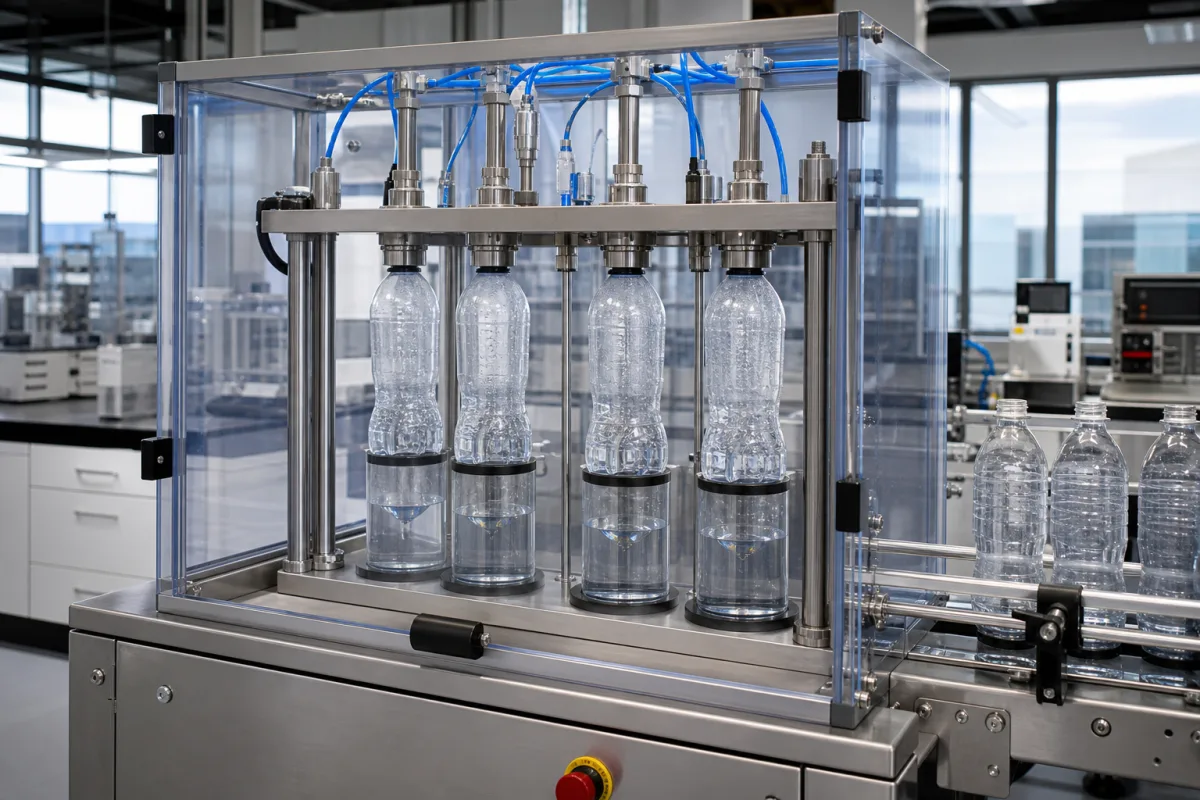
Representative product image. Confirm appearance and specifications with the manufacturer.

Product Specifications

Technical details and manufacturing context for Automated Beverage Container Pressure Testing System

Definition
The Automated Beverage Container Pressure Testing System is an industrial automation solution for verifying the pressure resistance and seal integrity of filled beverage containers, including bottles, cans, and pouches. It applies controlled internal pressure to containers and measures for leaks, deformation, or failure. This system ensures product safety, prevents spoilage, and maintains carbonation levels by identifying defective containers before packaging and distribution. It integrates with existing production lines for inline quality control.

The system is designed for the beverage manufacturing industry and operates as a standalone unit or integrated into a production line. It accommodates containers with heights or diameters ranging from 50 to 3000 mm, making it suitable for a wide variety of packaging formats. The test pressure range is 0.1 to 2.5 bar, with a pressure hold time adjustable from 5 to 60 seconds. The system can achieve a maximum throughput of 1200 containers per hour, with a cycle time of 3 to 10 seconds including pressurization and hold. Leak detection sensitivity is as low as 0.1 mbar/s, and pressure measurement accuracy is ±0.5% of full scale (FS) per IEC 60770.

Constructed with a stainless steel frame, food-grade silicone seals, and aluminum actuators, the system is built for hygiene and durability in food environments. It is controlled by a PLC (Programmable Logic Controller) and uses pressure sensors to monitor and regulate test parameters. The system operates on a three-phase power supply of 220–480 V AC (50/60 Hz) and is designed for non-condensing environments with an operating temperature range of 10–40 °C. The enclosure rating is IP54 to IP65, providing protection against dust and water spray. The machine weight ranges from 1500 to 2500 kg, and its approximate footprint is 3000×1500×2000 mm (L×W×H).

All technical parameters are provided as reference ranges and must be verified with the legal manufacturer or supplier for the specific model and application. Standards such as IEC 60770, IEC 60204, and IEC 60529 are listed as procurement references and do not imply certification or compliance of any particular unit.
Working Principle
The system clamps a container securely, seals it, and injects air to a preset pressure within the range of 0.1 to 2.5 bar. The pressure is held for a set duration (5–60 seconds) while sensors monitor pressure decay and container deformation. If the pressure drop exceeds the leak detection sensitivity of 0.1 mbar/s, or if deformation indicates structural weakness, the container is flagged as defective. The system then releases the pressure and removes the container, either automatically or for manual inspection. This process ensures that only containers meeting pressure and seal integrity standards proceed to packaging.
Common Materials
stainless steel frame, food-grade silicone seals, aluminum actuators, PLC controller, pressure sensors
Technical Parameters
ParameterTypical rangeNotes & selection driver
Test Pressure RangeRequired0.1–2.5 barRange of pressures the system can applyISO 5208
Maximum ThroughputRequired1200 units/hourMaximum containers tested per hour
Pressure Hold TimeRequired5–60 secondsTime pressure is maintained during test
Container Size RangeRequired50–3000 mmRange of container heights/diameters accommodated
Leak Detection Sensitivity0.1 mbar/sMinimum detectable pressure decay rate
Pressure Measurement Accuracy±0.5 % FSFull scale of selected sensorIEC 60770
Cycle Time3–10 sIncluding pressurization and hold
Power Supply220–480 V ACThree-phase, 50/60 HzIEC 60204
Operating Temperature10–40 °CNon-condensing environment
Enclosure RatingIP54–IP65Dust and water spray protectionIEC 60529
Machine Weight1500–2500 kgDepending on configuration
Footprint (L×W×H)3000×1500×2000 mmApproximate dimensions

Ranges are indicative industry figures for RFQ preparation, not a supplier commitment. Confirm every value and standard with the legal manufacturer before ordering.

Components / BOM
  • Loading Conveyor
    Transports containers into testing station
    Material: Stainless steel
  • Test Chamber
    Encloses container during pressure application
    Material: Stainless steel
  • Sealing Head
    Creates airtight seal on container opening
    Material: Food-grade silicone
  • Pressure Regulator
    Controls and applies precise air pressure
    Material: Brass
  • Pressure Sensor Part
    Monitors pressure inside container during test
    Material: Stainless steel
  • PLC Controller
    Automates test sequence and records results
    Material: Electronic components
  • Rejection Mechanism
    Removes failed containers from production line
    Material: Aluminum
  • HMI Interface Optional
    Allows operator to set parameters and view results
    Material: Touchscreen display

Industry Taxonomies & Aliases

Commonly used trade names and technical identifiers for Automated Beverage Container Pressure Testing System.

Industrial Ecosystem & Supply Chain Structure

Complementary Systems
Downstream Applications
Specialized Tooling

Application Fit & Sizing Matrix

Operational Limits
pressure: 0 to 150 psi (test pressure range)
other spec: Container size: 100ml to 2L, Cycle time: 15-60 seconds per test, Accuracy: ±0.5% FS
temperature: 5°C to 40°C (ambient operation range)
Media Compatibility
✓ Carbonated beverages (CO2 pressurized) ✓ Nitrogen-infused drinks ✓ Aseptic liquid packaging
Unsuitable: Highly corrosive chemicals or abrasive slurries
Sizing Data Required
  • Maximum container diameter and height
  • Required test pressure range and accuracy
  • Production throughput (tests per hour)

Reliability & Engineering Risk Analysis

Failure Mode & Root Cause
Pressure Transducer Drift
Cause: Exposure to moisture, thermal cycling, or mechanical vibration leading to calibration loss and inaccurate pressure readings.
Seal Degradation
Cause: Chemical incompatibility with beverage residues, repeated compression cycles, or improper installation causing leaks and pressure loss.
Maintenance Indicators
  • Audible hissing or whistling during pressure cycles indicating seal failure or air leaks.
  • Visual fluid accumulation or corrosion around fittings, seals, or pressure chambers.
Engineering Tips
  • Implement a regular calibration schedule for pressure sensors using traceable standards to maintain measurement accuracy.
  • Use compatible sealing materials (e.g., FDA-approved elastomers) and establish preventive replacement intervals based on cycle counts.

Indicative industry ranges for design and RFQ preparation. Confirm the exact figures and applicable standard with the manufacturer before specifying.

Compliance & Manufacturing Standards

Applicable Standards
ASME B31.3 — Process piping Pressure Equipment Directive (PED) 2014/68/EU

Quoted from the published standard.

Manufacturing Precision
  • Pressure sensor accuracy: +/- 0.25% of full scale
  • Seal surface flatness: 0.05mm across mating surfaces
Quality Inspection
  • Pressure sensor calibration against a traceable reference
  • Burst and leak test of the test fixture

Manufacturers of Automated Beverage Container Pressure Testing System

Manufacturer profiles associated with Automated Beverage Container Pressure Testing System.

Sourcing Automated Beverage Container Pressure Testing System from China?
Tell us your specification and target quantity — we will match it against manufacturer records and come back with the factories that fit.
Request manufacturers We manufacture this

Manufacturer listings support early research and capability understanding. They are not certification, ranking, or transaction guarantees.

Technical documentation
Request current drawings, revision history, and a signed specification sheet.
Manufacturing capability
Verify equipment lists, process limits, capacity, and representative production evidence.
Inspection readiness
Confirm test methods, calibrated equipment, sampling plans, and traceable reports.
Supplier transparency
Check the legal entity, factory address, ownership, certifications, and direct contacts.

CNFX does not score or rank suppliers. Buyers must verify all claims and documents with the legal manufacturer before ordering.

Supply Chain Commonly Integrated Components

Human-Machine Interface (HMI)

A hardware and software interface that allows human operators to monitor, control, and interact with the automated beverage blending system.

Explore Specs →
Chemical Dosing System

A precision-controlled system that accurately meters and injects sterilizing chemicals into beverage containers during the sterilization process.

Explore Specs →
Infeed/Outfeed Conveyor Section

A conveyor section that handles the automated loading and unloading of beverage containers into and out of an integrity testing system.

Explore Specs →
Container Infeed Starwheel

A rotating star-shaped wheel that precisely positions and feeds containers into a high-speed rotary bottle filling machine.

Explore Specs →

Frequently Asked Questions

What types of containers can be tested?

The system accommodates bottles, cans, and pouches with heights or diameters ranging from 50 to 3000 mm. The actual range depends on the specific configuration and must be confirmed with the supplier.

What is the maximum throughput?

The maximum throughput is 1200 containers per hour, with a cycle time of 3 to 10 seconds including pressurization and hold. Actual throughput may vary based on container size and test parameters.

How does the system detect leaks?

The system applies a preset pressure and monitors pressure decay over a hold time. If the decay rate exceeds 0.1 mbar/s, the container is considered leaking. Pressure measurement accuracy is ±0.5% FS.

What standards are referenced?

The system references IEC 60770 for pressure transmitters, IEC 60204 for electrical safety, and IEC 60529 for enclosure ratings. These are procurement references; compliance must be verified with the manufacturer.

Data Basis

Editorial classification, named public sources where available, and source-reviewed manufacturer records.

Preliminary Technical Classification
This page supports structured research, RFQ preparation, and supplier evaluation. It does not replace buyer-led supplier qualification, standards review, or technical approval.
Buyer enquiry

Request manufacturing insight for Automated Beverage Container Pressure Testing System

Ask for use case, specification boundaries, supplier type, and RFQ preparation information for this product.

Where it goes
Straight to the CNFX editorial desk, and to the manufacturer if this product is linked to a claimed profile. Nothing is broadcast to a supplier list.
Your details stay here
We do not sell or rent enquiry data, and we do not add you to a mailing list. Used only to answer this request.
No commission, no middleman
CNFX is a directory. We take no cut of any order and never negotiate on a supplier's behalf.
What we don't claim
A listing is not an endorsement. Qualify every supplier and verify every figure yourself before ordering.

Your business information is used only to process this request.

Thank you! Your message has been sent. We'll respond within 1–3 business days.
Sorry, we couldn't send your message. Please try again, or email us at contact@cnfx.com.

Need to Manufacture Automated Beverage Container Pressure Testing System?

Compare manufacturer profiles with relevant product and process capability.

Previous Product
Automated Beverage Container Leak Detection System
Next Product
Bottle Conveyor
Get QuotesChat