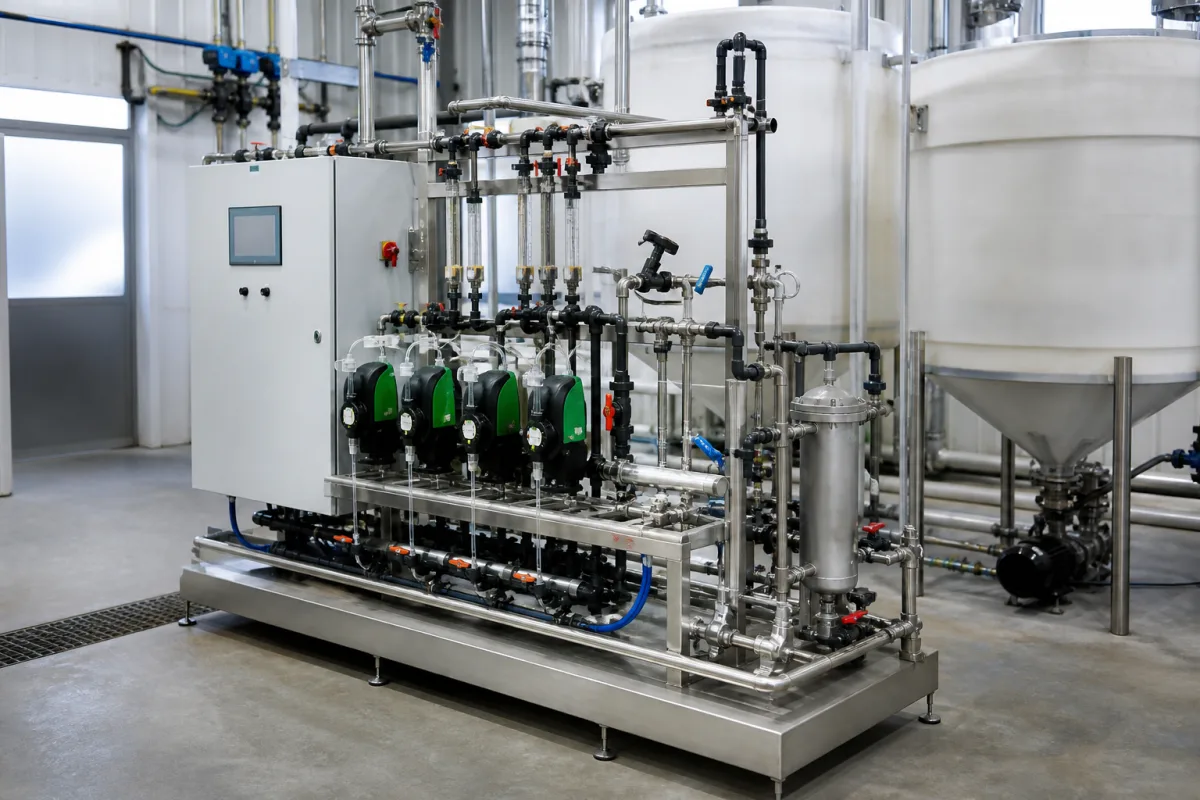
Liquid fertiliser injection system (fertigation injector)
Fertigation injectors that dose liquid fertiliser into irrigation water · positive-displacement piston and diaphragm pumps, centrifugal, peristaltic and gear pumps, proportional mixers, pressurised tanks and venturi injectors compared on precision and calibration, plus injection-rate calculation and anti-siphon and backflow safety requirements
A fertiliser injection system takes liquid fertiliser from a supply tank and injects it into a pressurised irrigation line, either at a set concentration or as a bulk volume. Ask three things first: whether you need a steady concentration or only a total dose, what irrigation flow and pressure the injector must work against, and which backflow and anti-siphon devices your water source and local rules require.
Injection pumps, proportional mixers, pressurised mixing tanks and venturi injectors used to dose liquid fertiliser (and other chemicals) into irrigation systems, with their safety devices. pH dosing systems for process water and reagent injection systems in industrial plants have their own pages.
CNFX editorial research · Sources checked October 12, 2026 · 4 sources
A University of Florida IFAS Extension circular groups chemical injection methods for irrigation into centrifugal pumps, positive-displacement pumps, pressure-differential methods and venturi injectors. It explains that a positive-displacement pump moves a constant volume per stroke. Piston, fluid-filled diaphragm and piston/diaphragm pumps come closest to the ideal, giving a constant flow independent of discharge pressure. In a mechanically driven diaphragm pump the displacement can change if internal parts deform under pressure. [1]
Its comparison table lists piston and piston/diaphragm pumps as high precision with linear calibration independent of pressure, at high cost, and calibration may require stopping. Diaphragm pumps can be adjusted while injecting and have high chemical resistance, but calibration is non-linear and depends on system pressure. Peristaltic pumps have high chemical resistance and short tube life. Discharge-line proportional mixers control injection rates accurately but need a pressure differential and frequent refills. Pressurised mixing tanks control the total volume but not a constant rate. Venturi injectors are low-cost, water-powered and have no moving parts, but create pressure drops, and their calibration depends on the chemical level in the tank. A suction-line port on the main pump is very low cost but is permitted only for surface water sources and fertiliser injection. [1]
A companion Florida bulletin separates concentration injection, which must be calibrated for the irrigation system under its actual operating pressure, flow and temperature, from bulk injection of a set volume. It notes that the uniformity of chemical application cannot exceed that of the irrigation system. [2]
Give the supplier the irrigation flow rate and pressure, whether you need constant concentration or bulk dosing, the fertiliser products and their specific weight, the injection rate range, the number of fertiliser channels, the water source, and the control and monitoring you need.
02
Size the injection rate and protect the water supply
Extension guidance on chemigation regulations says chemigation systems must have an anti-siphon device that prevents backflow to the mainline, with an automatic shut-off on the injection pump to stop chemicals being injected when irrigation flow stops. It cites Florida rules and EPA Pesticide Regulation Notice 87-1 on backflow prevention, and says: "Chemical injection on the suction side of a centrifugal pump is generally not permitted in Florida." Local ordinances may be more restrictive. [3]
The rates bulletin gives equations to mix a stock solution to a target concentration in parts per million and to set the injection rate needed to hold that concentration in flowing water. As an example, 200 ppm nitrogen requires 0.17 lb of nitrogen per 100 gallons of water. For liquid products, the bulletin says the specific weight (for example 9.6 lb per gallon for one 4-0-8 solution) is needed to convert mass to volume. [2]
03
Fit the safety devices the label rules list
EPA Pesticide Registration Notice 87-1 sets label statements for pesticides applied through irrigation (chemigation). For sprinkler, flood, furrow, border and drip chemigation it lists a functional check valve, vacuum relief valve and low-pressure drain on the irrigation pipeline; an automatic, quick-closing check valve in the injection line; a normally closed, solenoid-operated valve on the intake side of the injection pump, connected to the system interlock so fluid is not drawn from the supply tank when irrigation shuts down; interlocking controls that stop the injection pump when the water pump motor stops; a pressure switch that stops the water pump when pressure falls too low for proper distribution; and a metering pump, such as a positive-displacement diaphragm pump, of compatible materials and able to take an interlock. [4]
For systems connected to public water systems, the notice requires a reduced-pressure zone backflow preventer (RPZ) or its functional equivalent upstream of the injection point, or, as an option, discharge into a reservoir tank with an air gap of at least twice the fill pipe's inside diameter. These statements are written for pesticide labels; fertiliser-only injection is governed by the state and local rules noted above, which may be stricter. [4][3]
Editorial calculation: for a 50 mm fill pipe the air gap is at least 2 × 50 = 100 mm. Using the UF/IFAS figures, a 4-0-8 solution at 9.6 lb per gallon carries 0.04 × 9.6 = 0.384 lb of nitrogen per gallon, so 200 ppm (0.17 lb N per 100 gallons) needs 0.17 / 0.384 ≈ 0.44 gallon of product per 100 gallons of water, about 1 part in 226; at 1,000 gallons per hour of irrigation flow the injector must deliver about 4.4 gallons per hour. [4][2]
List the backflow and interlock devices supplied with the injector, the injection rate range at your irrigation flow, and whether the water source is a public water system.
04
Injector type, calibration, injection rate and backflow devices for a fertigation quotation
Work out the injection-rate row before asking for prices: at 1,000 gallons per hour of irrigation flow, the 200 ppm nitrogen example needs about 4.4 gallons per hour of a 4-0-8 solution (editorial calculation from the UF/IFAS figures). [2]
Find liquid fertiliser injection system manufacturers
2 companies list this product among what they make. Company figures are quoted from each
company's own website; every card states where the relationship came from.
Explore company information and manufacturing capabilities, then discuss the scope of your project with a relevant supplier.
Share this page
Compiled and source-reviewed by the CNFX editorial team.
Each manufacturer above links to the page on that company's own website where the product is listed, with the date we checked it. How we source and review
· Page last updated 13 October 2026
Buyer questions
Which injection pumps does the guide rate as high precision?
The Florida circular lists piston and piston/diaphragm pumps as high precision with linear calibration independent of system pressure. [1]
What safety devices does chemigation need?
An anti-siphon device to prevent backflow to the mainline and an automatic shut-off that stops injection when irrigation flow stops. [3]
What are the drawbacks of a venturi injector?
It creates pressure drops in the system, and its calibration depends on the chemical level in the tank. [1]
Which valves does EPA list for chemigation?
A check valve, vacuum relief valve and low-pressure drain on the irrigation line, a quick-closing check valve in the injection line and a normally closed solenoid valve on the injection pump intake. [4]
What is needed when the water comes from a public system?
An RPZ backflow preventer or equivalent, or a reservoir tank with an air gap of at least twice the fill pipe diameter. [4]
Sources and what still needs a direct check
Sources checked 2026-10-12. Three sources are University of Florida IFAS Extension publications and the fourth is EPA Pesticide Registration Notice 87-1; the regulatory points refer to Florida rules and that EPA notice and should be checked against the rules where the system will be used.