Industry-Verified Manufacturing Data (2026)

Controller

Based on aggregated insights from multiple verified factory profiles within the CNFX directory, the standard Controller used in the Machinery and Equipment Manufacturing sector typically supports operational capacities ranging from standard industrial configurations to heavy-duty production requirements.

Technical Definition & Core Assembly

A canonical Controller is characterized by the integration of Central Processing Unit (CPU) and Power Supply Unit. In industrial production environments, manufacturers listed on CNFX commonly emphasize Printed Circuit Board (PCB) construction to support stable, high-cycle operation across diverse manufacturing scenarios.

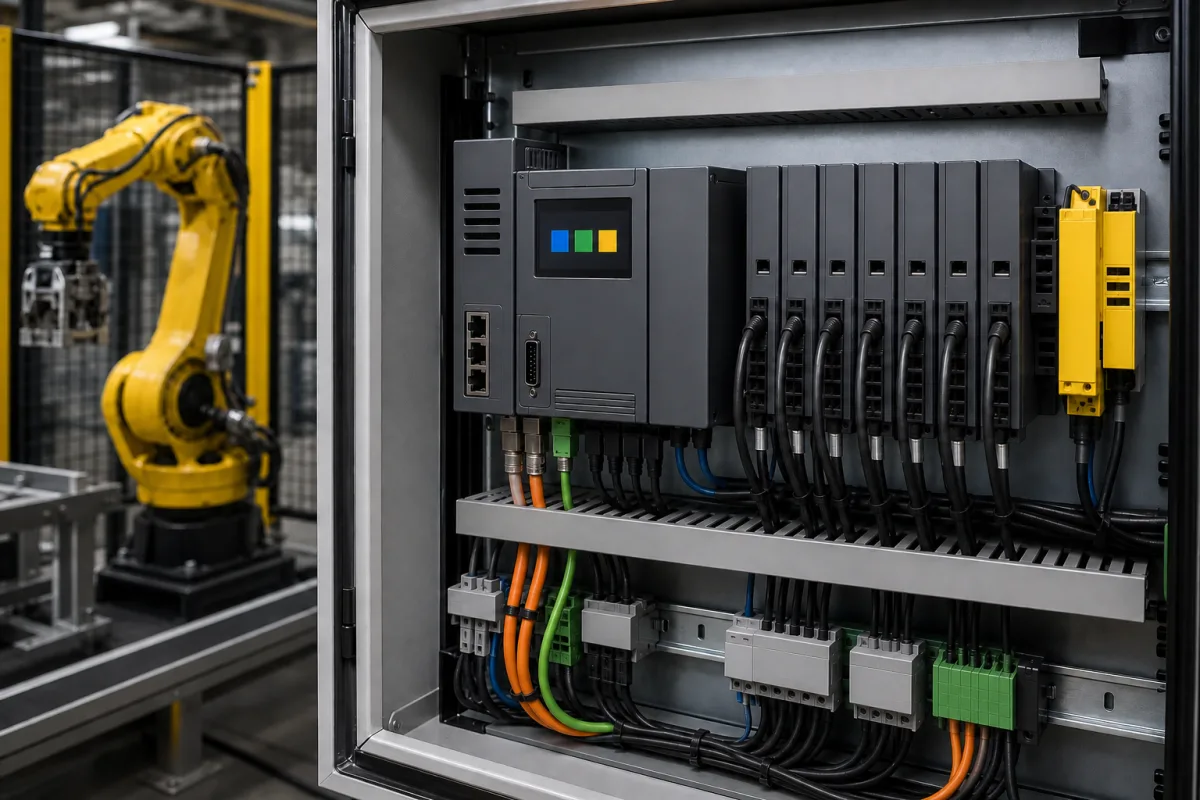
The electronic control unit that governs the operation of a robotic manipulator arm.
Product Specifications

Technical details and manufacturing context for Controller

Definition
A specialized electronic device that serves as the central processing unit for a robotic manipulator arm. It receives input commands from programming interfaces or sensors, processes these instructions using control algorithms, and outputs precise signals to drive motors and actuators, enabling coordinated movement, positioning, and task execution of the robotic arm.
Working Principle
The controller operates by executing programmed instructions or responding to real-time sensor feedback. It typically uses a microprocessor or PLC to run control algorithms (such as PID control) that calculate the required torque, speed, and position for each joint motor. It then sends pulse-width modulation (PWM) signals or other command signals to motor drivers, which power the actuators to achieve the desired arm movement and force application.
Common Materials
Printed Circuit Board (PCB), Semiconductor components (microprocessor, memory chips), Aluminum alloy housing
Technical Parameters
  • Controller dimensions (length x width x height) for mounting compatibility (mm) Customizable
Components / BOM
  • Central Processing Unit (CPU)
    Executes control algorithms and processes input/output signals
    Material: semiconductor silicon
  • Power Supply Unit
    Converts AC mains power to regulated DC voltages required by controller electronics
    Material: copper windings, ferrite core, electronic components
  • Communication Module
    Handles data exchange with external devices via various industrial protocols
    Material: PCB with communication chips, connectors
  • Memory Module
    Stores operating system, control programs, and temporary data
    Material: semiconductor memory chips
Engineering Reasoning
3.0-5.5 VDC (logic), 24 VDC ±10% (power)
Logic voltage <2.7 VDC or >5.8 VDC sustained for >10 ms, power voltage <21.6 VDC or >26.4 VDC sustained for >50 ms
Design Rationale: Semiconductor junction breakdown due to overvoltage exceeding dielectric strength (typically 6-8 V/μm for silicon), or latch-up from transient-induced parasitic thyristor activation
Risk Mitigation (FMEA)
Trigger Electrostatic discharge (ESD) event exceeding 8 kV HBM
Mode: Gate oxide rupture in MOSFET drivers causing permanent short circuit
Strategy: Integrated silicon-controlled rectifier (SCR) clamps at all I/O pins with 5 ns response time
Trigger Junction temperature exceeding 150°C for >1 second
Mode: Thermal runaway in power transistors due to negative temperature coefficient
Strategy: On-die thermal sensors with hardware shutdown at 145°C, independent of firmware

Industry Taxonomies & Aliases

Commonly used trade names and technical identifiers for Controller.

Applied To / Applications

This component is essential for the following industrial systems and equipment:

Industrial Ecosystem & Supply Chain DNA

Complementary Systems
Downstream Applications
Specialized Tooling

Application Fit & Sizing Matrix

Operational Limits
pressure: N/A (electronic enclosure, typically IP54/IP65 rated)
other spec: 24V DC ±10% power supply, 0-10V/4-20mA analog I/O, Ethernet/IP, PROFINET, EtherCAT communication protocols
temperature: -20°C to +70°C (operating), -40°C to +85°C (storage)
Media Compatibility
✓ Industrial automation environments ✓ Cleanroom manufacturing ✓ Precision assembly lines
Unsuitable: High-vibration environments without additional damping (e.g., heavy machinery foundations)
Sizing Data Required
  • Number of axes to control
  • Required communication protocols (Ethernet/IP, PROFINET, etc.)
  • I/O count (digital/analog inputs and outputs)

Reliability & Engineering Risk Analysis

Failure Mode & Root Cause
Electronic Component Degradation
Cause: Thermal cycling, voltage spikes, or prolonged exposure to high temperatures leading to capacitor leakage, transistor failure, or integrated circuit damage.
Corrosion or Contamination
Cause: Exposure to moisture, dust, chemicals, or conductive particulates causing short circuits, contact oxidation, or insulation breakdown.
Maintenance Indicators
  • Erratic or unstable output signals, intermittent operation, or unexplained system resets.
  • Unusual audible noises (buzzing, clicking) from internal components or visible signs of overheating (discoloration, burnt smell).
Engineering Tips
  • Implement environmental controls: Maintain stable temperature and humidity within specifications, use enclosures with proper IP ratings, and ensure clean, filtered air supply to prevent contamination.
  • Establish predictive maintenance: Regularly monitor voltage stability, perform thermal imaging to detect hot spots, and use vibration analysis to identify mechanical wear in cooling fans or internal components.

Compliance & Manufacturing Standards

Reference Standards
ISO 9001:2015 Quality Management Systems IEC 61131-2:2017 Programmable Controllers CE Marking (EU Machinery Directive 2006/42/EC)
Manufacturing Precision
  • Enclosure IP Rating: IP65 (dust-tight, water jet protected)
  • Electrical Connections: Torque +/-10% of specified value
Quality Inspection
  • Functional Safety Test (IEC 61508)
  • Environmental Stress Screening (Temperature/Humidity Cycling)

Factories Producing Controller

Verified manufacturers with capability to produce this product in China

✓ 94% Supplier Capability Match Found

P Project Engineer from United Arab Emirates Jan 21, 2026
★★★★★
"As a professional in the Machinery and Equipment Manufacturing sector, I confirm this Controller meets all ISO standards."
Technical Specifications Verified
S Sourcing Manager from Australia Jan 18, 2026
★★★★★
"Standard OEM quality for Machinery and Equipment Manufacturing applications. The Controller arrived with full certification."
Technical Specifications Verified
P Procurement Specialist from Singapore Jan 15, 2026
★★★★★
"Great transparency on the Controller components. Essential for our Machinery and Equipment Manufacturing supply chain."
Technical Specifications Verified
Verification Protocol

“Feedback is collected from verified sourcing managers during RFQ (Request for Quote) and factory evaluation processes on CNFX. These reports represent historical performance data and technical audit summaries from our B2B manufacturing network.”

17 sourcing managers are analyzing this specification now. Last inquiry for Controller from Thailand (55m ago).

Supply Chain Compatible Machinery & Devices

Hydraulic Press

Industrial machine using hydraulic pressure to compress, form, or assemble materials

Explore Specs →
Heavy-Duty CNC Plasma Cutting Machine

Industrial machine for precision metal cutting using plasma arc technology

Explore Specs →
Automated Assembly Line System

Integrated production system for sequential component assembly operations

Explore Specs →
Automated Powder Coating System

Integrated industrial system for applying dry powder coatings to metal substrates.

Explore Specs →

Frequently Asked Questions

What materials are used in this robotic controller's construction?

This controller features a Printed Circuit Board (PCB) with semiconductor components including a microprocessor and memory chips, housed in a durable aluminum alloy casing for industrial environments.

How does this controller manage robotic manipulator arm operations?

The electronic control unit governs arm movement through its Central Processing Unit (CPU), Communication Module for data exchange, Memory Module for program storage, and Power Supply Unit for stable operation.

What industries typically use this type of machinery controller?

This controller is designed for machinery and equipment manufacturing sectors, particularly in automation, robotics assembly lines, material handling systems, and precision manufacturing applications.

Can I contact factories directly on CNFX?

CNFX is an open directory, not a transaction platform. Each factory profile provides direct contact information and production details to help you initiate direct inquiries with Chinese suppliers.

Get Quote for Controller

Request technical pricing, lead times, or customized specifications for Controller directly from verified manufacturing units.

Your business information is encrypted and only shared with verified Controller suppliers.

Thank you! Your message has been sent. We'll respond within 1–3 business days.

Need to Manufacture Controller?

Connect with verified factories specializing in this product category

Add Your Factory Contact Us
Previous Product
Controlled Lighting Chamber
Next Product
Controller & Drive System