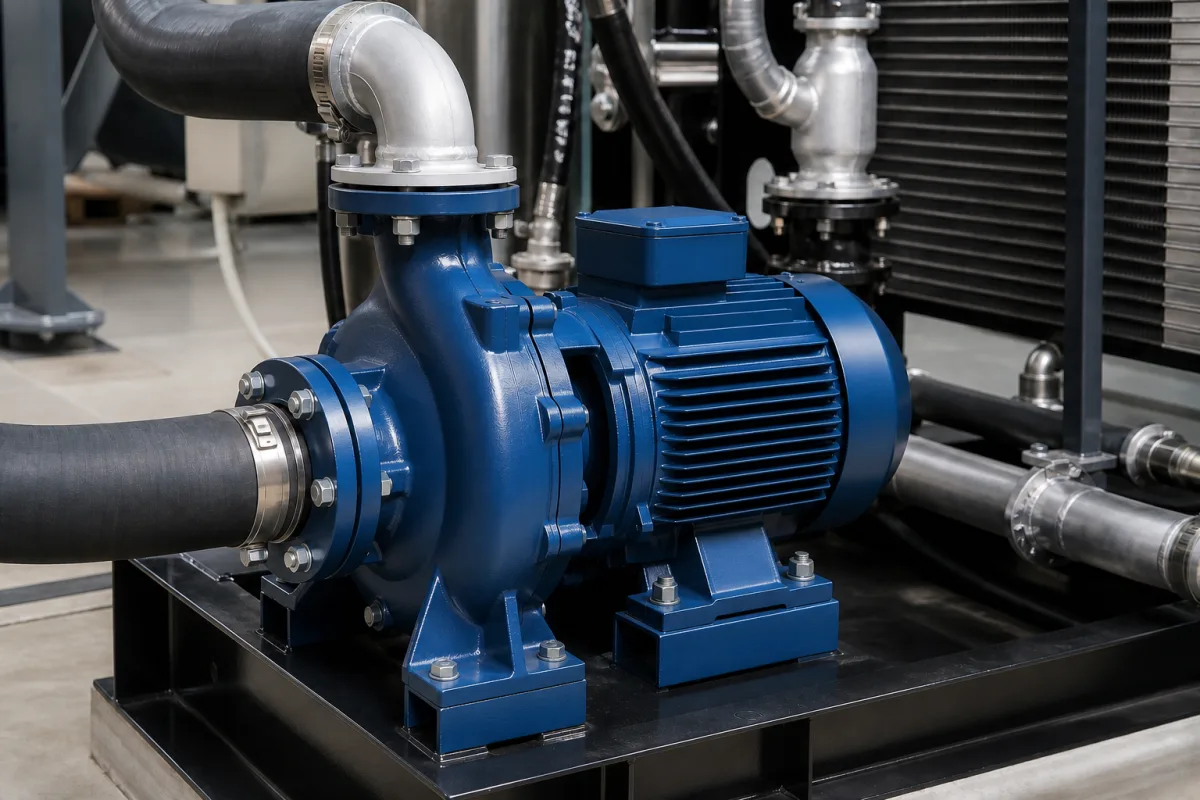
Glycol coolant pump for closed-loop chiller and dry-cooler skids
Close-coupled end-suction pumps that circulate inhibited ethylene glycol coolant on chiller and dry-cooler skids · viscosity against the motor, extra flow for a weaker coolant, freeze point and fluid quality
A glycol coolant pump is the motor-driven centrifugal pump on a closed cooling loop that carries an ethylene glycol and water coolant instead of plain water: the circulation pump on a chiller, dry-cooler or process cooling skid that must keep running through freezing weather. The glycol changes three things about the pump order. The thicker liquid takes more shaft power, the coolant carries less heat per litre so more flow is needed, and the mixture strength sets the freeze protection and the fluid care the loop needs.
Electric close-coupled and end-suction centrifugal pumps on closed loops filled with inhibited ethylene glycol solutions: chiller, dry-cooler, ice-storage and process cooling skids. The glycol-specific points are covered here: viscosity and density against motor size, flow for a lower-heat-capacity coolant, freeze protection by concentration, inlet pressure in a closed loop and fluid quality. Plain cooling-water circulation pumps for closed and cooling-tower loops are covered on the Cooling-water circulation pump page; machine-tool coolant supply units for cutting fluids on the Coolant system page; centrifugal pump hydraulic selection, NPSH and operating regions on the Industrial pumps page; and cast volute casings on the Volute casing page. Engine-mounted and 12 V electric vehicle coolant pumps are outside this page.
CNFX editorial research · Sources checked October 12, 2026 · 3 sources
Ethylene glycol thickens when cold: viscosity, density and the motor
Dow's engineering data for its DOWTHERM SR-1 inhibited ethylene glycol give a viscosity of 6.77 cP for a 50% glycol solution at 40 °F, against 0.94 cP at 180 °F, and 3.0 cP for a 25% solution at 40 °F. The same table gives a density of 67.47 lb/ft³ for the 50% solution at 40 °F. [1]
Grundfos states for its DNM and DNP close-coupled end-suction pumps that when the pumped liquid has a kinematic viscosity above 3 mm²/s a new motor size should be calculated, and that a liquid denser than water needs a motor with a correspondingly larger output. Its published curves apply to 1 mm²/s. [2]
Editorial calculation: kinematic viscosity = dynamic viscosity ÷ density. 67.47 lb/ft³ × 0.016018 = 1.081 g/cm³, so 50% solution at 40 °F is 6.77 ÷ 1.081 ≈ 6.3 mm²/s; the 30% solution (3.54 cP, 65.66 lb/ft³ = 1.052 g/cm³) is ≈ 3.4 mm²/s; the 25% solution (3.0 cP, 65.17 lb/ft³ = 1.044 g/cm³) is ≈ 2.9 mm²/s. On Dow's figures, a loop at 40 °F with 30% or more glycol is past the 3 mm²/s point at which Grundfos asks for the motor to be recalculated. [1][2]
R. L. Deppmann shows the effect on one Bell & Gossett 1510 selection with a 10.125-inch impeller: 600 gpm at 80 ft takes 15.14 brake horsepower on water at 60 °F and 17.11 brake horsepower on 50% ethylene glycol at 45 °F, while the corrected head-flow curve stays on top of the water curve. Editorial calculation: 17.11 ÷ 15.14 = 1.13, about 13% more shaft power for the same duty. [3]
State the glycol type and percentage and the lowest and highest coolant temperature on the pump order, not just flow and head; a selection made for water at 20 °C hides the cold-start power.
02
More litres per kilowatt: specific heat of the mix sets the pump flow
Dow lists the specific heat of DOWTHERM SR-1 solutions at 40 °F as 0.882 Btu/lb·°F at 25% glycol, 0.861 at 30%, 0.816 at 40%, 0.770 at 50% and 0.721 at 60%. Thermal conductivity falls as well, from 0.262 to 0.196 Btu/(hr·ft²)(°F/ft) between 25% and 60% at 40 °F. [1]
Editorial calculation: the volume flow needed to carry a given heat load at a given temperature difference is inversely proportional to density × specific heat. At 40 °F, 30% solution gives 65.66 × 0.861 = 56.5 and 50% solution gives 67.47 × 0.770 = 52.0 Btu/(ft³·°F), so moving the same loop from 30% to 50% glycol needs 56.5 ÷ 52.0 ≈ 1.09 times the flow, about 9% more, before any change in friction head. [1]
Editorial note: because the pump must deliver that larger flow against a thicker liquid, the flow increase from this section and the power increase from the section above stack on the same motor.
03
Glycol percentage by volume against freeze point
The glycol strength is chosen for the lowest temperature the loop will see. Dow's freezing-point table for DOWTHERM SR-1 solutions, by volume:
Editorial note: the table shows why stronger is not automatically safer for the pump. Each step up in glycol percentage lowers the freeze point, but on Dow's property table it also raises cold viscosity and lowers specific heat, the two effects that size the motor and the flow above. Dow gives an operating range of −60 °F to 250 °F for the fluid. [1] Celsius values are editorial conversions of Dow's Fahrenheit figures.
Inlet pressure and fluid quality in a sealed glycol loop
Grundfos gives the minimum inlet pressure to avoid cavitation on its DNM pumps as H = pb × 10.2 − NPSH − Hf − Hv − Hs, where pb in a closed system is the system pressure in bar, Hv is the vapour pressure in metres head and the safety margin Hs is at least 0.5 m. The DNM range covers 2 to 160 m³/h, heads to 64 m, liquid temperatures from −15 °C to +140 °C and a maximum operating pressure of 16 bar. [2]
Dow's specification for closed-loop HVAC systems asks for an industrially inhibited, phosphate-based ethylene glycol and excludes automotive antifreezes and silicate formulations. It asks for dilution water with less than 25 ppm chloride and sulfate and less than 50 ppm hard-water ions, cleaning of new systems with a 1% to 2% trisodium phosphate solution before filling, and no automatic water make-up, to avoid undetected dilution of the glycol. [1]
Editorial note: a pump's shaft seal and casing sit in this coolant for their whole life, so ask the pump supplier to confirm the seal faces and elastomers for the named glycol fluid and its temperature range.
05
Coolant and loop data for a glycol pump enquiry
Paste it into your enquiry below or into an email to a maker, then replace every bracket.
Coolant: [ethylene glycol product; % by volume; inhibited, phosphate-based]
Temperatures: [lowest start-up coolant temperature; normal supply and return]
Duty: [heat load; design temperature difference; flow; head at the stated coolant]
Motor: [power at the coldest coolant; voltage; frequency; speed control]
Loop: [closed-system pressure; expansion tank pre-charge; suction-side losses]
Pump: [close-coupled or long-coupled; flange standard; PN rating]
Materials: [casing; impeller; mechanical seal faces and elastomers for glycol]
Installation: [skid layout; indoor or outdoor; ambient minimum]
Explore company information and manufacturing capabilities, then discuss the scope of your project with a relevant supplier.
Share this page
Compiled and source-reviewed by the CNFX editorial team.
Each manufacturer above links to the page on that company's own website where the product is listed, with the date we checked it. How we source and review
· Page last updated 13 October 2026
Buyer questions
Does a pump need a bigger motor for glycol?
Grundfos asks for a new motor size above 3 mm²/s on its DNM pumps; on Dow's figures a 50% ethylene glycol solution at 40 °F is about 6.3 mm²/s. In a Bell & Gossett selection shown by R. L. Deppmann, the same duty needed 17.11 instead of 15.14 BHP. [2][1][3]
Why does a glycol loop need more flow than a water loop?
Glycol solutions carry less heat per volume: Dow lists 0.770 Btu/lb·°F for 50% solution at 40 °F against 0.861 for 30%, so the stronger mix needs about 9% more flow for the same load and temperature difference. [1]
What glycol strength protects a loop to −30 °F?
Dow's table gives a freezing temperature of −12 °F at 40% and −34 °F at 50% by volume, so 50% covers −30 °F on those figures. [1]
Sources and what still needs a direct check
Sources checked 2026-10-12. Fluid properties are Dow's published values for its own inhibited ethylene glycol and differ slightly between glycol products; the pump limits are Grundfos's for its DNM range, and the power example is one Bell & Gossett selection shown by R. L. Deppmann.