Industry-Verified Manufacturing Data (2026)

Thermal Control Unit

Based on aggregated insights from multiple verified factory profiles within the CNFX directory, the standard Thermal Control Unit used in the Machinery and Equipment Manufacturing sector typically supports operational capacities ranging from standard industrial configurations to heavy-duty production requirements.

Technical Definition & Core Assembly

A canonical Thermal Control Unit is characterized by the integration of Temperature Sensor and Control Circuit Board. In industrial production environments, manufacturers listed on CNFX commonly emphasize Aluminum alloy construction to support stable, high-cycle operation across diverse manufacturing scenarios.

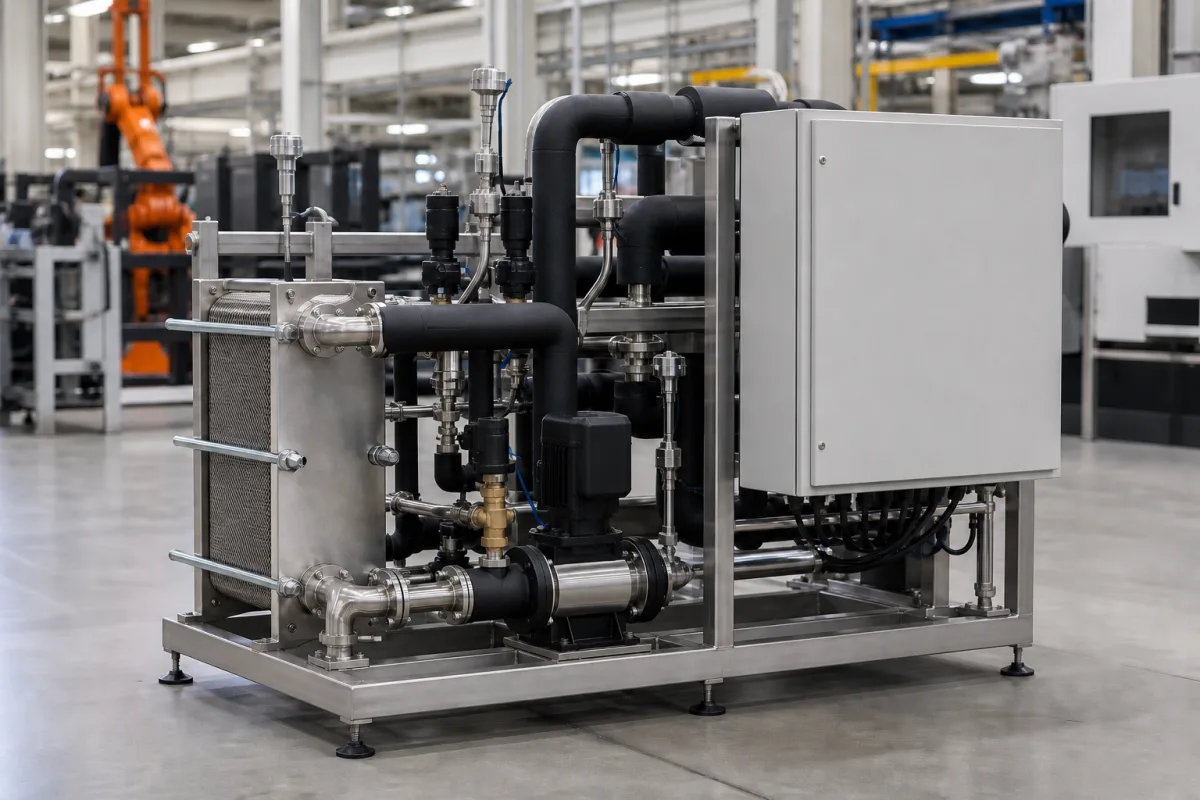
A component within a Thermal Management System that regulates temperature by controlling heating, cooling, or heat transfer processes.
Product Specifications

Technical details and manufacturing context for Thermal Control Unit

Definition
The Thermal Control Unit is a critical subsystem within a Thermal Management System responsible for maintaining precise temperature conditions. It monitors thermal parameters and executes control actions to ensure optimal operating temperatures, prevent overheating or undercooling, and enhance system efficiency and reliability across various industrial applications.
Working Principle
The unit operates by continuously measuring temperature via sensors, comparing it to a setpoint, and activating control mechanisms (such as heaters, coolers, valves, or fans) to adjust heat transfer and maintain the desired thermal equilibrium within the system.
Common Materials
Aluminum alloy, Stainless steel, Copper, Thermal interface materials
Technical Parameters
  • Dimensions (length, width, height) of the unit housing (mm) Customizable
Components / BOM
  • Temperature Sensor
    Measures actual temperature and provides feedback to the controller
    Material: Stainless steel, thermocouple/alloy
  • Control Circuit Board
    Processes sensor data and executes control algorithms to regulate temperature
    Material: FR4 PCB, electronic components
  • Heating/Cooling Element
    Actively adds or removes heat based on control signals
    Material: Resistive wire (heater), copper/aluminum (cooler)
  • Power Supply Unit
    Provides regulated electrical power to all components
    Material: Aluminum housing, electronic components
  • Communication Interface
    Enables data exchange and remote control with external systems
    Material: Plastic connectors, copper contacts
Engineering Reasoning
283-353 K (10-80°C) with heat transfer coefficient of 50-200 W/m²·K
Thermal stress exceeds yield strength of 316L stainless steel (205 MPa at 373 K) or coolant flow drops below 0.1 m/s causing laminar flow
Design Rationale: Thermal fatigue from cyclic temperature differentials exceeding 50 K/min, or fouling resistance exceeding 0.0005 m²·K/W reducing heat transfer efficiency below 60%
Risk Mitigation (FMEA)
Trigger Coolant pump cavitation at NPSH below 2.3 m H₂O
Mode: Localized boiling at heat exchanger surfaces creating vapor lock
Strategy: Installation of pressurization system maintaining 3.5 bar absolute pressure in coolant loop
Trigger PID controller integral windup with setpoint deviation exceeding 15 K for 300 seconds
Mode: Overshoot of 25 K beyond setpoint causing thermal shock
Strategy: Implementation of anti-windup circuit with 0.05-0.2 integral time constant and 10 K error deadband

Industry Taxonomies & Aliases

Commonly used trade names and technical identifiers for Thermal Control Unit.

Applied To / Applications

This component is essential for the following industrial systems and equipment:

Industrial Ecosystem & Supply Chain DNA

Complementary Systems
Downstream Applications
Specialized Tooling

Application Fit & Sizing Matrix

Operational Limits
pressure: 0 to 10 bar
flow rate: 0.5 to 50 L/min
temperature: -40°C to 200°C
slurry concentration: 0 to 30% solids by weight
Media Compatibility
✓ Water/Glycol Mixtures ✓ Thermal Oils ✓ Process Fluids (non-corrosive)
Unsuitable: Highly Corrosive Acids (e.g., Hydrochloric Acid)
Sizing Data Required
  • Heat Load (kW)
  • Inlet/Outlet Temperature Differential (°C)
  • Required Flow Rate (L/min)

Reliability & Engineering Risk Analysis

Failure Mode & Root Cause
Fouling and scaling
Cause: Accumulation of mineral deposits, biological growth, or particulate matter on heat transfer surfaces, reducing thermal efficiency and increasing pressure drop due to poor water quality, inadequate filtration, or improper chemical treatment.
Corrosion and pitting
Cause: Degradation of metal components (e.g., tubes, plates, or casing) due to electrochemical reactions, often exacerbated by aggressive coolant chemistry, oxygen ingress, galvanic couples, or microbiologically influenced corrosion (MIC) from untreated water or improper inhibitor dosing.
Maintenance Indicators
  • Abnormal temperature differentials (ΔT) across the unit exceeding design limits, indicating reduced heat transfer efficiency
  • Unusual noises such as knocking, rattling, or gurgling, suggesting air entrainment, flow restriction, or impending component failure
Engineering Tips
  • Implement a robust water treatment program with regular chemical analysis and blowdown control to maintain proper pH, conductivity, and biocide levels, preventing scaling and corrosion
  • Establish a predictive maintenance routine using infrared thermography to detect hot spots and vibration analysis to monitor pump and fan health, enabling early intervention before failures occur

Compliance & Manufacturing Standards

Reference Standards
ISO 9001:2015 - Quality management systems ASME B31.3 - Process piping DIN EN 13445 - Unfired pressure vessels
Manufacturing Precision
  • Temperature control accuracy: +/-0.5°C
  • Flow rate deviation: +/-2% of rated capacity
Quality Inspection
  • Pressure test (hydrostatic/pneumatic) per ASME BPVC Section VIII
  • Leak test with helium mass spectrometer

Factories Producing Thermal Control Unit

Verified manufacturers with capability to produce this product in China

✓ 92% Supplier Capability Match Found

P Procurement Specialist from United States Feb 08, 2026
★★★★★
"As a professional in the Machinery and Equipment Manufacturing sector, I confirm this Thermal Control Unit meets all ISO standards."
Technical Specifications Verified
T Technical Director from United Arab Emirates Feb 05, 2026
★★★★★
"Standard OEM quality for Machinery and Equipment Manufacturing applications. The Thermal Control Unit arrived with full certification."
Technical Specifications Verified
P Project Engineer from Australia Feb 02, 2026
★★★★★
"Great transparency on the Thermal Control Unit components. Essential for our Machinery and Equipment Manufacturing supply chain."
Technical Specifications Verified
Verification Protocol

“Feedback is collected from verified sourcing managers during RFQ (Request for Quote) and factory evaluation processes on CNFX. These reports represent historical performance data and technical audit summaries from our B2B manufacturing network.”

17 sourcing managers are analyzing this specification now. Last inquiry for Thermal Control Unit from USA (11m ago).

Supply Chain Compatible Machinery & Devices

Hydraulic Press

Industrial machine using hydraulic pressure to compress, form, or assemble materials

Explore Specs →
Heavy-Duty CNC Plasma Cutting Machine

Industrial machine for precision metal cutting using plasma arc technology

Explore Specs →
Automated Assembly Line System

Integrated production system for sequential component assembly operations

Explore Specs →
Automated Powder Coating System

Integrated industrial system for applying dry powder coatings to metal substrates.

Explore Specs →

Frequently Asked Questions

What materials are used in this Thermal Control Unit?

This unit is constructed from durable materials including aluminum alloy, stainless steel, copper, and thermal interface materials to ensure efficient heat transfer and long-lasting performance in industrial environments.

How does the Thermal Control Unit regulate temperature?

The unit regulates temperature by controlling heating, cooling, and heat transfer processes through its integrated components: temperature sensors, control circuit board, and heating/cooling elements, maintaining precise thermal conditions.

What are the main components in the Thermal Control Unit's BOM?

The Bill of Materials includes a Communication Interface, Control Circuit Board, Heating/Cooling Element, Power Supply Unit, and Temperature Sensor, all working together to manage thermal processes effectively.

Can I contact factories directly on CNFX?

CNFX is an open directory, not a transaction platform. Each factory profile provides direct contact information and production details to help you initiate direct inquiries with Chinese suppliers.

Get Quote for Thermal Control Unit

Request technical pricing, lead times, or customized specifications for Thermal Control Unit directly from verified manufacturing units.

Your business information is encrypted and only shared with verified Thermal Control Unit suppliers.

Thank you! Your message has been sent. We'll respond within 1–3 business days.

Need to Manufacture Thermal Control Unit?

Connect with verified factories specializing in this product category

Add Your Factory Contact Us
Previous Product
Thermal Control System
Next Product
Thermal Expansion Joint