Industry-Verified Manufacturing Data (2026)

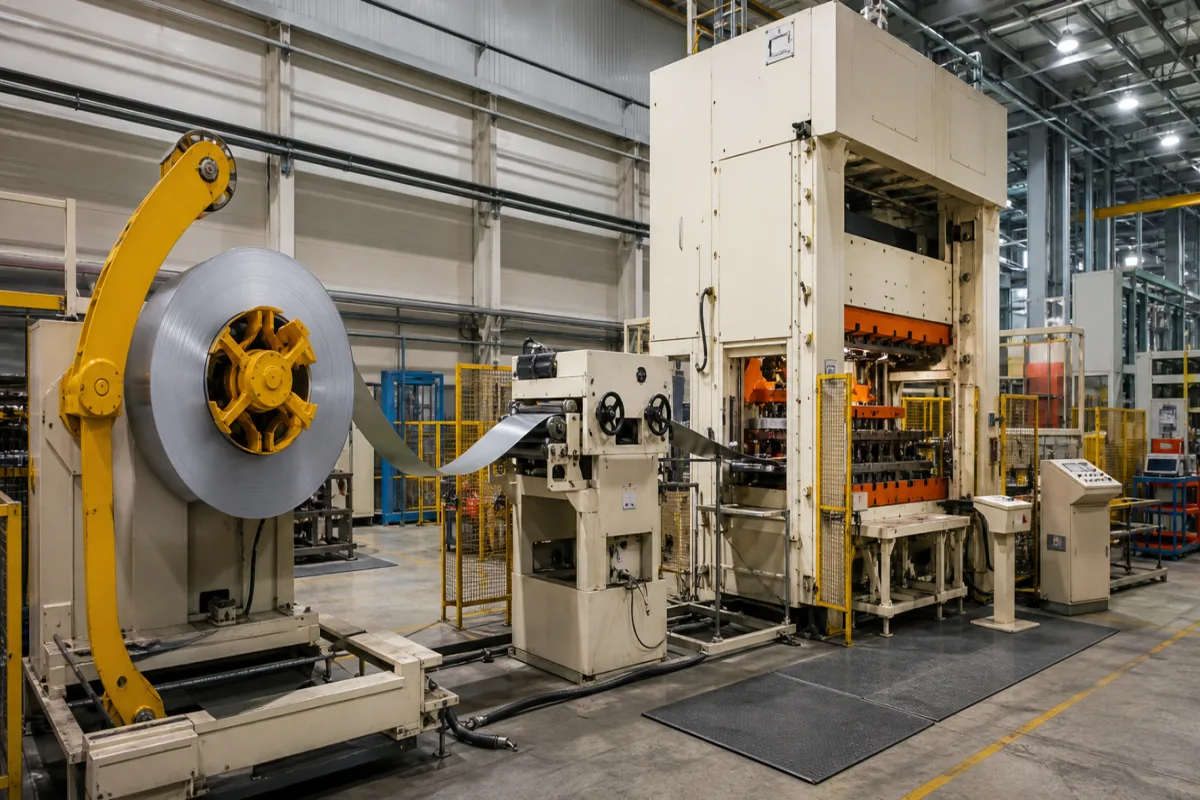
High-Speed Progressive Stamping Press

Based on aggregated insights from multiple verified factory profiles within the CNFX directory, the standard High-Speed Progressive Stamping Press used in the Basic Metal Manufacturing sector typically supports operational capacities ranging from standard industrial configurations to heavy-duty production requirements.

Technical Definition & Core Assembly

A canonical High-Speed Progressive Stamping Press is characterized by the integration of Main Frame and Ram/Slide Assembly. In industrial production environments, manufacturers listed on CNFX commonly emphasize High-Strength Steel construction to support stable, high-cycle operation across diverse manufacturing scenarios.

Automated press for sequential metal stamping operations in continuous strip feeding
Product Specifications

Technical details and manufacturing context for High-Speed Progressive Stamping Press

Definition
A high-speed progressive stamping press is an industrial machine designed for continuous, automated metal forming operations on strip or coil stock. It performs multiple stamping, punching, bending, and cutting operations in sequence as the material progresses through successive stations. This machine enables high-volume production of complex metal components with tight tolerances and minimal manual intervention. It is essential for manufacturing electrical contacts, automotive brackets, appliance components, and precision hardware where efficiency and consistency are critical.
Working Principle
Coiled metal strip feeds continuously through multiple die stations; each station performs a specific forming operation (punching, bending, cutting) as the press ram cycles, producing finished parts at the final station.
Common Materials
High-Strength Steel, Cast Iron, Hardened Tool Steel
Technical Parameters
  • Maximum pressing force available (tons) Per Request
  • Maximum operating speed in strokes per minute (SPM) Per Request
Components / BOM
  • Main Frame
    Provides structural rigidity and houses moving components
    Material: High-strength steel casting
  • Ram/Slide Assembly
    Delivers vertical force through connecting rods to the die
    Material: Forged steel with hardened guides
  • Progressive Die Set
    Multi-station tooling for sequential forming operations
    Material: Tool steel with carbide inserts
  • Coil Feeding System
    Automatically feeds and positions metal strip through die stations
    Material: Steel with servo motors
  • Clutch-Brake System
    Controls press engagement and emergency stopping
    Material: Steel with friction materials
  • Scrap Cutter Optional
    Separates finished parts from carrier strip
    Material: Hardened tool steel
Engineering Reasoning
150-250 kN at 800-1200 strokes per minute
Eccentric shaft deflection exceeding 0.05 mm at 300 kN load
Design Rationale: Hertzian contact stress exceeding 1500 MPa at cam-follower interface causing subsurface fatigue crack initiation
Risk Mitigation (FMEA)
Trigger Strip feed misalignment exceeding ±0.1 mm tolerance
Mode: Progressive die interference causing tool collision
Strategy: Laser alignment sensors with 0.01 mm resolution and servo-corrective feed system
Trigger Clutch-brake system air pressure drop below 0.6 MPa
Mode: Incomplete stroke cycle causing strip feed desynchronization
Strategy: Dual-redundant pneumatic circuits with 0.55 MPa low-pressure cutoff switches

Industry Taxonomies & Aliases

Commonly used trade names and technical identifiers for High-Speed Progressive Stamping Press.

Industrial Ecosystem & Supply Chain DNA

Complementary Systems
Downstream Applications
Specialized Tooling

Application Fit & Sizing Matrix

Operational Limits
pressure: Up to 2500 kN maximum stamping force
other spec: Strip feed speed: 10-120 m/min, Stroke rate: 30-120 SPM, Maximum strip width: 300 mm
temperature: 5°C to 40°C ambient operating range
Media Compatibility
✓ Cold-rolled steel strips ✓ Aluminum alloy coils ✓ Copper-based alloys
Unsuitable: Abrasive or highly corrosive materials (e.g., titanium with high chloride content)
Sizing Data Required
  • Required production rate (parts per minute)
  • Material thickness and tensile strength
  • Maximum part dimensions and progressive die complexity

Reliability & Engineering Risk Analysis

Failure Mode & Root Cause
Bearing fatigue failure
Cause: High cyclic loading and shock loads from stamping operations, combined with inadequate lubrication or contamination ingress, leading to spalling and premature bearing wear.
Clutch/brake system degradation
Cause: Excessive heat generation from frequent engagement cycles, wear of friction materials, and misalignment causing uneven wear and loss of torque capacity.
Maintenance Indicators
  • Unusual knocking or grinding noises from the drive train during operation
  • Excessive vibration or visible misalignment in the ram or slide mechanism
Engineering Tips
  • Implement condition-based monitoring with vibration analysis and thermal imaging to detect early bearing and alignment issues before catastrophic failure.
  • Establish a rigorous lubrication schedule using high-quality, manufacturer-specified lubricants and ensure proper sealing to prevent contamination in critical components.

Compliance & Manufacturing Standards

Reference Standards
ISO 12100:2010 - Safety of machinery ANSI B11.1 - Safety Requirements for Mechanical Power Presses CE Marking - Machinery Directive 2006/42/EC
Manufacturing Precision
  • Slide parallelism: 0.02mm per 300mm
  • Die height repeatability: +/-0.005mm
Quality Inspection
  • Dimensional accuracy verification using CMM
  • Load testing and tonnage verification

Factories Producing High-Speed Progressive Stamping Press

Verified manufacturers with capability to produce this product in China

✓ 94% Supplier Capability Match Found

P Project Engineer from United Arab Emirates Feb 19, 2026
★★★★★
"Testing the High-Speed Progressive Stamping Press now; the Tonnage Capacity (tons) results are within 1% of the laboratory datasheet."
Technical Specifications Verified
S Sourcing Manager from Australia Feb 16, 2026
★★★★★
"Impressive build quality. Especially the Tonnage Capacity (tons) is very stable during long-term operation."
Technical Specifications Verified
P Procurement Specialist from Singapore Feb 13, 2026
★★★★★
"As a professional in the Basic Metal Manufacturing sector, I confirm this High-Speed Progressive Stamping Press meets all ISO standards."
Technical Specifications Verified
Verification Protocol

“Feedback is collected from verified sourcing managers during RFQ (Request for Quote) and factory evaluation processes on CNFX. These reports represent historical performance data and technical audit summaries from our B2B manufacturing network.”

17 sourcing managers are analyzing this specification now. Last inquiry for High-Speed Progressive Stamping Press from Germany (1h ago).

Supply Chain Commonly Integrated Components

Purge Air System

A system that provides controlled airflow to clear optical paths and protect sensors in molten metal temperature measurement applications.

Explore Specs →
Degassing Chamber

A specialized vessel within a molten metal degassing system where dissolved gases are removed from molten metal through controlled processes.

Explore Specs →
Gas Control System

A system that regulates and controls the flow, pressure, and composition of gases used in molten metal degassing processes.

Explore Specs →
Burner Assembly

A combustion system component that generates controlled flame for heating applications in industrial preheating stations.

Explore Specs →

Frequently Asked Questions

What materials can this high-speed progressive stamping press handle?

This press is designed for high-strength steel, cast iron, and hardened tool steel, making it ideal for demanding metal forging, pressing, and stamping applications.

What are the key components in the BOM for this stamping press?

The bill of materials includes a clutch-brake system, coil feeding system, main frame, progressive die set, ram/slide assembly, and scrap cutter, ensuring reliable and efficient operation.

What specifications should I consider when selecting this press?

Key specs include bed area, maximum strip width, motor power (kW), stroke length, stroke speed (SPM), and tonnage capacity (tons), which determine suitability for your production needs.

Can I contact factories directly on CNFX?

CNFX is an open directory, not a transaction platform. Each factory profile provides direct contact information and production details to help you initiate direct inquiries with Chinese suppliers.

Get Quote for High-Speed Progressive Stamping Press

Request technical pricing, lead times, or customized specifications for High-Speed Progressive Stamping Press directly from verified manufacturing units.

Your business information is encrypted and only shared with verified High-Speed Progressive Stamping Press suppliers.

Thank you! Your message has been sent. We'll respond within 1–3 business days.

Need to Manufacture High-Speed Progressive Stamping Press?

Connect with verified factories specializing in this product category

Add Your Factory Contact Us
Previous Product
High-Purity Zinc Anode Slab
Next Product
High-Strength Forging Steel Ingot