Industry-Verified Manufacturing Data (2026)

Smart Continuous Casting System for Non-Ferrous Alloys

Based on aggregated insights from multiple verified factory profiles within the CNFX directory, the standard Smart Continuous Casting System for Non-Ferrous Alloys used in the Basic Metal Manufacturing sector typically supports operational capacities ranging from standard industrial configurations to heavy-duty production requirements.

Technical Definition & Core Assembly

A canonical Smart Continuous Casting System for Non-Ferrous Alloys is characterized by the integration of Tundish with Pre-Heating and Water-Cooled Copper Mold. In industrial production environments, manufacturers listed on CNFX commonly emphasize Refractory Lined Steel construction to support stable, high-cycle operation across diverse manufacturing scenarios.

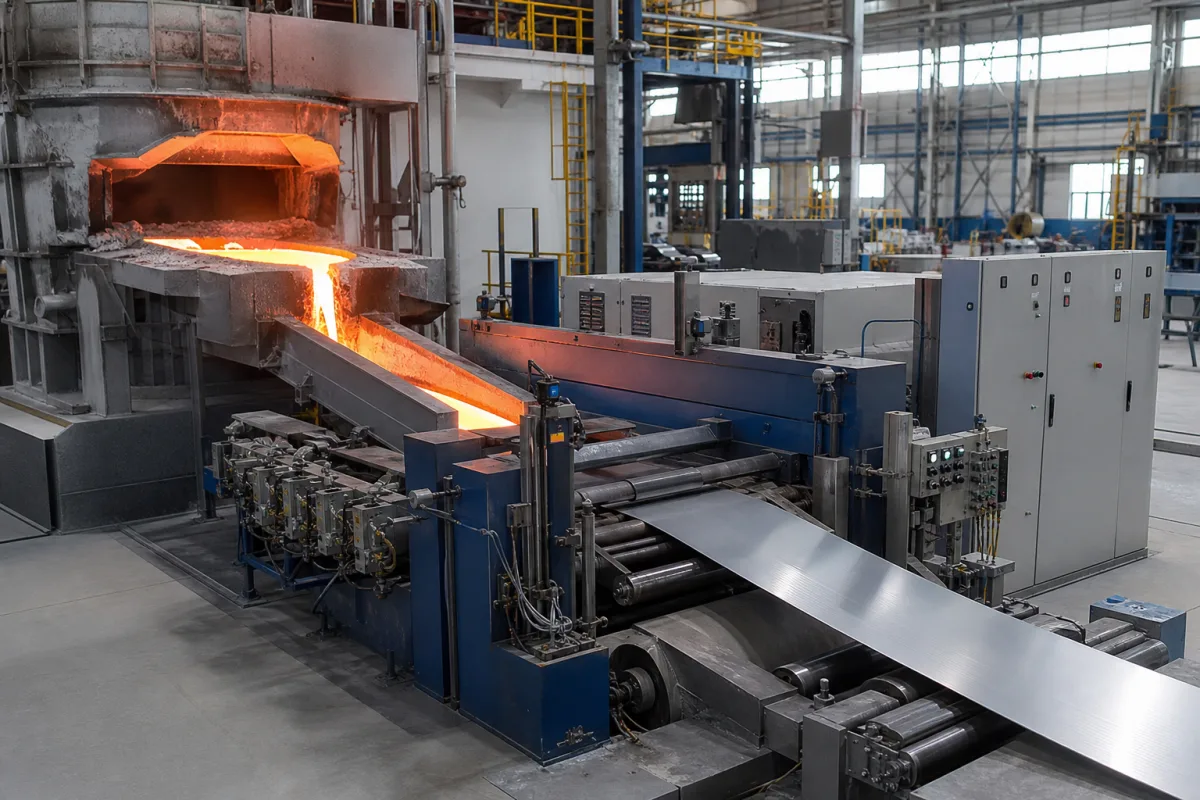
Automated production line for continuous casting of non-ferrous metal alloys

Product Specifications

Technical details and manufacturing context for Smart Continuous Casting System for Non-Ferrous Alloys

Definition
An integrated industrial system designed for the continuous casting of non-ferrous metal alloys such as aluminum, copper, zinc, and lead-based compositions. It transforms molten metal directly into semi-finished products like billets, rods, or strips in a single, uninterrupted process. The system enhances production efficiency by eliminating batch processing steps, improves material consistency through precise thermal and mechanical control, and reduces energy consumption compared to traditional casting methods. It is engineered for high-volume manufacturing environments requiring reliable, round-the-clock operation.
Working Principle
Molten non-ferrous alloy is fed from a holding furnace into a water-cooled mold, where it solidifies into a continuous strand. The strand is withdrawn by synchronized pinch rolls and guided through secondary cooling zones for complete solidification before being cut to length or coiled.
Common Materials
Refractory Lined Steel, Copper Alloy Mold, High-Temperature Ceramics
Technical Parameters
  • Maximum linear speed of strand extraction (m/min) Standard Spec
  • Typical product dimensions (e.g., diameter or thickness) (mm) Standard Spec
  • Operating range for molten metal input (°C) Standard Spec
Components / BOM
  • Tundish with Pre-Heating
    Receives and distributes molten metal from furnace to mold at controlled flow
    Material: Refractory lined steel
  • Water-Cooled Copper Mold
    Initial solidification chamber that shapes the molten alloy into a continuous strand
    Material: High-conductivity copper alloy with chromium plating
  • Secondary Cooling Chamber
    Spray chamber that completes solidification through controlled water mist application
    Material: Stainless steel with spray nozzles
  • Pinch Roll Assembly
    Motorized rollers that grip and withdraw the solidified strand at precise speed
    Material: Hardened steel with heat-resistant coating
  • Programmable Logic Controller (PLC)
    Central control unit automating casting speed, temperature, and cooling parameters
    Material: Electronic components in industrial enclosure
  • Flying Shear or Saw Optional
    Cuts the continuous strand into predetermined lengths without stopping production
    Material: High-speed tool steel
Engineering Reasoning
0.5-2.0 MPa (mold pressure), 680-750°C (melt temperature), 0.1-1.5 m/min (casting speed)
Mold pressure exceeds 2.5 MPa causing mold deformation, melt temperature drops below 660°C (aluminum solidus), casting speed exceeds 2.0 m/min causing shell rupture
Design Rationale: Thermal stress-induced mold distortion at ΔT>150°C, constitutional supercooling at cooling rates >100°C/s, hydrodynamic instability at Reynolds number >2300 in mold channel
Risk Mitigation (FMEA)
Trigger Cooling water flow reduction below 15 L/min per mold segment
Mode: Localized solidification front instability causing shell tearing
Strategy: Redundant cooling circuits with 25% oversizing and flow sensors with 0.5 L/min resolution
Trigger Alloy composition deviation beyond ±0.5% Cu or ±0.3% Si from target
Mode: Hot tearing at grain boundaries due to improper eutectic formation
Strategy: Real-time LIBS spectroscopy with 0.1% composition accuracy and automated ladle metallurgy correction

Industry Taxonomies & Aliases

Commonly used trade names and technical identifiers for Smart Continuous Casting System for Non-Ferrous Alloys.

Industrial Ecosystem & Supply Chain DNA

Complementary Systems
Downstream Applications
Specialized Tooling

Application Fit & Sizing Matrix

Operational Limits
pressure: 0.1-2.0 bar (mold pressure)
flow rate: 5-50 kg/min (metal throughput)
temperature: 600-1200°C (alloy dependent)
cooling rate: 10-100°C/s (secondary cooling)
casting speed: 0.5-5.0 m/min
slurry concentration: Not applicable (molten metal system)
Media Compatibility
✓ Aluminum alloys (e.g., 6061, 7075) ✓ Copper alloys (e.g., brass, bronze) ✓ Zinc alloys (e.g., ZA series)
Unsuitable: Highly reactive metals (e.g., titanium, magnesium without inert atmosphere)
Sizing Data Required
  • Required annual production capacity (tons/year)
  • Target alloy composition and solidification characteristics
  • Finished product dimensions (width, thickness, cross-section shape)

Reliability & Engineering Risk Analysis

Failure Mode & Root Cause
Thermal fatigue cracking
Cause: Cyclic heating and cooling from molten alloy contact and water cooling systems, leading to stress concentrations in mold and spray chamber components.
Nozzle clogging and erosion
Cause: Oxide buildup and alloy impurities accumulating in secondary cooling nozzles, combined with high-pressure water impingement causing material degradation.
Maintenance Indicators
  • Irregular casting surface or visible oscillations in strand shape indicating mold wear or misalignment
  • Abnormal hissing sounds or steam plumes from cooling zones signaling water spray system failures or leaks
Engineering Tips
  • Implement predictive maintenance using thermal imaging to monitor mold temperature profiles and detect early-stage thermal fatigue before cracks propagate
  • Install automated water treatment and filtration systems with real-time conductivity monitoring to prevent nozzle clogging and minimize erosion from impurities

Compliance & Manufacturing Standards

Reference Standards
ISO 9001:2015 - Quality Management Systems ASTM B275 - Standard Practice for Codification of Non-Ferrous Metals and Alloys CE Machinery Directive 2006/42/EC - Safety of Machinery
Manufacturing Precision
  • Casting Dimensional Tolerance: +/- 0.5mm per meter
  • Surface Roughness: Ra ≤ 3.2 μm
Quality Inspection
  • Ultrasonic Testing for Internal Defects
  • Chemical Composition Analysis via Optical Emission Spectrometry

Factories Producing Smart Continuous Casting System for Non-Ferrous Alloys

Verified manufacturers with capability to produce this product in China

✓ 98% Supplier Capability Match Found

P Procurement Specialist from Singapore Jan 23, 2026
★★★★★
"The technical documentation for this Smart Continuous Casting System for Non-Ferrous Alloys is very thorough, especially regarding Maximum Casting Speed (m/min)."
Technical Specifications Verified
T Technical Director from Germany Jan 20, 2026
★★★★★
"Reliable performance in harsh Basic Metal Manufacturing environments. No issues with the Smart Continuous Casting System for Non-Ferrous Alloys so far."
Technical Specifications Verified
P Project Engineer from Brazil Jan 17, 2026
★★★★★
"Testing the Smart Continuous Casting System for Non-Ferrous Alloys now; the Maximum Casting Speed (m/min) results are within 1% of the laboratory datasheet."
Technical Specifications Verified
Verification Protocol

“Feedback is collected from verified sourcing managers during RFQ (Request for Quote) and factory evaluation processes on CNFX. These reports represent historical performance data and technical audit summaries from our B2B manufacturing network.”

18 sourcing managers are analyzing this specification now. Last inquiry for Smart Continuous Casting System for Non-Ferrous Alloys from Turkey (22m ago).

Supply Chain Commonly Integrated Components

Signal Processor

Electronic device that conditions, amplifies, filters, and converts raw sensor signals into standardized outputs for temperature measurement systems

Explore Specs →
Purge Air System

A system that provides controlled airflow to clear optical paths and protect sensors in molten metal temperature measurement applications.

Explore Specs →
Degassing Chamber

A specialized vessel within a molten metal degassing system where dissolved gases are removed from molten metal through controlled processes.

Explore Specs →
Gas Control System

A system that regulates and controls the flow, pressure, and composition of gases used in molten metal degassing processes.

Explore Specs →

Frequently Asked Questions

What is the maximum casting speed of this continuous casting system?

The system's maximum casting speed is measured in meters per minute (m/min), with specific values depending on alloy type and strand diameter configuration.

What materials are used in the construction of this casting system?

The system features refractory lined steel components, copper alloy molds, and high-temperature ceramics to withstand molten non-ferrous alloys and ensure durability.

How does the secondary cooling chamber improve casting quality?

The secondary cooling chamber provides controlled cooling after initial solidification, reducing thermal stress and improving the metallurgical structure and surface quality of the cast strands.

Can I contact factories directly on CNFX?

CNFX is an open directory, not a transaction platform. Each factory profile provides direct contact information and production details to help you initiate direct inquiries with Chinese suppliers.

Get Quote for Smart Continuous Casting System for Non-Ferrous Alloys

Request technical pricing, lead times, or customized specifications for Smart Continuous Casting System for Non-Ferrous Alloys directly from verified manufacturing units.

Your business information is encrypted and only shared with verified Smart Continuous Casting System for Non-Ferrous Alloys suppliers.

Thank you! Your message has been sent. We'll respond within 1–3 business days.

Need to Manufacture Smart Continuous Casting System for Non-Ferrous Alloys?

Connect with verified factories specializing in this product category

Add Your Factory Contact Us
Previous Product
Slagging Spout
Next Product
Smart Molten Metal Degassing and Filtration System