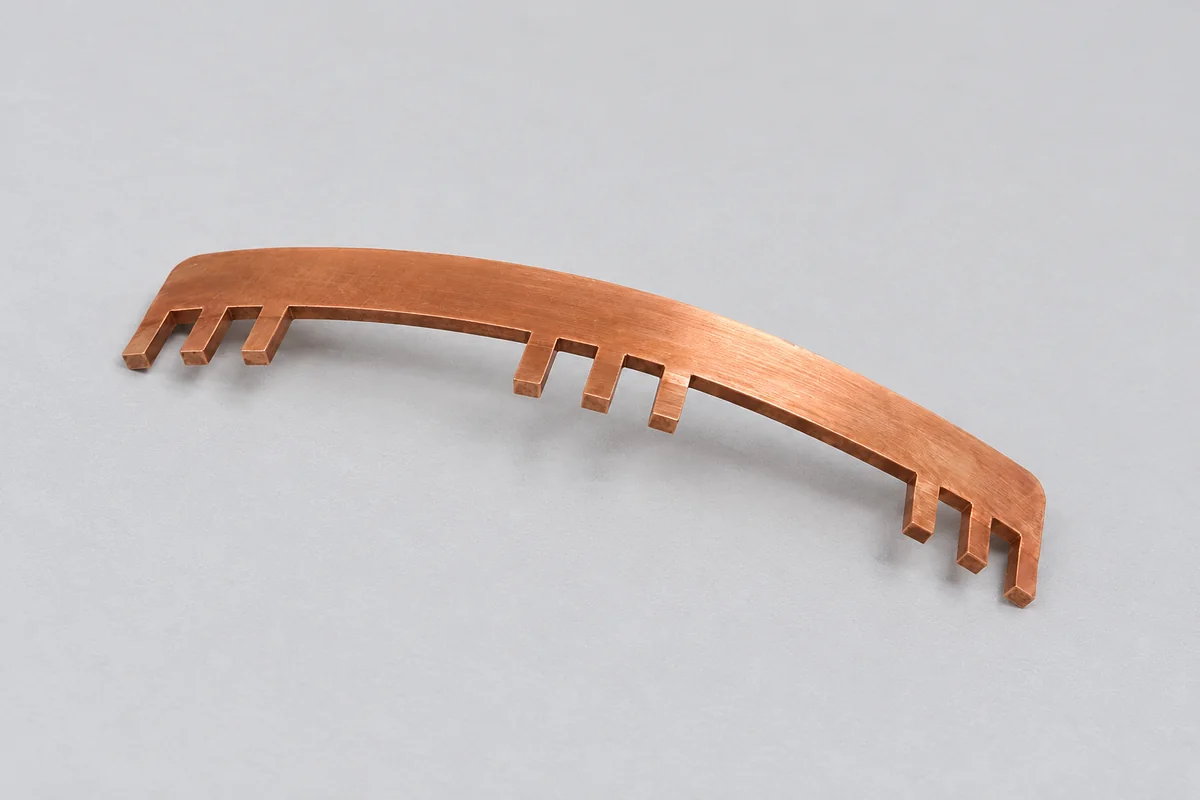
Copper busbars for switchgear, panels and battery systems · C11000 ampacity by size and temperature rise, skin effect at 60 Hz, emissivity and mounting conditions, ASTM B187 bar, plating and forming
A copper busbar is a solid or laminated copper conductor that carries high current between switchgear, panels, batteries and power electronics. Ask three things first: what continuous current it must carry and how hot it may run, since ampacity depends on size, temperature rise and mounting; what copper grade and bar standard apply; and what plating, forming, holes and insulation the assembly needs.
Rigid, formed, flexible and laminated copper busbars and copper bar stock for electrical distribution, switchgear, PDUs, battery and inverter systems. Aluminium busbars, busbar trunking systems, busbar processing machines and power distribution units are outside this page except where compared.
CNFX editorial research · Sources checked October 11, 2026 · 4 sources
The Copper Development Association's ampacity table for C11000 busbars, reproduced by Storm Power, lists for each bar size the area, weight per foot, DC resistance at 20 °C, and the 60 Hz skin-effect ratio and ampacity at 30 °C, 50 °C and 65 °C temperature rise. Examples: a 1/8 × 1 in bar carries 270, 360 and 415 A; a 1/4 × 2 in bar 710, 940 and 1,100 A; a 1/2 × 4 in bar 1,700, 2,300 and 2,650 A; and a 1/2 × 8 in bar 3,000, 4,000 and 4,600 A, with its skin-effect ratio reaching about 1.4. The ampacities assume an emissivity of 0.4 — observed on bars exposed for 60 days in an industrial environment — and typical indoor service at 40 °C ambient, a horizontal run on edge, and freedom from external magnetic influences. [1]
Editorial calculation: a 1/4 × 2 in bar has 0.5 in² (about 323 mm²) of copper, so 710 A at a 30 °C rise is about 2.2 A/mm² and 1,100 A at 65 °C about 3.4 A/mm²; a 1/2 × 8 in bar (about 2,581 mm²) at 3,000–4,600 A runs at only 1.2–1.8 A/mm², and its 60 Hz skin-effect ratio is about 1.4 against 1.04 for the smaller bar. The 1/4 × 2 in bar weighs 1.93 lb/ft, about 2.9 kg/m. [1] Editorial note: derate or recheck for higher ambient, flat mounting, enclosures, stacked bars or nearby magnetic material, which fall outside the table's stated conditions.
Give the supplier the continuous and short-circuit current, allowed temperature rise and ambient, AC or DC and frequency, bar size or cross-section, copper grade and standard, length, bends, holes and slots with tolerances, plating type and thickness, insulation (sleeve, coating, laminate), flexible sections, flatness and edge finish, drawings, and quantity.
02
Specify the copper grade, bar standard and finish
Storm Power supplies copper bar manufactured to ASTM B187, B152 and B283 in electrolytic tough pitch C11000 — 99.90% copper with 0.04% oxygen — for high thermal and electrical conductivity, in 12 ft lengths or custom cuts, in US sizes from 0.094 × 1 in to 0.5 × 4 in and metric sizes such as 5 × 20 mm to 10 × 140 mm. Some sizes come pre-plated with tin or silver flash, and custom cuts can be plated in-house with tin, matte tin, silver, nickel or lead. [2]
Editorial calculation: a 10 × 100 mm metric bar has 1,000 mm² of copper, about the same as 1/2 × 3 in (1.5 in², 968 mm²), which the CDA table rates at 1,400 A for a 30 °C rise. [2][1]
ASTM's own scope for B187/B187M-26 (Standard Specification for Copper, Bus Bar, Rod, and Shapes and General Purpose Rod, Bar, and Shapes) separates bar for electrical (bus) applications from general-purpose bar. Bus products must be made from one of the coppers listed in its section 1.1.1, and may be furnished from any of them unless the contract or purchase order names one; C10800 (OFLP) and C12200 (DHP) are allowed only for general applications. Products are made in two tempers, O60 (soft annealed) and H04 (hard), and are tested for dimensions (including straightness, edge contour and corner radii), mechanical properties (tensile, yield and bend strength, elongation, Rockwell hardness and embrittlement), electrical resistivity and chemical composition. Inch-pound and SI values are each standard on their own and are not to be combined. [4]
Editorial note: because B187 lets the mill supply any listed bus copper unless the order names one, state the UNS number (for example C11000 ETP, the grade Storm Power stocks), the temper (O60 soft annealed or H04 hard), and whether the order is in inch-pound or SI units. [4][2]
Suppliers linked to this page list copper busbars; each card links to the page reviewed.
Listings include flat, bent and formed copper busbars, stamped and welded busbars, flexible copper-foil and flexible insulated busbars, extruded and copper-aluminium composite busbars, and busbar systems; ask each for copper grade and certificate, flatness and hole tolerances, plating thickness and insulation testing.
04
Allow for surface emissivity and stacked bars when rating the busbar
The Copper Development Association's Table 4 shows how surface emissivity and the number of parallel bars change ampacity, for 1/4 × 4 in bars at 1/4 in spacing. A single bar at a 30 °C rise carries 1,100 A at emissivity 0.15, 1,250 A at 0.4, 1,400 A at 0.7 and 1,600 A at 0.9. Adding bars raises current by less than the bar count: at emissivity 0.4 and a 30 °C rise, two bars carry 2,050 A, three 2,700 A and four 3,300 A. CDA says this relationship is nonlinear, that ampacity can be raised by convection cooling or by surface treatments that improve emissivity, and that other configurations must be calculated from size, spacing, number of bars and overall skin-effect ratio. [3]
Editorial calculation: four stacked bars at a 30 °C rise and emissivity 0.4 carry 3,300 A, against 4 × 1,250 A = 5,000 A for four bars rated singly, so the stack delivers about 66% (3,300 ÷ 5,000) of the single-bar sum. For one bar at a 30 °C rise, moving from emissivity 0.15 to 0.9 lifts ampacity from 1,100 A to 1,600 A, about 45% more (1,600 ÷ 1,100 = 1.45). Ask the supplier which emissivity, bar spacing and number of bars its quoted rating assumes. [3]
Fill the specification fields with values for your busbar
A copper busbar quotation needs values for your assembly. The table explains each field, gives published values where a reviewed source states them, and says what to obtain from the supplier.
Explore company information and manufacturing capabilities, then discuss the scope of your project with a relevant supplier.
Compiled and source-reviewed by the CNFX editorial team.
Published product pages show what a company offers, not tested performance. Confirm the legal seller, factory and scope for your order. How we source and review
· Page last updated 11 October 2026
The CDA table gives, for example, 710 A for a 1/4 × 2 in C11000 bar at a 30 °C rise and 1,100 A at 65 °C, indoors at 40 °C ambient on edge. [1]
How does AC skin effect change busbar ratings?
The CDA table lists 60 Hz skin-effect ratios from 1.00 on small bars to about 1.4 on a 1/2 × 8 in bar, which lowers the AC current per square millimetre. [1]
What copper is used for busbars?
Electrolytic tough pitch C11000, 99.90% copper, supplied to ASTM B187, B152 and B283. [2]
Do two copper busbars in parallel carry twice the current of one?
No. The Copper Development Association's Table 4 rates one 1/4 × 4 in bar at 1,250 A and two bars at 1/4 in spacing at 2,050 A, at a 30 °C rise and emissivity 0.4. [3]
Which coppers does ASTM B187 allow for busbar?
For electrical (bus) use B187/B187M-26 lists C10100, C10200, C10300, C10400–C10700, C10920–C10940, C11000, C11020, C11300–C11600 and C12000; C10800 and C12200 are for general applications only. [4]
Sources and what still needs a direct check
Sources checked 2026-10-11. The ampacity table is the Copper Development Association's, reproduced by fabricator Storm Power Components, which also describes its own bar stock. IEC markets may use different conditions and standards. ASTM's B187/B187M-26 scope page lists the coppers and tempers allowed for bus bar.