Electric vehicle supply equipment · AC Level 2 vs DC fast charging, power and voltage range, connectors, OCPP and ISO 15118, uptime
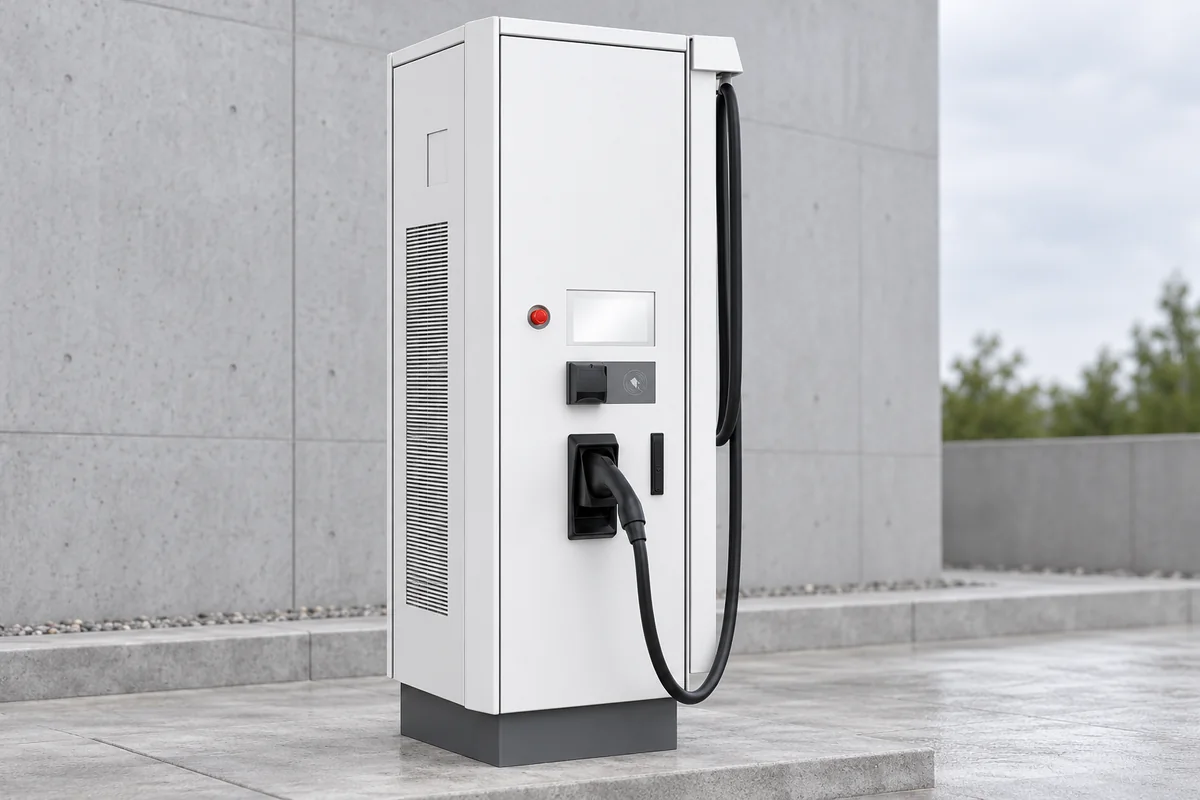
An EV charging pile is the electric vehicle supply equipment (EVSE) that delivers energy to a plug-in vehicle: an AC unit passes grid power to the car's on-board charger, while a DC fast charger converts power itself and feeds the battery directly through the connector. Ask three things first: which charging level and power per port the site needs, which connector standards and voltage range the vehicles require, and which communication protocols, metering and uptime the operator or funding programme demands.
AC Level 1/2 and DC fast charging equipment (wall boxes, pedestal and pile chargers, DC charging stations) for electric cars and light commercial vehicles. Charging cables and adapters on their own, enclosures, charging modules sold separately and battery swap stations are outside this page.
CNFX editorial research · Sources checked October 12, 2026 · 4 sources
The US Department of Energy's Alternative Fuels Data Center (AFDC) describes AC Level 1 as 120 V charging giving about 5 miles of range per hour at an assumed 1.9 kW; AC Level 2 as 240 V residential or 208 V commercial service, ranging from 2.9 to 19.2 kW, with residential units cited at up to 30 A delivering 7.2 kW on a dedicated 40 A circuit under NEC Article 625; and DC fast charging, fed from a three-phase AC input, at outputs up to 500 kW. It notes charging time depends on battery state of charge and capacity, the vehicle's on-board charger and the equipment's power. [1]
The US National Electric Vehicle Infrastructure standards (23 CFR 680) require funded DC fast charging ports to support output voltages from 250 to 920 V DC, corridor DC stations to deliver at least 150 kW continuously from each port simultaneously, stations to have at least four network-connected ports, and AC Level 2 ports at least 6 kW each simultaneously; power sharing is allowed only if each port still meets those minimums. [2]
Editorial calculation: adding 60 kWh to a battery takes about 60 / 7.2 ≈ 8.3 hours at a 7.2 kW Level 2 port, but about 24 minutes at a sustained 150 kW (real DC sessions taper as the battery fills). At 150 kW, the DC current is about 375 A at 400 V but 163 A at 920 V, which sets cable and connector ratings. [1][2]
A maker data sheet shows how those figures appear on a real unit. ABB E-mobility's Terra 124/184 leaflet (North American version) lists the Terra 184 at 180 kW to one vehicle or 90 kW to each of two, from 480Y/277 V AC ±10% three-phase input at 230 A and 192 kVA, with power factor above 0.96, current THD below 5%, 96% efficiency at nominal output and a 65 kA short-circuit current rating. DC output is 150–920 V for CCS1 and NACS (150–500 V for CHAdeMO) at up to 400 A peak (CCS1), 375 A (NACS) or 200 A (CHAdeMO). It supports OCPP 1.6J and 2.0.1 and ISO 15118, operates from −35 to +55 °C with derating at extremes, is rated IP54 and NEMA 3R, has a 6 m cable, measures 1,900 × 565 × 880 mm and weighs 395 kg; listed compliance includes UL 2202, UL 2231-1/-2, NEC Article 625, EN 61851 and ENERGY STAR. [3]
Editorial calculation: at 96% efficiency, 180 kW of output draws about 187.5 kW from the grid (180 ÷ 0.96), within the 192 kVA input rating, and the 7.5 kW difference is heat the cabinet must reject. [3]
Give the supplier the site type (home, workplace, public, fleet depot, highway), vehicles served and their connectors and voltages, power per port and number of ports, available grid supply and transformer, power sharing or load management, metering and payment requirements, network and protocol requirements (OCPP version, ISO 15118), environmental conditions and enclosure rating, cable length and management, and certifications required for the market.
02
Check connectors, communication and uptime
AFDC explains that an EV charging port charges one vehicle at a time even if it has more than one connector, and that the CCS (SAE J1772 combo) port accepts Level 1, Level 2 and DC fast charging, while CHAdeMO and the SAE J3400 (NACS) connector are the other DC systems. [1] 23 CFR 680 requires each funded DC port to charge any CCS-compliant vehicle with a permanently attached CCS Type 1 connector, and each AC Level 2 port to have a permanently attached J1772 connector. [2]
The NEVI rule also requires chargers to conform to ISO 15118-3 with hardware able to implement ISO 15118-2 and ISO 15118-20 and software capable of Plug and Charge, to communicate with charging networks using OCPP 2.0.1, to keep charging if network communication is temporarily lost, and to measure and report energy, port status, price and uptime; each funded port must average more than 97% uptime a year. [2]
AFDC points to EPRI's vetted product list, which checks safety listing by a nationally recognised testing laboratory and OCPP capability, and to ENERGY STAR certified chargers. [1] Editorial note: outside the US, connectors, grid codes and certification differ by market; tell the supplier where the chargers will be installed.
The US EPA's ENERGY STAR programme certifies Level 1 and Level 2 EV chargers. Its buyer page gives 2 to 5 miles of range per hour of charging for 120 V Level 1 chargers and 10 to 20 miles per hour for 240 V Level 2 chargers, says Level 2 charging is on average 10% more efficient than Level 1, and states that chargers spend about 85% of the time in standby mode, where certified units use 40% less energy than non-certified units. EPA also notes that its Clean School Bus Program requires every funded Level 2 charger to be ENERGY STAR certified. [4]
Editorial calculation: with standby taking about 85% of the hours in a year, a charger sits idle for roughly 0.85 × 8,760 ≈ 7,450 hours, so ask the supplier for the measured standby power in watts and whether the model appears on the ENERGY STAR certified list. [4]
03
Compare what suppliers offer
Suppliers linked to this page list EV chargers or charging piles; each card links to the page reviewed.
Listings include home and commercial AC wall boxes and piles, portable AC chargers, DC all-in-one chargers and split DC systems with charging modules, and charger lines from electrical equipment and energy-storage makers; ask each for power per port, voltage range, connectors, protocols and certifications.
04
Trace the charger parts
This is a functional reference built from the sources cited; it is not one maker's specification.
Fill the specification fields with values for your site
An EV charging pile quotation needs values for your site. The table explains each field, gives published values where a reviewed source states them, and says what to obtain from the supplier.
Explore company information and manufacturing capabilities, then discuss the scope of your project with a relevant supplier.
Compiled and source-reviewed by the CNFX editorial team.
Published product pages show what a company offers, not tested performance. Confirm the legal seller, factory and scope for your order. How we source and review
· Page last updated 12 October 2026
AFDC gives 2.9–19.2 kW, with residential units cited at up to 30 A and 7.2 kW on a dedicated 40 A circuit. [1]
What do US NEVI rules require of DC fast chargers?
23 CFR 680 requires 250–920 V DC output, at least 150 kW per corridor port, CCS Type 1 connectors, at least four ports and over 97% annual uptime. [2]
Which protocols should a charging pile support?
NEVI requires OCPP 2.0.1 for charger-to-network and ISO 15118 for charger-to-vehicle communication including Plug and Charge. [2]
What input supply does a 180 kW DC fast charger need?
ABB's Terra 184 data sheet lists 480Y/277 V AC three-phase at 230 A and 192 kVA, with 96% efficiency and power factor above 0.96 at nominal output. [3]
Does standby power matter for an AC charging pile?
ENERGY STAR states that EV chargers spend about 85% of the time in standby and that certified units use 40% less energy in standby than non-certified ones. [4]
Sources and what still needs a direct check
Sources checked 2026-10-12. The AFDC is the US Department of Energy's alternative fuels resource; 23 CFR 680 is the US federal rule for NEVI-funded chargers; ENERGY STAR is the US EPA's efficiency programme for EV chargers. Requirements in other markets differ.