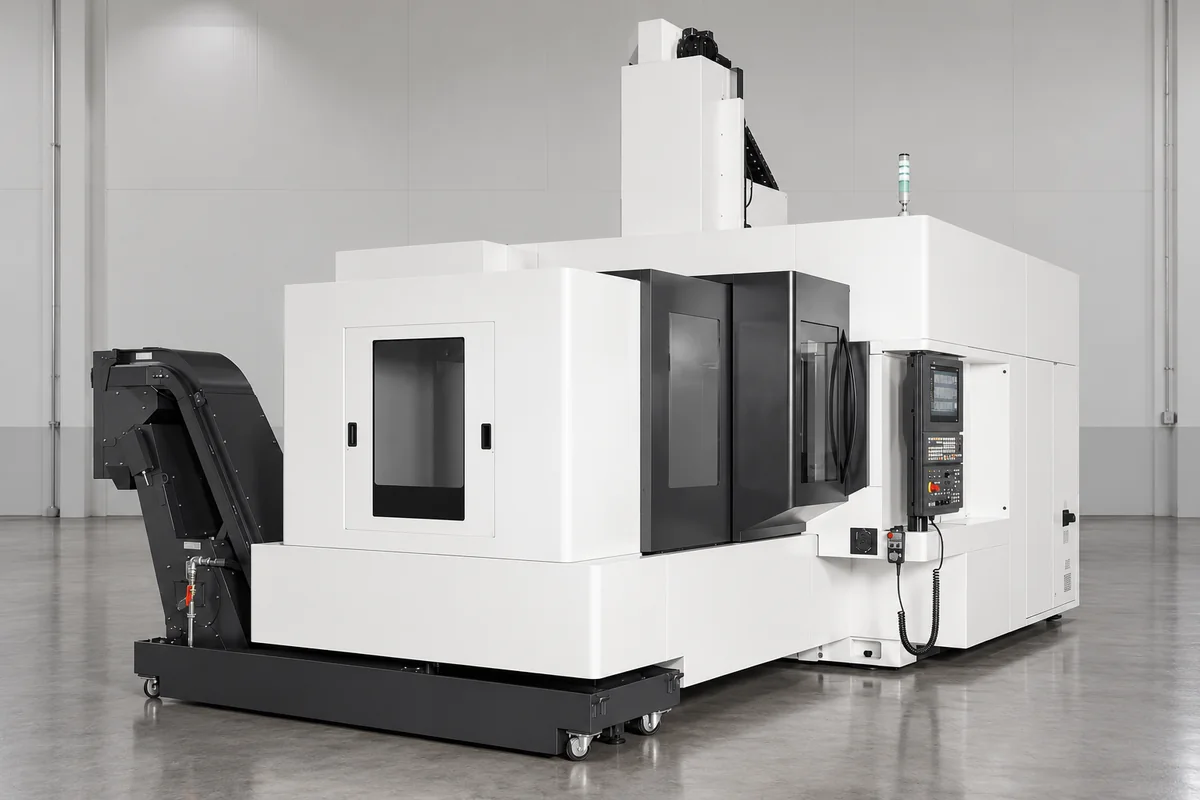
Gantry (double-column) machining centers · Table size and load, travels and column spacing, spindle taper, torque and power ratings, rapid feed, stated accuracy, power and floor space
A gantry machining center is a large CNC milling and boring machine in which the spindle head travels on a crossbeam supported by two columns spanning the worktable, giving a rigid frame for machining large, heavy workpieces such as moulds, plates, housings and machine bases. Ask three things first: whether the table, travels and space between the columns take your largest part and its weight, whether the spindle torque and power suit your cutting, and what accuracy, power and floor space the machine needs.
Gantry, bridge-type and double-column vertical machining centers, with fixed or moving tables and three or five axes. Gantry routers for wood and plastics, gantry grinders, single-column vertical machining centers and gantry robots are outside this page.
CNFX editorial research · Sources checked October 11, 2026 · 4 sources
Fit the workpiece: table, load, travels and column spacing
Kitamura's Bridgecenter double-column series specifies tables from 900 × 1,800 mm (Bridgecenter-6G) to 1,370 × 3,500 mm (12G) with maximum table loads of 3,000, 3,500 and 6,000 kg; X travels of 1,530 to 3,050 mm, Y 1,095 or 1,615 mm and Z 710 or 800 mm; a spindle-nose distance from the table of 152–862 mm or 150–950 mm; and 1,143 or 1,696 mm between the columns. [1]
SMTCL describes its GMC-RV series as gantry boring and milling machines with a moving table and a fixed crossbeam, a wrap-around ram, and an automatic right-angle milling head so that faces other than the clamping face can be milled, bored, drilled, reamed and tapped in one set-up, for shipbuilding, power generation, locomotive, machine-tool and mould work. [2]
Editorial note: check the part against the distance between columns as well as the table width; a part wider than the column gap cannot pass under the crossbeam even if it fits on the table.
A Chinese maker's single-model table shows the passing dimensions directly. Shandong Luzhong lists its GMC2014 gantry machining center with a 1,200 × 2,100 mm table carrying 3.5 t, X/Y/Z travels of 2,000, 1,500 and 800 mm, a gantry width of 1,500 mm and passing height of 1,030 mm, 150–950 mm from spindle nose to table, seven 22 mm T-slots at 170 mm pitch, a BT50 (190) spindle at 6,000 r/min with a 15/18.5 kW main motor, a 24-tool arm magazine, 15 m/min rapid traverse and 10 m/min cutting feed, positioning accuracy ±0.0075 mm on X/Y and ±0.015 mm on Z, repeat positioning accuracy ±0.005 mm, overall dimensions 6,700 × 4,200 × 4,200 mm and a machine weight of about 17.5 t. [3]
Editorial calculation: the GMC2014's 1,500 mm gantry width is 300 mm wider than its 1,200 mm table, and its 1,030 mm passing height is the tallest part that can pass under the beam; its 6,700 × 4,200 mm outline is about 28.1 m² of floor before access space. [3]
Give the supplier the largest part's length, width, height and weight, material, features on side faces (needing a right-angle head or five axes), tolerances and surface finish, cutting tools and taper, required stock removal, coolant and chip handling, power supply, floor space and foundation limits, and annual volume.
02
Check spindle torque and power, feed, accuracy and utilities
The Bridgecenter #40 spindle runs 20–20,000 min⁻¹ with 266.4 N·m maximum torque and a 22 kW (15-minute) / 15 kW (continuous) motor; the #50 spindle runs 35–12,000 min⁻¹ with 585.9 N·m and 40 kW (15-minute) / 22 kW (continuous), both gear driven in four steps. Rapid and cutting feed are 24 m/min on all axes, and Kitamura states an accuracy of ±0.002 mm over full stroke with linear-scale feedback. [1]
Utilities are 35–50 kVA at 200 V AC three-phase and 0.5 MPa air at 400 L/min; floor space runs from 3,494 × 4,472 mm to 4,168 × 8,800 mm, height up to 4,006 mm, and net weight from 17,500 kg to 31,000 kg. [1]
Editorial calculation: since power = torque × angular speed, 585.9 N·m at the 22 kW continuous rating is available only up to about 22,000 × 60 ÷ (2π × 585.9) ≈ 360 min⁻¹ (about 650 min⁻¹ at the 40 kW 15-minute rating); above that, torque falls with speed. The 12G's 8,800 mm × 4,168 mm footprint is about 36.7 m² before access space. [1]
Editorial note: Kitamura does not name the test standard behind its accuracy figure; ask each supplier for positioning accuracy and repeatability per axis with the test method and report.
03
Compare what suppliers offer
Suppliers linked to this page list gantry machining centers; each card links to the page reviewed.
Listings include three-axis and five-axis gantry machining centers, double-column machining centers and gantry boring and milling machines.
04
Compare large double-column ranges by column gap and spindle
Okuma Europe's MCR-series page lists four double-column machining centres with tables from 1,500 × 3,000 mm up to 3,000 × 12,000 mm (MCR-S: 2,000 × 4,000 to 2,500 × 6,500 mm) and tool magazines of 50 tools as standard with options up to 360. It describes the MCR-C as built for heavy industries' demand for high power, high torque and high productivity, with axis travels from X 4,200 / Y 3,200 / Z 1,050 mm to X 12,200 / Y 4,200 / Z 1,250 mm. The series lists automatic pallet changers (APC) and automatic attachment changers (AAC). [4]
Editorial calculation: Okuma's narrowest column gap, 2,150 mm, is 454 mm wider than Kitamura's widest 1,696 mm column spacing (2,150 − 1,696). [4][1]
Okuma's page does not state spindle torque, table load or accuracy; ask for them for the exact table size and spindle option, together with the attachment heads that come with the automatic attachment changer.
Okuma model
Distance between columns, mm
Spindle speed, min⁻¹ [options] / motor, kW
MCR-C
2,650–3,650
4,000 [6,000, 10,000] / 45/37 [37/30]
MCR-A5CII
2,150–3,650
4,000 [6,000, 10,000] / 26/22
MCR-S
2,650–3,150
10,000 [20,000] / 26/22
MCR-BV
2,150–3,650
4,000 [6,000, 8,000, 10,000, 20,000] / 43/37
05
Trace the machine components
This is a functional reference built from the sources cited; it is not one maker's design.
Fill the specification fields with values for your parts
A gantry machining center quotation needs values for your parts. The table explains each field, gives published values where a reviewed source states them, and says what to obtain from the supplier.
Field
What it means and published values
Ask the supplier for
Table Size (W x L) (mm)
900 × 1,800 to 1,370 × 3,500 mm in one series; 1,200 × 2,100 mm in one model. [1][3]
Explore company information and manufacturing capabilities, then discuss the scope of your project with a relevant supplier.
Compiled and source-reviewed by the CNFX editorial team.
Published product pages show what a company offers, not tested performance. Confirm the legal seller, factory, acceptance tests and scope for your order. How we source and review
· Page last updated 11 October 2026
How heavy a part can a gantry machining center carry?
Kitamura's Bridgecenter series lists 3,000 to 6,000 kg maximum table load. [1]
Is full spindle torque available at all speeds?
No; at 22 kW continuous the 585.9 N·m #50 spindle can deliver full torque only up to about 360 min⁻¹ (editorial calculation). [1]
Can a gantry machine work on side faces?
SMTCL's GMC-RV series uses an automatic right-angle milling head to machine faces other than the clamping face in one set-up. [2]
How tall a part can pass under a gantry?
It is the passing height under the beam, not the Z travel; Shandong Luzhong lists 1,030 mm passing height and 1,500 mm gantry width for its GMC2014. [3]
How wide can the column gap of a large double-column machining center be?
Okuma Europe lists 2,150–3,650 mm between columns across its MCR series, with tables up to 3,000 × 12,000 mm. [4]
Sources and what still needs a direct check
Sources checked 2026-10-11. Kitamura, SMTCL and Shandong Luzhong describe their own machines; capacities and accuracy for your machine must come from the supplier's specification and acceptance tests.