Industry-Verified Manufacturing Data (2026)

Lithium-Ion Battery Cell Assembly System

Based on aggregated insights from multiple verified factory profiles within the CNFX directory, the standard Lithium-Ion Battery Cell Assembly System used in the Electrical Equipment Manufacturing sector typically supports operational capacities ranging from standard industrial configurations to heavy-duty production requirements.

Technical Definition & Core Assembly

A canonical Lithium-Ion Battery Cell Assembly System is characterized by the integration of Electrode Stacking Module and Welding Station. In industrial production environments, manufacturers listed on CNFX commonly emphasize Stainless Steel construction to support stable, high-cycle operation across diverse manufacturing scenarios.

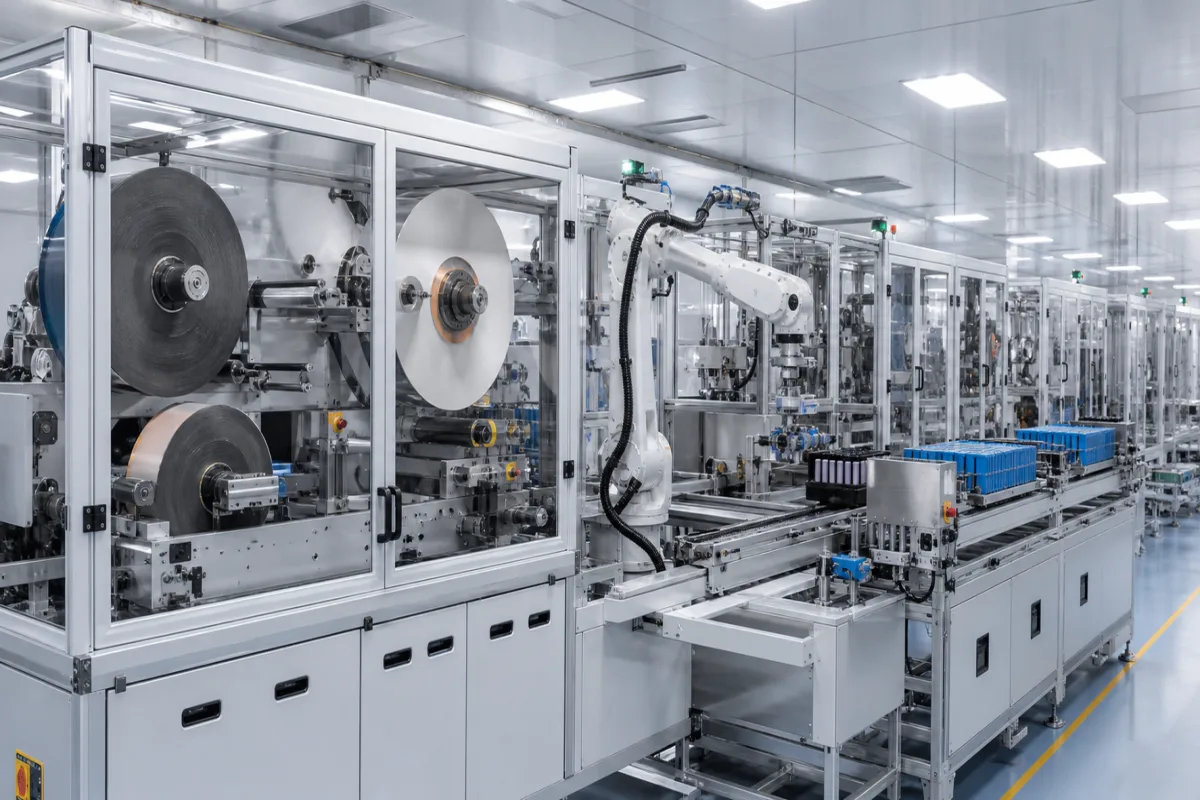
Integrated production line for assembling lithium-ion battery cells from coated electrodes
Product Specifications

Technical details and manufacturing context for Lithium-Ion Battery Cell Assembly System

Definition
A fully integrated industrial production system that automates the sequential assembly of lithium-ion battery cells. This coordinated multi-module solution transforms coated electrode rolls into finished battery cells through precise stacking, welding, sealing, and electrolyte filling operations. The system ensures consistent quality and high throughput for mass production of prismatic, cylindrical, or pouch battery cells. It integrates multiple specialized stations with material handling and quality control systems to create a complete manufacturing workflow.
Working Principle
Automated material handling transports coated electrode rolls through sequential stations where they are cut, stacked with separators, welded with current collectors, sealed in housings, filled with electrolyte, and finally sealed to produce finished battery cells.
Common Materials
Stainless Steel, Aluminum Alloy, Engineering Plastics, Industrial Ceramics
Technical Parameters
  • Operational availability percentage (%) Customizable
  • Maximum output rate of finished battery cells (cells/hour) Customizable
  • Number of different cell formats supported (types) Customizable
Components / BOM
  • Electrode Stacking Module
    Precisely stacks alternating layers of anodes, separators, and cathodes
    Material: Stainless Steel Frame with Ceramic Guides
  • Welding Station
    Connects electrode tabs to current collectors using laser or ultrasonic welding
    Material: Aluminum Alloy Housing with Copper Components
  • Cell Housing Assembly
    Assembles and seals battery cell housings (prismatic, cylindrical, or pouch)
    Material: Stainless Steel with Polymer Seals
  • Electrolyte Filling System
    Precisely injects electrolyte into assembled cell housings
    Material: Corrosion-Resistant Stainless Steel
  • Final Sealing Station
    Hermetically seals filled battery cells
    Material: Stainless Steel with Heat-Resistant Components
  • Material Handling System
    Transports components between stations using conveyors and robotic arms
    Material: Aluminum Alloy with Polymer Belts
  • Quality Inspection Module Optional
    Performs automated visual and electrical testing of finished cells
    Material: Aluminum Frame with Optical Components
Engineering Reasoning
0.5-3.0 MPa electrode compression pressure, 20-40°C ambient temperature, 30-60% relative humidity
Electrode compression pressure <0.3 MPa causes poor contact resistance >15 mΩ·cm², >3.5 MPa causes separator deformation <5 μm thickness, >45°C causes electrolyte decomposition rate >0.1%/day
Design Rationale: Electrode delamination due to insufficient compression pressure (contact resistance >15 mΩ·cm²), separator puncture from excessive compression (>3.5 MPa causing <5 μm thickness), electrolyte thermal decomposition (Arrhenius rate doubling per 10°C above 45°C)
Risk Mitigation (FMEA)
Trigger Electrode misalignment >0.2 mm during stacking
Mode: Internal short circuit with resistance <100 Ω between electrodes
Strategy: Vision-guided robotic alignment with 0.05 mm precision using laser triangulation sensors
Trigger Electrolyte filling vacuum level <10 Pa absolute pressure
Mode: Incomplete electrolyte wetting with >5% dry electrode area
Strategy: Two-stage vacuum filling: 1 Pa absolute pressure for 30 minutes followed by 50 kPa nitrogen backfill

Industry Taxonomies & Aliases

Commonly used trade names and technical identifiers for Lithium-Ion Battery Cell Assembly System.

Industrial Ecosystem & Supply Chain DNA

Complementary Systems
Downstream Applications
Specialized Tooling

Application Fit & Sizing Matrix

Operational Limits
pressure: Atmospheric to 0.5 bar positive pressure (cleanroom environment)
other spec: Slurry concentration: 40-60% solids by weight, Electrode coating thickness: 50-200 μm, Line speed: 0.5-5 m/min
temperature: 15-30°C (operating), 10-35°C (storage)
Media Compatibility
✓ NMP-based electrode slurries ✓ Aqueous electrode slurries ✓ Polymer separator films
Unsuitable: High-humidity environments (>60% RH) without proper dehumidification
Sizing Data Required
  • Required annual production capacity (MWh/year)
  • Electrode dimensions (width, length, coating area)
  • Target cell format (pouch, cylindrical, prismatic)

Reliability & Engineering Risk Analysis

Failure Mode & Root Cause
Electrode misalignment
Cause: Inaccurate positioning during stacking or calendering, leading to internal short circuits, reduced capacity, and thermal runaway risks.
Electrolyte leakage
Cause: Seal degradation or improper welding at cell casing joints, causing contamination, loss of ionic conductivity, and potential fire hazards.
Maintenance Indicators
  • Audible hissing or popping from cell casing indicating gas venting or internal pressure buildup
  • Visible electrolyte seepage or corrosion around cell terminals and casing seams
Engineering Tips
  • Implement automated optical inspection (AOI) with machine vision for real-time electrode alignment verification during stacking
  • Use laser welding with closed-loop thermal monitoring to ensure consistent, hermetic seals and prevent electrolyte leakage

Compliance & Manufacturing Standards

Reference Standards
ISO 9001:2015 Quality Management Systems IEC 62133-2:2017 Safety of Secondary Cells and Batteries UL 1642 Standard for Lithium Batteries
Manufacturing Precision
  • Electrode Alignment: +/- 0.1mm
  • Cell Stacking Pressure: +/- 5% of target value
Quality Inspection
  • Leak Test (Helium Mass Spectrometry)
  • Electrode Coating Uniformity Test (Beta Gauge Measurement)

Factories Producing Lithium-Ion Battery Cell Assembly System

Verified manufacturers with capability to produce this product in China

✓ 93% Supplier Capability Match Found

P Procurement Specialist from Germany Feb 21, 2026
★★★★★
"The Lithium-Ion Battery Cell Assembly System we sourced perfectly fits our Electrical Equipment Manufacturing production line requirements."
Technical Specifications Verified
T Technical Director from Brazil Feb 18, 2026
★★★★★
"Found 39+ suppliers for Lithium-Ion Battery Cell Assembly System on CNFX, but this spec remains the most cost-effective."
Technical Specifications Verified
P Project Engineer from Canada Feb 15, 2026
★★★★★
"The technical documentation for this Lithium-Ion Battery Cell Assembly System is very thorough, especially regarding Production Rate (cells/hour)."
Technical Specifications Verified
Verification Protocol

“Feedback is collected from verified sourcing managers during RFQ (Request for Quote) and factory evaluation processes on CNFX. These reports represent historical performance data and technical audit summaries from our B2B manufacturing network.”

18 sourcing managers are analyzing this specification now. Last inquiry for Lithium-Ion Battery Cell Assembly System from Poland (18m ago).

Supply Chain Commonly Integrated Components

Control Cabinet

Electrical enclosure housing control systems for automated industrial equipment

Explore Specs →
Rotor Assembly

The rotating component of an actuator motor that converts electrical energy into mechanical motion

Explore Specs →
Stator Assembly

The stationary component of an electric motor that generates a rotating magnetic field when energized.

Explore Specs →
Wire Tensioner

A device that applies and maintains precise tension on electrical wire during the winding process of transformers.

Explore Specs →

Frequently Asked Questions

What is the typical production capacity of this battery cell assembly system?

The system is designed for high-volume production with configurable rates typically ranging from 1,000 to 10,000 cells per hour, depending on cell size and automation level.

How does the system ensure consistent quality during battery assembly?

Multiple quality inspection modules monitor critical parameters including electrode alignment, electrolyte fill volume, seal integrity, and electrical properties to maintain yield rates above 99.5%.

What materials are used in the construction of this assembly system?

The system utilizes corrosion-resistant materials including stainless steel for structural components, aluminum alloy for lightweight parts, engineering plastics for wear surfaces, and industrial ceramics for high-temperature areas.

Can I contact factories directly on CNFX?

CNFX is an open directory, not a transaction platform. Each factory profile provides direct contact information and production details to help you initiate direct inquiries with Chinese suppliers.

Get Quote for Lithium-Ion Battery Cell Assembly System

Request technical pricing, lead times, or customized specifications for Lithium-Ion Battery Cell Assembly System directly from verified manufacturing units.

Your business information is encrypted and only shared with verified Lithium-Ion Battery Cell Assembly System suppliers.

Thank you! Your message has been sent. We'll respond within 1–3 business days.

Need to Manufacture Lithium-Ion Battery Cell Assembly System?

Connect with verified factories specializing in this product category

Add Your Factory Contact Us
Previous Product
Lithium Nickel Manganese Cobalt Oxide Cathode Active Material
Next Product
Lithium-Ion Battery Electrode Coating Machine