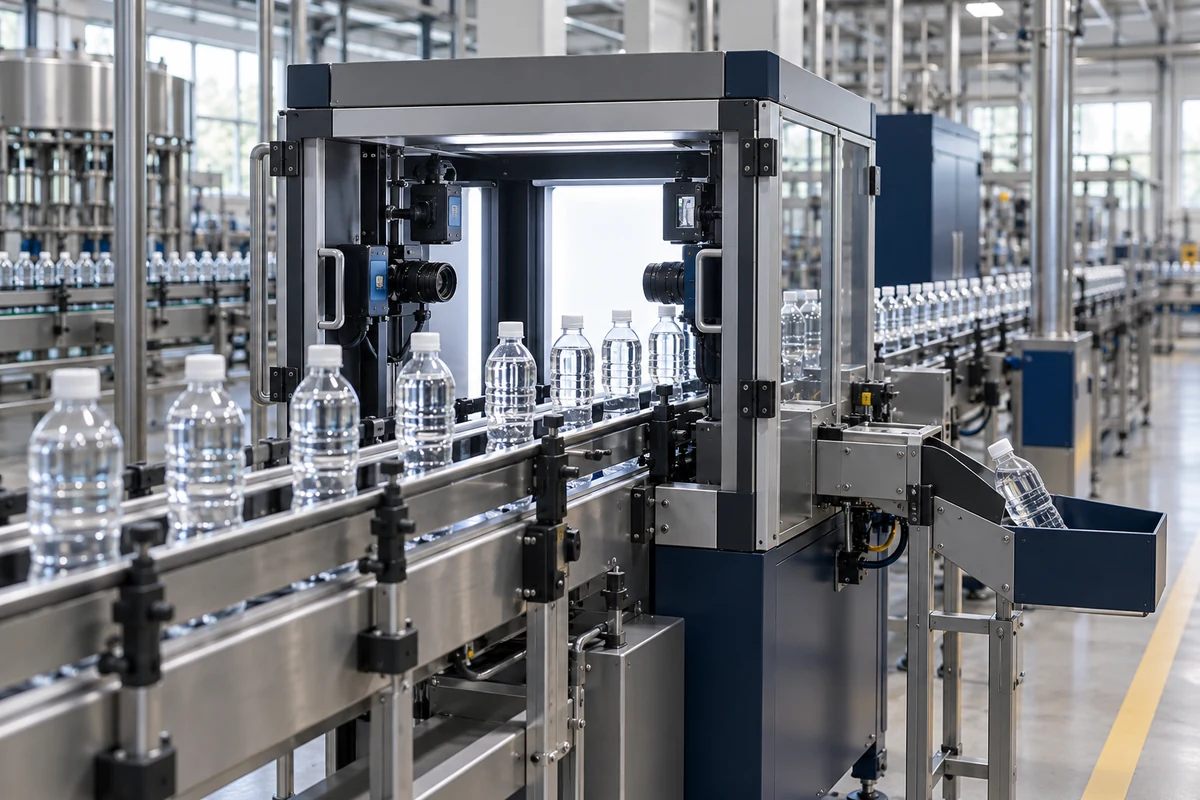
A bottle can pass a fill-level check and still have the wrong cap or label. Start with the defect you need to detect, then choose the sensing method and the rejection path. This guide separates filled-container checks, camera-system components and the evidence needed to accept a working line.
This entry covers bottle and package inspection on beverage lines. Krones figures describe its named Checkmat configurations; Bimeigao’s plastic-bottle claims have different evidence and limits. A camera result alone does not establish closure torque, leak tightness or sterile-package integrity.
CNFX editorial research · Sources checked October 10, 2026 · 4 sources
Pick the fill-level technology for container and product
Krones lists five Checkmat fill-level methods. The figures below are the stated maximum outputs of those configurations, not guaranteed speed for every combination of container, check and reject equipment [1].
Keep the measurement claim attached to the measured feature
Krones describes fill-height checking within one millimetre. That wording is not a published ±1 mm specification for every configuration, a millilitre accuracy figure, or evidence that cap position has the same accuracy. Specify the actual bottle and acceptance threshold [1].
Foaming/non-foaming products, including non-consistent foam; Applications names PET and cans.
Benefits also names glass, conflicting with Applications in both website and brochure. Glass suitability is unresolved; country restrictions are stated [1][4].
Krones says HF/camera versions need no registration or radiation-protection officer, and lists additional requirements for radiation versions. This is its equipment application guidance, not a universal statement of law in every destination [1].
02
Inspect caps and tamper-evident bands
The cap modules answer different questions. A presence sensor, an image of crown printing and four side views do not establish the same set of defects [1].
Presence only
One sensor checks whether a crown or plastic screw cap is present, up to 90,000 containers/h; it does not establish cap height or tightening torque [1].
Crown print
One camera checks colour/logo, wrong cap and print damage/position, up to 90,000 containers/h. “360°” here means independence from the rotation of the print; it is not a four-side-view module [1].
Plastic-cap colour
One compact camera inspects colour at a lateral region; uniform cap colour is required. Published maximum is 90,000 containers/h [1].
Four-side cap inspection
Four cameras inspect around crowns, plastic screw caps, tethered caps and aluminium roll-on caps, up to 90,000 containers/h. The brochure’s matrix assigns different checks to different cap types: rolling damage is an aluminium-cap check, while damaged perforation is listed for plastic/aluminium [1][4].
Droplets and the actual module
Classic camera modules specify no drops and a cap blower. The brochure’s AI cap-inclination arrangement for non-returnable PET says residual drops on the support ledge do not interfere. Dry-cap requirements therefore belong to the offered module, not every camera inspection [1][4].
The brochure describes AI fill-level processing for glass and PET, while the website camera tab names glass for its AI option. Keep those configurations separate until the supplier identifies the offered version. No visual cap-angle or band check is presented as a torque test or a validated leak test [1][4].
03
Follow the image decision through to a physical reject
Cognex’s In-Sight example has an imager, processor and input/output communications in a smart camera. A complete line still needs the product presentation, optical setup and defined handling of its result [2].
At rated output, bottles can be only milliseconds apart
An arithmetic conversion of the camera module’s 90,000/h maximum is 25 bottles/s, or 40 ms between uniformly spaced bottles. The 144,000/h configurations correspond to 40/s and 25 ms. These are arrival intervals, not proved processing latencies or a requirement that every operation finish sequentially within one interval. Agree triggering and reject tracking for the actual spacing and speed [1].
Present and trigger
The bottle enters the viewing position. Cognex describes an optional optical/magnetic synchronising sensor that can initiate image capture and a light pulse; the external sensor is not mandatory in every design. Bimeigao describes conveyor/camera-trigger synchronisation [2][3].
Illuminate and form the image
Lighting creates useful contrast; the lens frames the field of view. The camera converts the view into pixels. Lens choice, lighting and the bottle’s visible region belong to the detection task, rather than a megapixel count alone [2].
Measure or identify
Configured image tools count, measure or identify features and produce a pass/fail result. Cognex’s eight-bit monochrome example is an explanation of image values, not the bit depth or resolution of every camera [2].
Communicate and remove
The result can be sent to a PLC, HMI or robot, or to an optional reject/sort actuator. Bimeigao’s displayed arrangement uses cylinder sorting. Krones separately lists reject monitoring; an inspection signal and confirmed physical removal are separate acceptance observations [2][3][4].
04
See the optical, control and handling components
The functional structure below combines the documented In-Sight arrangement and Bimeigao’s displayed bottle cell. Integrated and separate-camera systems package these functions differently; it is not a manufacturer’s bill of materials with quantities, part numbers or certified material grades [2][3].
Component / BOM reference
Role in the inspection
Configuration and material boundary
Bottle transport and presentation
Move bottles through the intended view; Bimeigao describes synchronising its conveyor with camera triggering [3].
Bottle guides, spacing and access depend on the offered cell. Conveyor/frame grades are not specified in the viewed technical description.
Position/trigger input
Initiate capture at the viewing position; Cognex’s external synchronising sensor is optional [2].
Identify the real trigger source and line interface. No universal sensor material or encoder configuration is established.
Lens and optical view
Set the field of view onto the image sensor; focus and optics determine which bottle region is imaged [2].
Lens model, viewing coverage and optical material need the proposed camera configuration.
Industrial camera / imager
Capture images for measurement and identification. Bimeigao’s product overview describes six cameras in its displayed arrangement [2][3].
Six is that supplier’s stated arrangement, not a category requirement. Camera housing grade and sensor resolution are not published here.
Illumination
Highlight inspection features; Bimeigao lists ring, back or coaxial lighting [2][3].
The list describes choices, not proof all are fitted simultaneously. Light wavelength, power and housing material remain unspecified.
Image processor and inspection software
Analyse features and assign results. Cognex integrates processing in the camera; Bimeigao lists edge detection, matching and deep-learning algorithms [2][3].
A separate processing box is not universal. Software scope and version must match the checks demonstrated.
Operator interface and line I/O
Configure/monitor inspection and exchange results with line controls. Cognex lists HMI/PLC/network communications; Bimeigao shows a control screen [2][3].
Screen enclosure, voltage, network protocol and interface responsibility need the offered system documents.
Reject/sort mechanism and monitoring
Physically divert a failed bottle; Bimeigao describes two removal systems and cylinder sorting. Krones lists an optional reject-monitoring unit [3][4].
Actuator count/type, reject confirmation and air demand are configuration-specific. No universal stainless grade or pneumatic pressure is established.
Use the selected station’s issued parts list before ordering replacement cameras, lenses, lamps or actuators. Functional names alone do not establish spare-part compatibility.
05
Read Bimeigao’s bottle claims with their missing test conditions
The current plastic-bottle page embeds its technical explanation in images. Its overview describes six industrial cameras and two removal systems, with a claimed 360-degree view. These are the supplier’s published statements, not an independently tested line [3].
Published checks
The camera block lists appearance defects such as scratches, stains, black spots, bubbles and deformation; label position/printing and barcode/QR reading; fill height; skewed cap or leakage; and bottle/liquid colour [3].
Published speed and precision
The advantages image says hundreds of bottles per minute, dependent on line speed; measurement accuracy ±0.1 mm; and, as an example, small defects of 0.2 mm. No model-specific speed, field of view, tested defect contrast/location or validation report is provided [3].
Industry examples
The applications image names beverage/mineral-water fill level, labels and sealing; cosmetic appearance/print; and medical-bottle dimensions/sterile-packaging integrity. These marketing scopes do not establish the method or detection limit for a leak or integrity test [3].
What to obtain before accepting the claim
Request images and results from the proposed bottle, product, labels and caps at the requested speed. Have the supplier identify which algorithm, view and rejection channel handles each defined defect. This is a proposed procurement check, not an assertion that those tests have already passed.
The page does not publish the conditions needed to adopt its precision or defect example as your acceptance limit. No claimed “100%” quality coverage is treated as a statistical guarantee, and no general capability to detect every contaminant is established [3].
06
Tie each parameter to a bottle, check and configuration
Specify one detection requirement for each feature and its real line condition. A measurement error, the smallest detectable defect and the fraction of faulty bottles caught answer different questions. The numerical maker examples above cannot be combined into a universal system rating [1][3].
Parameter
Unit / basis
Meaning and evidence needed
Detection / measurement accuracy
mm; named measured feature
Separate fill-height measurement error from cap-position measurement and smallest detectable flaw. Bimeigao’s ±0.1 mm and 0.2 mm example have unspecified test conditions [3].
Inspection speed
containers/h; actual spacing and check set
Krones publishes configuration maxima of 72,000, 90,000 or 144,000/h. Establish sustained speed for the offered checks and reject path; camera count alone does not prove throughput [1].
Camera resolution
pixels or MP; field of view and optics
Specify each camera, lens and visible bottle region. Cognex makes optics and lighting part of the solution; the viewed Bimeigao page does not give a camera-resolution value [2][3].
Defect detection rate
%; identified faulty samples as denominator
Report caught faulty bottles / faulty bottles presented, per named defect and operating condition. Agree the sample and target; no category-wide percentage is established here.
False-reject rate
%; conforming samples as denominator
Report incorrectly rejected good bottles / good bottles presented. Include normal colour, printing, foam and droplet variations in the agreed trial.
Operating environment
°C, moisture and line cleaning conditions
Use the selected enclosure/camera/light/actuator ratings and issued cleaning instructions. The viewed sources do not establish a shared temperature range.
Ingress protection
Verified rating of each exposed assembly
Obtain the actual enclosure, connector and component ratings and cleaning limits. No category-wide IP rating or washdown permission is established by these sources.
Supply voltage
V, AC/DC, phases/frequency and tolerance
Use the issued electrical specification for the complete cell and its components; no shared 24 V supply or voltage tolerance is confirmed.
Electrical demand
kW installed/running; defined scope
Include supplied conveyance, lighting, processing and actuators. No system power range is given by these source descriptions.
Air consumption
Defined reference conditions; average and reject duty
State whether air is needed by the selected reject and blower. Krones’s Ingeniq example includes an electric cap blower, so compressed-air demand is not universal [4].
Pneumatic pressure / quality
At the selected actuator; specified quality class
Use the actual pneumatic design and duty. Neither a universal supply pressure nor an air-purity class follows from a generic cylinder description [3].
Weight
kg; supplied-cell and transport boundaries
Identify included conveyor, enclosure and reject equipment. No reliable shared weight is published in the sources used here.
Dimensions and line envelope
L×W×H; conveyor height, interfaces and access
Use the station drawing and include reject clearance and service access. A generic box dimension cannot establish installation fit.
The fields are specification explanations. Values absent from the offered-system documentation remain open, rather than being filled with typical category numbers.
07
Test faulty bottles and good bottles through the complete line
The following is an editorial acceptance-plan proposal. Agree defect definitions and pass criteria with the supplier before the trial. It separates image recognition, good-product loss and actual rejection, rather than treating the word “inspection” as proof of all three.
Create a defect-by-view schedule
List low/high fill, missing/wrong/slanted cap, damaged band, label/printing/code defects and any specifically demonstrated contamination check. For each, state the threshold, sample condition, viewing method, software configuration and rejection channel. Only claim coverage that was tested.
Run known faulty and conforming samples
Test the agreed bottle/product combinations at the required speed and spacing, including the foam and droplet conditions relevant to the offered module. Record the number presented, identified, missed and physically removed for each defect; also run good bottles and count false rejects.
Use the right denominator
Worked illustration, not a supplier result: identifying 99 of 100 known faulty bottles is a 99% observed detection rate. Rejecting 20 of 20,000 known good bottles is a 0.1% observed false-reject rate. The first says nothing about the second, and a finite trial alone is not a lifetime performance guarantee.
Keep evidence for operation and changeover
Retain sample images, software/recipe version, settings, counts and the physical reject outcome. Define the issued cleaning, optical checks and repeat-verification instructions after a bottle, cap, label or recipe change. No maintenance interval or cleaning agent is invented here.
Cognex documents image tools and result outputs; Krones lists reject monitoring separately. These support the distinction between detecting a failed bottle and removing it. They do not supply a mandatory test sample size or universal acceptance percentage [2][4].
08
Describe the bottle, defect and reject path in your enquiry
Paste it into your enquiry below or into an email to a maker, then replace every bracket.
Product: bottle/package inspection system; quantity [ ]; destination/site [ ]
Container: PET/glass/can [ ], size/shape/drawing [ ], colour/transparency [ ], labels/embossing at fill height [ ]
Contents: foam/consistency [ ], oil [ ], alcohol [ %], product and temperature during inspection [ ]
Line: required sustained [containers/h], spacing [ ], conveyor height/interfaces [ ], station position [ ]
Fill: measured region [ ], low/high threshold [mm], method [ ]; any volume requirement and its validation [ ]
Caps/bands: cap type [ ], presence/colour/print/height/inclination/perforation/rolling checks [ ]; droplet condition [ ]
Labels/codes/appearance: defined flaws and limits [ ], viewing coverage [ ], acceptable variation [ ]
Leak/integrity/foreign-matter tasks, if required: method [ ], detectable sample [ ], evidence of suitability [ ]
Configuration: camera/lens/light/trigger/processor [ ], software version/recipes [ ], radiation application requirements for destination [ ]
Reject: device/channel [ ], tracking and confirmed removal [ ], bin/alarm/interlock responsibility [ ]
Acceptance: faulty and conforming sample sets [ ], speed/condition [ ], per-defect detection and false-reject targets [ ], recorded images/outcomes [ ]
Utilities/site: issued electrical/pneumatic specs [ ], enclosure/cleaning limits [ ], layout/weight/service clearance [ ]
Handover: parts list, drawings, interfaces, settings backup, operating/cleaning/reverification instructions [ ]; delivery/commissioning [ ]
Bimeigao publishes plastic-bottle vision equipment. Newgoer and Shanan publish food X-ray inspection equipment with a different sensing task.
Guangzhou Bimeigao Intelligent System Technology Co., Ltd.
Guangzhou, Guangdong, CN
Bimeigao publishes plastic-bottle visual inspection equipment, describing six cameras and two removal systems. Its ±0.1 mm and example 0.2 mm defect claims lack a model-specific test basis. Fill height, appearance, labels/codes and stated sealing checks need demonstrated coverage for the offered bottle.
Newgoer’s food X-ray catalogue lists packaged-product inspection under NG-708F, but its description also names SC-E. Resolve model identity and obtain bottle-specific contaminant/fill-level evidence. This is X-ray food inspection, not verified cap/label camera performance. The working source uses the www hostname.
Shanan’s current site lists food X-ray inspection, metal detectors and checkweighers, including packaged can/bottle applications. Those product families do not establish a camera-based cap/label station or the stated Checkmat speeds. Bottle and contaminant suitability remain offer-specific; certificate and customer claims have not been independently verified here.
Explore company information and manufacturing capabilities, then discuss the scope of your project with a relevant supplier.
Share this page
Compiled and source-reviewed by the CNFX editorial team.
Each manufacturer above links to the page on that company's own website where the product is listed, with the date we checked it. How we source and review
· Page last updated 13 October 2026
Buyer questions
Can I inspect fill height through an opaque or labelled bottle?
The cited Checkmat camera configuration needs a transparent container and a clear fill-height region without printing or embossing. HF also excludes metallic labels/foiling/containers and some products. The listed gamma/X-ray configurations have different container and foam limits; choose by the offered configuration, not speed alone. [1]
Must every camera cap inspection have perfectly dry caps?
Classic Checkmat camera modules specify no droplets and a blower. The brochure’s AI cap-inclination configuration for non-returnable PET says residual water drops on the support ledge do not interfere. Identify the exact module and test the actual droplet condition. [1][4]
Does 360-degree crown inspection mean four side cameras?
In the single-camera crown-print module, it means the print can be inspected independently of rotational orientation. The all-cap module separately uses four side cameras. Their checks and configurations differ. [1]
Has Bimeigao’s ±0.1 mm claim been verified for my bottle?
The current page’s advantages image publishes that measurement claim and an example 0.2 mm defect, but no defined field of view, model-specific trial conditions or validation report. It cannot be adopted as your guaranteed measurement error or minimum detectable flaw without a demonstrated configuration. [3]
Does a smart camera include everything needed to reject a bottle?
Cognex describes integrated imaging, processing and I/O, while an external synchronising sensor and reject/sort actuator are optional. The line needs the selected optics, lighting, product presentation, result interface and physical reject equipment; a pass/fail image result alone is not confirmed removal. [2][4]
Sources and what still needs a direct check
Sources checked 2026-10-10. The technology tabs, linked brochure and Bimeigao technical images were read directly. Manufacturer maxima and marketing claims are attributed; none is a tested result for your installation. The test-plan illustrations are editorial examples.