Editorial Technical Reference

End-Effector

This page explains how End-Effector is classified within Machinery and Equipment Manufacturing. Technical values and manufacturer relationships are research references; confirm the current specification and supplier evidence for each order.

Technical Definition & Core Assembly

The terminal component of a robotic arm that directly interacts with objects or performs specific tasks.
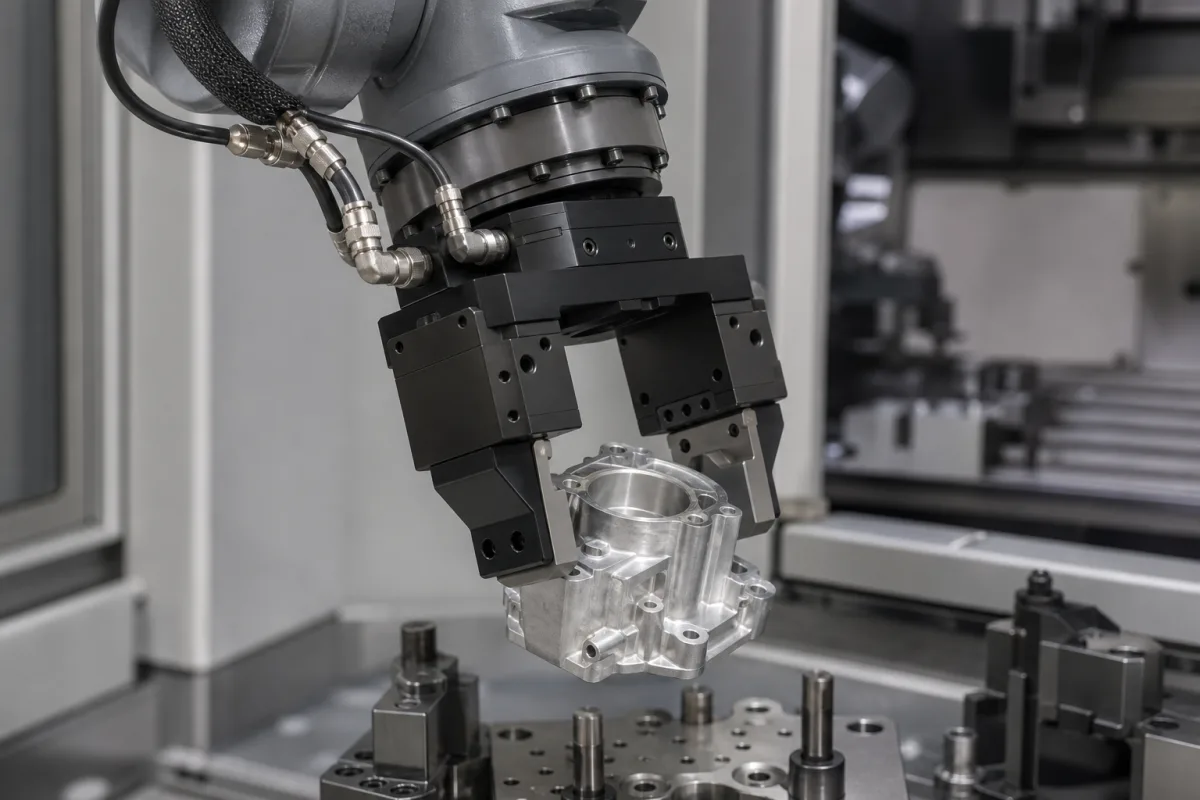
Representative manufacturing scene; not a photograph of a specific supplier or model.

Product Specifications

Technical details and manufacturing context for End-Effector

Definition
As part of the Robotic Upper Handling Module, the end-effector is the final attachment point that enables the robot to manipulate, grasp, assemble, or process workpieces. It serves as the interface between the robotic system and its operational environment, determining the robot's functional capabilities for specific applications.
Working Principle
The end-effector receives mechanical, electrical, or pneumatic signals from the robotic controller to execute precise movements such as gripping, rotating, lifting, or applying force. It translates the robot's programmed motions into physical interactions with target objects.
Common Materials
Aluminum alloy, Stainless steel, Engineering plastics
Technical Parameters
ParameterNotes & selection driver
Spec(mm) Mounting interface dimensions for compatibility with robotic arm flange
Components / BOM
  • Gripper Jaw Part
    Direct contact surface for grasping objects
    Material: Hardened steel
  • Actuator
    Provides mechanical motion for gripping or tool operation
    Material: Aluminum housing with steel components
  • Mounting Flange Part
    Interface for attaching to robotic arm
    Material: Stainless steel

Industry Taxonomies & Aliases

Commonly used trade names and technical identifiers for End-Effector.

Applied To / Applications

This component is essential for the following industrial systems and equipment:

Industrial Ecosystem & Supply Chain Structure

Complementary Systems
Downstream Applications
Specialized Tooling

Application Fit & Sizing Matrix

Operational Limits
pressure: 0 to 10 bar
other spec: Max payload: 50 kg, Max flow rate: 100 L/min, Max slurry concentration: 30% solids
temperature: -20°C to 150°C
Media Compatibility
✓ Metallic components ✓ Plastic parts ✓ Food-grade materials
Unsuitable: Highly corrosive chemical environments
Sizing Data Required
  • Object weight and dimensions
  • Required gripping force
  • Robot arm interface specifications

Reliability & Engineering Risk Analysis

Failure Mode & Root Cause
Mechanical wear at joints/bearings
Cause: Cyclic loading and insufficient lubrication leading to increased friction and material degradation
Electrical/electronic component failure
Cause: Environmental contamination (dust, moisture), vibration-induced fatigue, or power surges damaging sensors/actuators
Maintenance Indicators
  • Unusual vibrations or audible grinding/noise during operation
  • Inconsistent positioning accuracy or drift in tool alignment
Engineering Tips
  • Implement predictive maintenance using vibration analysis and thermal imaging to detect early wear patterns
  • Establish regular calibration schedules and environmental controls (cleanliness, humidity) to protect sensitive components

Compliance & Manufacturing Standards

Reference Standards
ISO 9283:1998 (Manipulating industrial robots - Performance criteria and related test methods) ANSI/RIA R15.06 (Industrial Robots and Robot Systems - Safety Requirements) CE Marking (EU Machinery Directive 2006/42/EC for safety and compliance)
Manufacturing Precision
  • Positioning repeatability: +/-0.05mm
  • Force/torque sensor accuracy: +/-1% of full scale
Quality Inspection
  • Coordinate Measuring Machine (CMM) verification of dimensional accuracy
  • Functional safety test (including emergency stop and collision detection)

Published Manufacturer Relationships

Source-reviewed profile relationships currently associated with End-Effector

No source-reviewed manufacturer relationship is currently published for this product.

Manufacturer listings support early research and capability understanding. They are not certification, ranking, or transaction guarantees.

Technical documentation
Request current drawings, revision history, and a signed specification sheet.
Manufacturing capability
Verify equipment lists, process limits, capacity, and representative production evidence.
Inspection readiness
Confirm test methods, calibrated equipment, sampling plans, and traceable reports.
Supplier transparency
Check the legal entity, factory address, ownership, certifications, and direct contacts.

CNFX does not score or rank suppliers. Buyers must verify all claims and documents with the legal manufacturer before ordering.

Supply Chain Compatible Machinery & Devices

Automated Powder Coating System

Integrated industrial system for applying dry powder coatings to metal substrates.

Explore Specs →
High-Precision CNC Laser Cutting Machine

Computer-controlled industrial machine using focused laser beams to cut sheet metal with micron-level accuracy.

Explore Specs →
Infeed Conveyor

A conveyor system component designed to receive and transport raw materials or workpieces into an industrial processing system.

Explore Specs →
Heating Zone

A designated section within an industrial system where controlled thermal energy is applied to materials or products.

Explore Specs →

Frequently Asked Questions

What materials are best for end-effectors in harsh industrial environments?

Stainless steel offers superior corrosion resistance for wet or chemical environments, while aluminum alloy provides lightweight durability for high-speed applications. Engineering plastics are ideal for non-marring applications on delicate surfaces.

How do I select the right end-effector for my robotic application?

Consider payload capacity, required precision, environmental conditions, and task specifics (gripping, welding, dispensing). Our BOM components (actuator, gripper jaw, mounting flange) can be customized to match your robotic arm interface and operational requirements.

Can end-effectors be customized for specific manufacturing tasks?

Yes, we provide fully customizable end-effectors with tailored gripper jaws, specialized actuators, and compatible mounting flanges to handle unique parts, perform precise operations, or integrate with existing machinery and equipment.

Data Basis

Editorial classification, named public sources where available, and source-reviewed manufacturer records.

Preliminary Technical Classification
This page supports structured research, RFQ preparation, and supplier evaluation. It does not replace buyer-led supplier qualification, standards review, or technical approval.

Request Manufacturing Insight for End-Effector

Ask for use case, specification boundaries, supplier type, and RFQ preparation information for End-Effector.

Your business information is used only to process this request.

Thank you! Your message has been sent. We'll respond within 1–3 business days.

Need to Manufacture End-Effector?

Compare manufacturer profiles with relevant product and process capability.

Create Manufacturer Profile Contact Us
Previous Product
Workpiece Fixture
Last Product