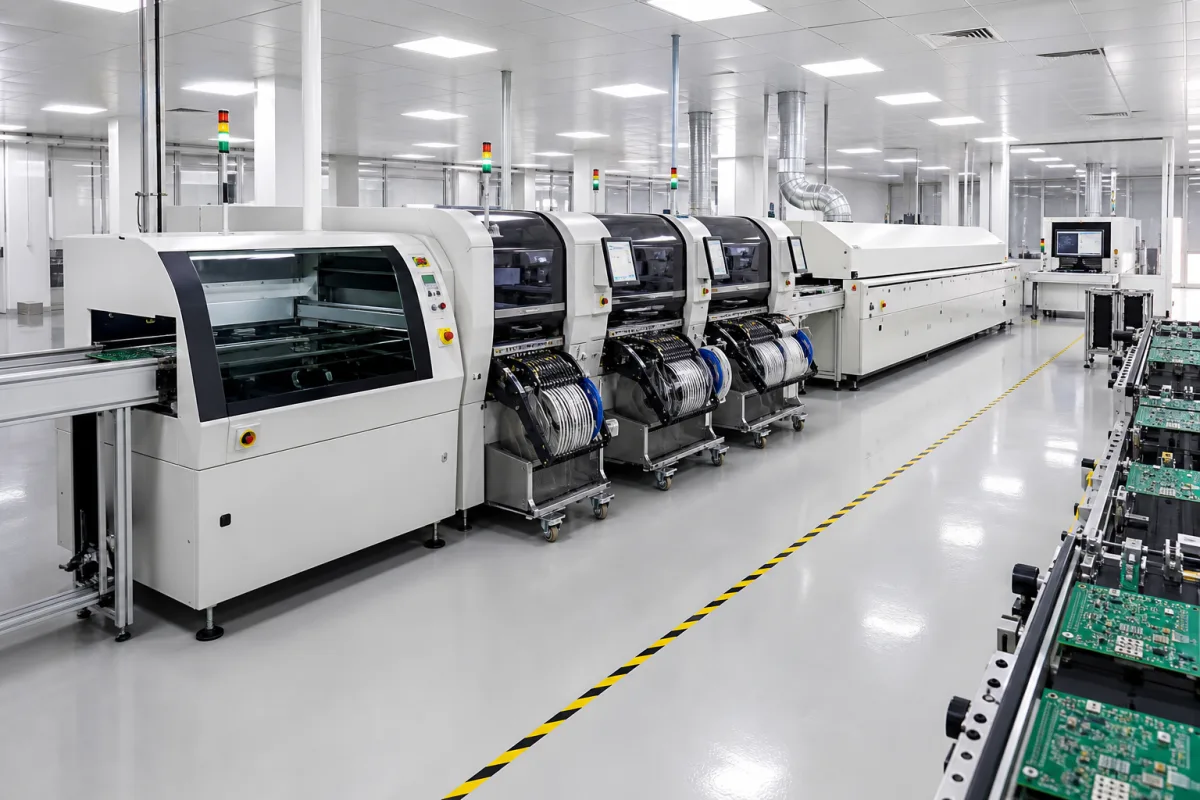
SMT lines · Rated versus real placement speed, oven conveyor speed, line balance, board flow between machines, profiling
An automated SMT assembly line is a chain of machines joined by conveyors that prints solder paste onto bare boards, places surface-mount components, reflows the solder and inspects the result, with loaders and unloaders at the ends. Ask three things first: which machine limits the line's output for your boards, how the reflow oven's conveyor speed fits that output, and how boards and product data pass between machines from different makers.
Complete or partial SMT lines: board loaders, solder paste printers, placement machines, reflow ovens, inspection and conveyors, supplied as a configured line. Single machines are covered on their own pages (placement head, solder paste printer, reflow oven); PCB assembly services are outside this page.
CNFX editorial research · Sources checked October 18, 2026 · 4 sources
Yamaha's specification for its YSM20R (now discontinued) gives 95,000 CPH with two beams and two high-speed heads, and a mounting accuracy of ±0.035 mm (±0.025 mm) at Cpk ≥ 1.0 (3σ), both under optimum conditions as defined by Yamaha Motor, the accuracy with standard evaluation materials. It takes boards from L50 × W50 to L810 × W490 mm and up to 140 component types (8 mm tape feeder equivalent) on a fixed plate. [1]
The reflow oven also sets a pace. Kester's profile guidance says to measure the heated tunnel and divide its length by 3.5 and by 4 minutes; the result is the conveyor speed range that lets the profile end in the last zone at 3.5–4 minutes and uses the whole oven. [2] This is a starting point in the cited guide; validate the populated-board profile against the actual solder-paste data sheet and component limits.
Editorial placement arithmetic: assume exactly 600 placements and uninterrupted operation at the cited 95,000 CPH optimum rating. Then 600 ÷ 95,000 × 3,600 ≈ 22.7 s of equivalent placement time. This omits board transfer, fiducial recognition, component mix, feeder/nozzle changes, inspection, rejected picks and downtime; it is not a demonstrated board cycle. [1]
Editorial conveyor arithmetic: assume a 3.0 m heated tunnel and apply only Kester’s 3.5–4 minute starting residence-time guidance. Length/time gives approximately 0.75–0.86 m/min. If boards have a constant 0.30 m pitch in one lane with no gaps or interruptions beyond that pitch, the geometric passage rate is approximately 2.5–2.9 boards/minute. This is not a validated thermal profile or achieved line throughput. [2]
Give the supplier your board sizes and panelisation, placements per board and component mix (smallest chip, largest part, odd-form parts), number of feeder slots needed, target boards per hour, product changeovers per shift, solder alloy, inspection needs, floor space, power and air supply.
02
Check that the paste printer keeps pace with placement
The solder paste printer is the first process step and can pace the whole line. ASMPT's page for its DEK TQ XL large-format stencil printer gives the figures a line plan needs: boards up to 850 × 610 mm, up to 8 mm thick and up to 12 kg, warpage compensation up to 4 mm, a wet print accuracy of ±20 µm at 2.0 Cpk, and a core cycle time of 12 s with a full cycle time of 22.4 s. ASMPT states that cleaning processes and motion sequences are coordinated to keep the cycle stable. [4]
Editorial printer arithmetic: assuming continuous repeat operation at the published 22.4 s full-cycle figure, with no extra cleaning, loading, alignment, recipe-change, reject or downtime penalties, 3,600 ÷ 22.4 ≈ 161 boards/hour. This is an ideal reciprocal, not a measured production rate or a comparison with another maker’s placement rating. Obtain board-specific cycles and board-envelope compatibility for every station. [4]
Link board flow, changeover and profiling between machines
The Hermes Standard (IPC-HERMES-9852) is an open, non-proprietary protocol based on TCP/IP and XML for machine-to-machine communication in SMT lines. Its initiative describes it as the next-generation successor to IPC-SMEMA-9851 board handover, passing board data such as dimensions and IDs along mixed-vendor lines so barcodes need not be read again at each machine; version 1.0 was released in April 2017 and it can be implemented without licence fees. [3]
Yamaha lists optional compatibility with the SEMI SMT-ELS communication standards for its mounter, giving automatic program changeover with other companies' machines. [1] Editorial note: if the line mixes vendors, write the protocol (SMEMA, Hermes, SMT-ELS) and the data each machine must exchange into the order.
For the oven, Kester lists a calibrated profiler with at least four thermocouple ports and a populated board representative of production, with thermocouples at the board's leading and trailing edges and at its largest and smallest thermal masses. Its chart puts a lead-free profile peak at 235–255 °C against a 217 °C liquidus, compared with 205–215 °C and 183 °C for leaded paste. [2] The chart is a reference example, not a single lead-free setting for every paste, board and component.
04
Configured SMT lines and separately supplied line equipment
NeoDen, Charmhigh, Tronstol and I.C.T list line configurations or SMT solutions. Reaching describes line integration, and SunzonTech and YUSH list SMT line equipment. MOJE lists placement machines; Jinghe lists printers and line solutions; Hayawin and Hansome list board-handling equipment. State whether the order is a complete coordinated line or identified stations and handover work.
05
Printing, placement, thermal processing and inspection handovers
Send the board, output and integration data together
Paste it into your enquiry below or into an email to a maker, then replace every bracket.
Boards: [sizes; panels; sides]
Components: [placements per board; smallest and largest parts; feeder count]
Output: [boards per hour; changeovers per shift]
Soldering: [alloy; oven length; nitrogen or air]
Inspection: [SPI; AOI; positions]
Integration: [handover protocol; data to exchange; MES]
11 companies list this product among what they make. Company figures are quoted from each
company's own website; every card states where the relationship came from.
Zhejiang NeoDen Technology Co., Ltd
TBC
Lists SMT production line configurations with printers, pick-and-place machines and reflow ovens.
Explore company information and manufacturing capabilities, then discuss the scope of your project with a relevant supplier.
Share this page
Compiled and source-reviewed by the CNFX editorial team.
Each manufacturer above links to the page on that company's own website where the product is listed, with the date we checked it. How we source and review
· Page last updated 18 October 2026
Buyer questions
Will a 95,000 CPH mounter place 95,000 parts an hour on my boards?
Not necessarily. Yamaha states that rating under optimum conditions it defines; ask for a simulation on your boards. [1]
How fast should the reflow conveyor run?
Kester’s guide uses heated-tunnel length divided by 3.5–4 minutes as a starting speed range. Verify the actual populated-board profile against the selected solder-paste data sheet and component limits. [2]
How do machines from different makers share board data?
Through standards such as IPC-HERMES-9852, an open TCP/IP and XML protocol that succeeds IPC-SMEMA-9851. [3]
Can the solder paste printer limit SMT line output?
A printer can constrain a line, but determine its full cycle on the actual board and cleaning recipe. ASMPT lists 12 s core and 22.4 s full cycle for its DEK TQ XL; those figures alone do not identify the bottleneck of a mixed-vendor line. [4]
Sources and what still needs a direct check
Sources checked 2026-10-18. Yamaha's figures are for one discontinued mounter, stated under its own optimum conditions; ASMPT publishes figures for its own large-format stencil printer; Kester is a solder paste maker giving profiling guidance; the Hermes Standard Initiative maintains IPC-HERMES-9852.