Industrial sensors · Target material, sensing distance, output type and switching speed
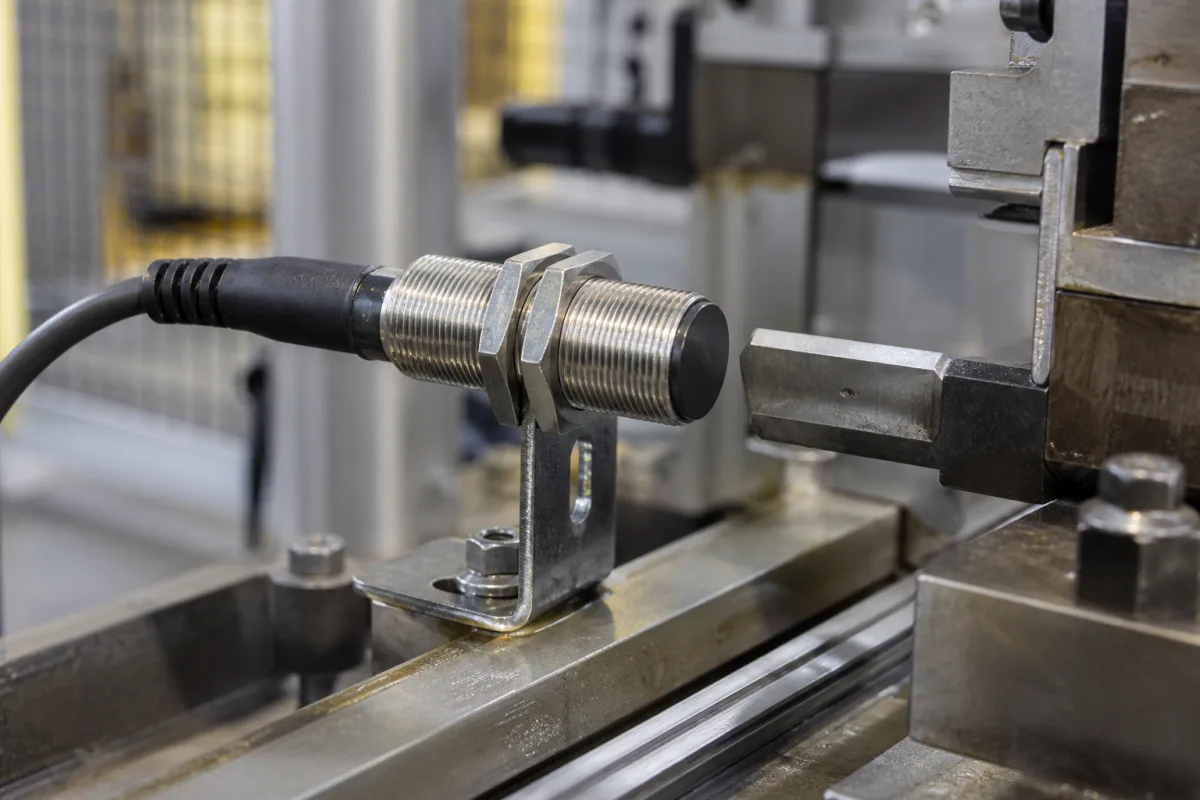
An inductive proximity sensor detects metal without contact. Ask three things first: what the target is made of and how far away it sits, whether your controller input needs a PNP or NPN output, and how fast and how dirty the application is.
Inductive proximity sensors in threaded barrel and block housings with DC switching outputs; capacitive proximity sensors are noted where suppliers list them. Photoelectric, ultrasonic, magnetic cylinder and limit switches are outside this page.
CNFX editorial research · Sources checked October 11, 2026 · 6 sources
Balluff explains that an inductive sensor's coil and capacitor form an oscillator; a metal target in the field picks up eddy currents that absorb energy, the oscillation drops and a Schmitt trigger switches the output. [1] Rated sensing distance is measured on a standard target: 1 mm thick Fe360 carbon steel, square, as wide as the sensor's active face. [2]
Other metals switch closer. Balluff gives correction factors of 1.0 for steel, 0.6–1.0 for stainless steel, 0.30–0.45 for aluminium, 0.35–0.50 for brass and 0.25–0.45 for copper, and suggests extended-range, non-shielded or factor-1 sensors when the standard range is too short. [2]
Editorial calculation: KJT lists an M18 non-flush sensor with 8 mm sensing distance. [4] On an aluminium target, 8 mm × 0.30–0.45 ≈ 2.4–3.6 mm. [2] Set the gap with margin inside that figure and confirm it on your actual part.
Give the supplier the target material, thickness and size, the mounting (flush in metal or not), the gap you need, the controller input type and the environment.
02
Match output type, load and switching speed
Balluff describes PNP outputs as switching the positive side and sourcing current, and NPN outputs as switching the negative side and sinking current; Balluff says "Most sensors use only 3 wires because one wire does double duty, carrying both power and output signals", and a solid-state output carries current in one direction only. [3] Confirm which type your controller input expects before ordering.
One supplier's M18 non-flush sensor shows the values to compare: 10–36 V DC operation, 200 mA maximum load current, voltage drop of 1.5 V or less, 1,000 Hz switching frequency, 0.5 ms response time, repeat accuracy under 3% of Sr, short-circuit protection, IP67, PBT sensing face, nickel-plated copper housing and −25 to +70 °C. [4]
The same page lists both an M12 connector and 2 m PVC leads, so confirm the connection on the order. Treat these as one supplier's catalogue figures, not tested values. [4]
03
Standard, ring, temperature-rated, analog, NAMUR and capacitive sensors on the linked makers' sites
KJT lists standard, ring, high- and low-temperature, metal-face, analog and NAMUR inductive sensors and capacitive sensors; Hebai lists inductive, long-range and capacitive proximity sensors with connectors; DADISICK lists inductive and capacitive proximity sensors among safety and measuring sensors; HYF lists inductive and capacitive proximity sensors, including corrosion-resistant capacitive types; F&C Sensing lists NPN and PNP proximity sensors and an M12 capacitive sensor; DEGSON and VIOX list proximity sensors among electrical products. [5][6]
04
Coil and oscillator, output stage, sensing face, housing, protection circuits and connection
The coil-and-oscillator row sets the rated distance; Balluff suggests extended-range, non-shielded or factor-1 sensors when the standard range is too short on your target metal. [2]
Part
Role
Fix in the order
Coil and oscillator
Creates the field at the active face; damped by the target. [1]
Shielded or non-shielded; rated distance.
Trigger and output stage
Switches the output when oscillation drops. [1][3]
Sensing distance, supply, load current, voltage drop, switching frequency, IP rating and housing for a sensor order
The example values come from one KJT M18 non-flush sensor; the sensing-distance row adds Balluff's steel test-target basis, and weight has no published value. [4][2]
Field
What it means and published values
Ask the supplier for
Sensing distance (mm)
Rated on a steel test target; e.g. 8 mm M18 non-flush. [2][4]
10 companies list this product among what they make. Company figures are quoted from each
company's own website; every card states where the relationship came from.
Nanjing KJT Electric Co,. LTD.
Manufacturing site to be confirmed for the order
Lists standard, ring, temperature-rated and analog inductive sensors and capacitive sensors.
Explore company information and manufacturing capabilities, then discuss the scope of your project with a relevant supplier.
Compiled and source-reviewed by the CNFX editorial team.
Each manufacturer above links to the page on that company's own website where the product is listed, with the date we checked it. How we source and review
· Page last updated 11 October 2026
Why does my sensor switch closer on aluminium than on steel?
Rated distance is set on a steel test target; Balluff gives aluminium a correction factor of 0.30–0.45, so an 8 mm sensor works at roughly 2.4–3.6 mm. [2][4]
PNP or NPN proximity sensor?
PNP outputs source current from the positive side; NPN outputs sink current to the negative side. Choose the type your controller input expects. [3]
How does an inductive proximity sensor work?
An oscillator coil creates a field; eddy currents in a metal target damp it, and a trigger circuit switches the output. [1]
Sources and what still needs a direct check
Sources checked 2026-10-11. Balluff is a sensor maker; its engineers wrote the three technical articles. KJT is a supplier listed on this page; its datasheet values are catalogue figures. Supplier pages describe their own offers.